Nobel economics prize goes to 3 researchers for explaining innovation-driven economic growth
Nobel economics prize goes to 3 researchers for explaining innovation-driven economic growth
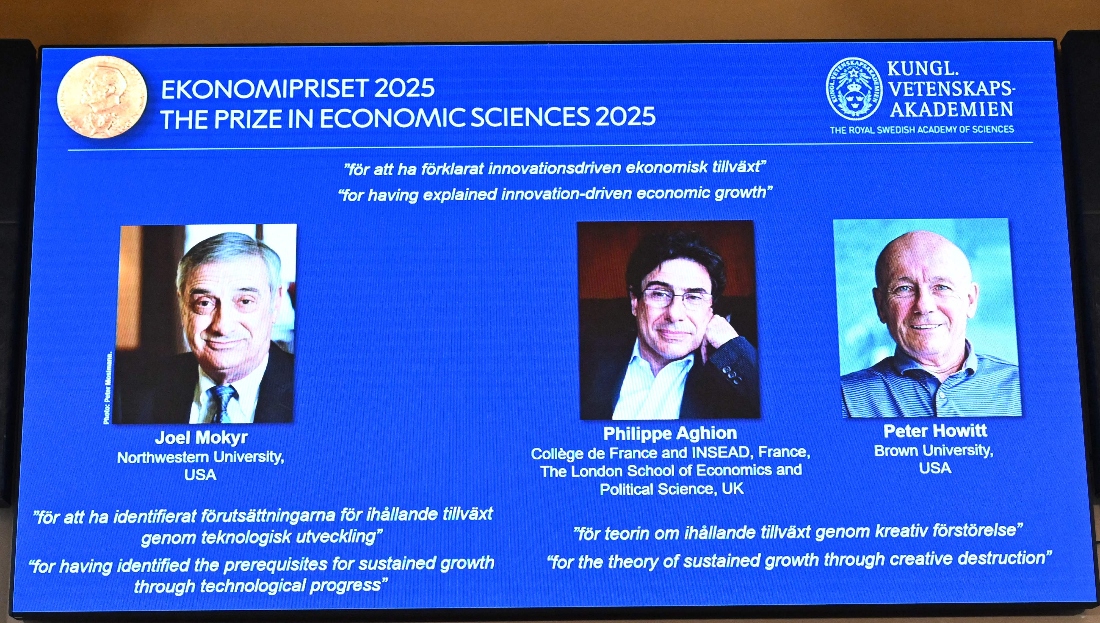
American-Israeli Joel Mokyr, France's Philippe Aghion and Canada's Peter Howitt during the announcement of the winner of the 2025 Nobel Prize in Economics, the Sveriges Riksbank Prize in Economic Sciences in Memory of Alfred Nobel, at the Royal Swedish Academy of Sciences in Stockholm, Sweden. (AFP)
Short Url
Updated 13 October 2025
Follow

Nobel economics prize goes to 3 researchers for explaining innovation-driven economic growth
Nobel economics prize goes to 3 researchers for explaining innovation-driven economic growth

STOCKHOLM: Joel Mokyr, Philippe Aghion and Peter Howitt won the Nobel memorial prize in economics Monday for “having explained innovation-driven economic growth” including the key principle of creative destruction.
The winners represent contrasting but complementary approaches to economics. Mokyr is an economic historian who delved into long-term trends using historical sources, while Howitt and Aghion relied on mathematics to explain how creative destruction works.
Dutch-born Mokyr, 79, is from Northwestern University; Aghion, 69, from the Collège de France and the London School of Economics; and Canadian-born Howitt, 79, from Brown University.
Aghion said he was shocked by the honor. “I can’t find the words to express what I feel,” he said by phone to the press conference in Stockholm. He said he would invest his prize money in his research laboratory.
Asked about current trade wars and protectionism in the world, Aghion said that: “I am not welcoming the protectionist way in the US. That is not good for ... world growth and innovation.”
The winners were credited with better explaining and quantifying “creative destruction,” a key concept in economics that refers to the process in which beneficial new innovations replace — and thus destroy — older technologies and businesses. The concept is usually associated with economist Joseph Schumpeter, who outlined it in his 1942 book “Capitalism, Socialism and Democracy.”
The Nobel committee said Mokyr “demonstrated that if innovations are to succeed one another in a self-generating process, we not only need to know that something works, but we also need to have scientific explanations for why.”
Aghion and Howitt studied the mechanisms behind sustained growth, including in a 1992 article in which they constructed a mathematical model for creative destruction.
Aghion helped shape French President Emmanuel Macron’s economic program during his 2017 election campaign. More recently, Aghion co-chaired the Artificial Intelligence Commission, which in 2024 submitted a report to Macron outlining 25 recommendations to position France as a leading force in the field of AI.
“The laureates’ work shows that economic growth cannot be taken for granted. We must uphold the mechanisms that underlie creative destruction, so that we do not fall back into stagnation,” said John Hassler, Chair of the committee for the prize in economic sciences.
One half of the 11 million Swedish kronor (nearly $1.2 million) prize goes to Mokyr and the other half is shared by Aghion and Howitt. Winners also receive an 18-carat gold medal and a diploma.
The economics prize is formally known as the Bank of Sweden Prize in Economic Sciences in Memory of Alfred Nobel. The central bank established it in 1968 as a memorial to Nobel, the 19th-century Swedish businessman and chemist who invented dynamite and established the five Nobel Prizes.
Since then, it has been awarded 56 times to a total of 96 laureates. Only three of the winners have been women.
Nobel purists stress that the economics prize is technically not a Nobel Prize, but it is always presented together with the others on Dec. 10, the anniversary of Nobel’s death in 1896.
Last year’s award went to three economists — Daron Acemoglu, Simon Johnson and James A. Robinson — who studied why some countries are rich and others poor and have documented that freer, open societies are more likely to prosper.
Nobel honors were announced last week in medicine, physics, chemistry, literature and peace.


North Korea sends 5,000 construction troops to Russia: Seoul

Updated 4 sec ago
Follow

North Korea sends 5,000 construction troops to Russia: Seoul

North Korea sends 5,000 construction troops to Russia: Seoul
North Korean leader Kim Jong Un has been emboldened by the war in Ukraine
South Korean lawmaker Lee Seong-kweun told reporters that “around 5,000 North Korean construction troops have been moving to Russia in phases since September

SEOUL: North Korea has sent about 5,000 construction troops to Russia since September to help with “infrastructure reconstruction,” a South Korean lawmaker said Tuesday after a briefing by Seoul’s spy agency.
North Korean leader Kim Jong Un has been emboldened by the war in Ukraine, securing critical support from Moscow after sending thousands of troops to fight alongside Russian forces.
South Korean lawmaker Lee Seong-kweun told reporters that “around 5,000 North Korean construction troops have been moving to Russia in phases since September and are expected to be mobilized for infrastructure reconstruction.”
He added that “continued signs of training and personnel selection in preparation for additional troop deployments have been detected.”
The spy agency told lawmakers that about 10,000 North Korean troops were estimated to be currently deployed near the Russia-Ukraine border, according to Lee.
At least 600 North Korean soldiers have died in the Ukraine war and thousands more sustained injuries, according to South Korean estimates.
Analysts say North Korea is receiving financial aid, military technology, and food and energy supplies from Russia in return for sending troops.
That has allowed it to sidestep tough international sanctions imposed over its nuclear and missile programs that were once a crucial bargaining chip for the United States.

- US talks -

Since Kim’s 2019 summit with US President Donald Trump collapsed over the scope of denuclearization and sanctions relief, Pyongyang has repeatedly declared itself an “irreversible” nuclear state.
Pyongyang did not respond to Trump’s offer to meet with Kim last week, and instead its Foreign Minister Choe Son Hui headed to Moscow, where she and Russian President Vladimir Putin agreed to strengthen bilateral ties.
Lee said Seoul’s spy agency believes Kim was open to talks with Washington “and will seek contact when the conditions are in place.”
Although the proposed meeting with Trump did not materialize, “multiple signs suggest” that Pyongyang “had been preparing behind the scenes for possible talks with the US,” said the lawmaker.
In September, Kim appeared alongside Xi Jinping and Russia’s Vladimir Putin at an elaborate military parade in Beijing — a striking display of his new, elevated status in global politics.
An international sanctions monitoring group, the Multilateral Sanctions Monitoring Team, said in a report last month that North Korea was planning to send “40,000 laborers to Russia, including several delegations of IT workers.”
Under UN sanctions, North Korean workers are prohibited from earning money abroad.