Journalists turn in access badges, exit Pentagon rather than agree to new reporting rules

Journalists turn in access badges, exit Pentagon rather than agree to new reporting rules
1 / 2
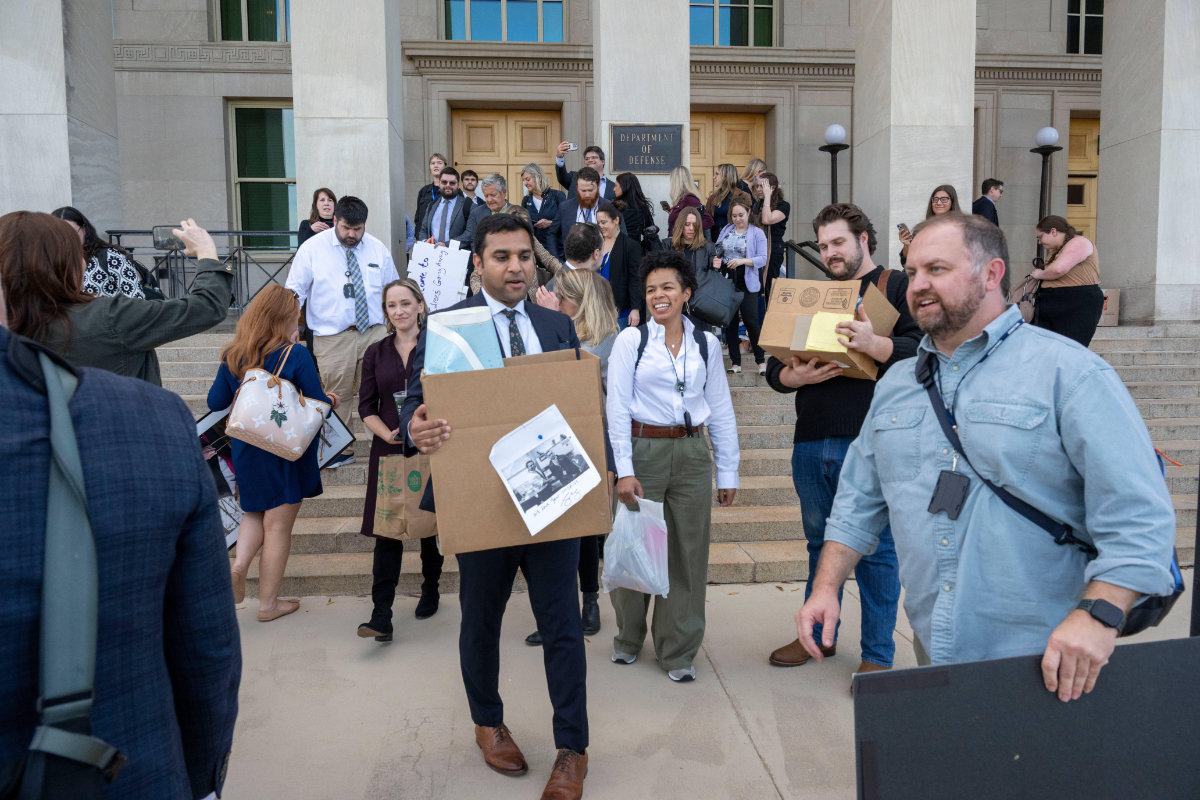
Members of the Pentagon press corp carry their belongings out of the Pentagon after turning in their press credentials on Oct. 15, 2025 in Washington. (AP)
Journalists turn in access badges, exit Pentagon rather than agree to new reporting rules
2 / 2
Members of the Pentagon press corp carry their belongings out of the Pentagon after turning in their press credentials on Oct. 15, 2025 in Washington. (AP)
Short Url
Updated 16 October 2025
Follow

Journalists turn in access badges, exit Pentagon rather than agree to new reporting rules

Journalists turn in access badges, exit Pentagon rather than agree to new reporting rules
  • News outlets nearly unanimous in rejecting new rules imposed by defense chief Hegseth, effectively censoring what they can report on
  • “They want to spoon-feed information to the journalist... That’s not journalism,” said Jack Keane, a retired US Army general and Fox News analyst

NEW YORK: Dozens of reporters turned in access badges and exited the Pentagon on Wednesday rather than agree to government-imposed restrictions on their work, pushing journalists who cover the American military further from the seat of its power. The nation’s leadership called the new rules “common sense” to help regulate a “very disruptive” press.
News outlets were nearly unanimous in rejecting new rules imposed by Defense Secretary Pete Hegseth that would leave journalists vulnerable to expulsion if they sought to report on information — classified or otherwise — that had not been approved by Hegseth for release.
Many of the reporters waited to leave together at a 4 p.m. deadline set by the Defense Department to get out of the building. As the hour approached, boxes of documents lined a Pentagon corridor and reporters carried chairs, a copying machine, books and old photos to the parking lot from suddenly abandoned workspaces. Shortly after 4, about 40 to 50 journalists left together after handing in badges.
“It’s sad, but I’m also really proud of the press corps that we stuck together,” said Nancy Youssef, a reporter for The Atlantic who has had a desk at the Pentagon since 2007. She took a map of the Middle East out to her car.
It is unclear what practical impact the new rules will have, though news organizations vowed they’d continue robust coverage of the military no matter the vantage point.
Images of reporters effectively demonstrating against barriers to their work are unlikely to move supporters of President Donald Trump, many of whom resent journalists and cheer his efforts to make their jobs harder. Trump has been involved in court fights against The New York Times, CBS News, ABC News, the Wall Street Journal and The Associated Press in the past year.

Trump supports the new rules
Speaking to reporters at the White House on Tuesday, Trump backed his defense secretary’s new rules. “I think he finds the press to be very disruptive in terms of world peace,” Trump said. “The press is very dishonest.”
Even before issuing his new press policy, Hegseth, a former Fox News Channel host, has systematically choked off the flow of information. He’s held only two formal press briefings, banned reporters from accessing many parts of the sprawling Pentagon without an escort and launched investigations into leaks to the media.
He has called his new rules “common sense” and said the requirement that journalists sign a document outlining the rules means they acknowledge the new rules, not necessarily agree to them. Journalists see that as a distinction without a difference.
“What they’re really doing, they want to spoon-feed information to the journalist, and that would be their story. That’s not journalism,” said Jack Keane, a retired US Army general and Fox News analyst, said on Hegseth’s former network.
When he served, Keane said he required new brigadier generals to take a class on the role of the media in a democracy so they wouldn’t be intimidated and also see reporters as a conduit to the American public. “There were times when stories were done that made me flinch a little bit,” he said. “But that’s usually because we had done something that wasn’t as good as we should have done it.”
Youssef said it made no sense to sign on to rules that said reporters should not solicit military officials for information. “To agree to not solicit information is to agree to not be a journalist,” she said. “Our whole goal is soliciting information.”
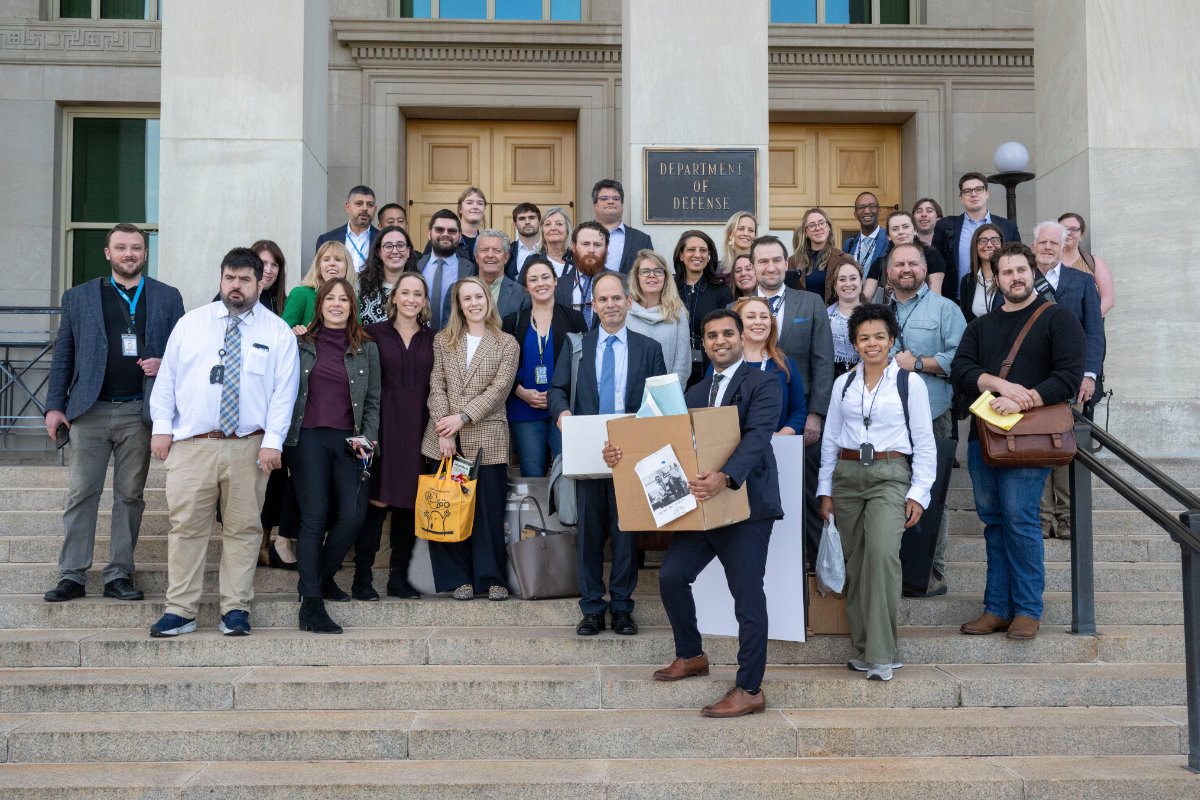


Members of the Pentagon press corp gather for a group photo after turning in their press credentials on Oct. 15, 2025 in Washington. (AP)

Reporting on US military affairs will continue — from a greater distance
Several reporters posted on social media when they turned in their press badges.
“It’s such a tiny thing, but I was really proud to see my picture up on the wall of Pentagon correspondents,” wrote Heather Mongilio, a reporter for USNINews, which covers the Navy. “Today, I’ll hand in my badge. The reporting will continue.”
Mongilio, Youssef and others emphasized that they’ll continue to do their jobs no matter where their desks are. Some sources will continue to speak with them, although they say some in the military have been chilled by threats from Pentagon leadership.
In an essay, NPR reporter Tom Bowman noted the many times he’d been tipped off by people he knew from the Pentagon and while embedded in the military about what was happening, even if it contradicted official lines put out by leadership. Many understand the media’s role.
“They knew the American public deserved to know what’s going on,” Bowman wrote. “With no reporters able to ask questions, it seems the Pentagon leadership will continue to rely on slick social media posts, carefully orchestrated short videos and interviews with partisan commentators and podcasters. No one should think that’s good enough.”
The Pentagon Press Association, whose 101 members represent 56 news outlets, has spoken out against the rules. Organizations from across the media spectrum, from legacy organizations like The Associated Press and The New York Times to outlets like Fox and the conservative Newsmax, told their reporters to leave instead of signing the new rules.
Only the conservative One America News Network signed on. Its management likely believes it will have greater access to Trump administration officials by showing its support, Gabrielle Cuccia, a former Pentagon reporter who was fired by OANN earlier this year for writing an online column criticizing Hegseth’s media policies, told the AP in an interview.

Trump threatens $1 billion action as BBC apologises for speech edit

Trump threatens $1 billion action as BBC apologises for speech edit
Updated 11 November 2025
Follow

Trump threatens $1 billion action as BBC apologises for speech edit

Trump threatens $1 billion action as BBC apologises for speech edit
  • Trump’s lawyers say broadcaster must retract documentary or face action
  • BBC apologizes for ‘error of judgment,’ chair Shah rejects institutional bias

LONDON: US President Donald Trump has threatened the BBC with a billion-dollar lawsuit, US sources said, as the broadcaster apologized Monday for editing a speech that gave the impression he urged “violent action” just before the 2021 assault on the US Capitol.
Trump could seek $1 billion in damages from the BBC, a source close to his legal team said, amid a growing furor that prompted the resignations Sunday of two of the broadcaster’s top brass.
The source said the British broadcaster has been given until Friday to retract the 2024 documentary and apologize for the documentary broadcast just before the 2024 US presidential election.
Trump has been accused of launching lawsuits to stifle US media. But the latest controversy has reignited a debate over the British broadcaster, cherished by many but which has faced long-standing accusations of bias, from both ends of the political spectrum.
A spokesman for Trump’s private legal team confirmed that a letter had been sent to the BBC but did not give details.
“The BBC defamed President Trump by intentionally and deceitfully editing its documentary in order to try and interfere in the presidential election,” the spokesman said in a statement to AFP.
“President Trump will continue to hold accountable those who traffic in lies, deception, and fake news.”
A BBC spokesperson said: “We will review the letter and respond directly in due course.”

‘Vital role’ 

In a letter sent to MPs, BBC chairman Samir Shah said the broadcaster accepted that the editing of Trump’s speech for the documentary “did give the impression of a direct call for violent action.”
“The BBC would like to apologize for that error of judgment,” he added, vowing to reform oversight within the broadcaster.
Director general Tim Davie and BBC News CEO Deborah Turness stepped down over the escalating backlash on Sunday.
Trump promptly celebrated, accusing BBC journalists of being “corrupt” and “dishonest.” His press secretary called the broadcaster “100-percent fake news.”
However, Prime Minister Keir Starmer’s spokesman told reporters the organization “has a vital role in an age of disinformation.”
“It’s important that the BBC acts swiftly to maintain trust and correct mistakes quickly when they occur,” he added.
The government is preparing a review of the BBC’s charter, which outlines the corporation’s governance and funding framework. The current charter ends in 2027.
The broadcaster, which has cut hundreds of jobs amid stretched finances, is funded by a license fee paid by anyone who watches live TV in Britain.
Some have welcomed the resignations as a timely reckoning for the BBC, while others fear the influence of right-wing detractors, including in the United States.
Ed Davey, leader of the centrist Liberal Democrats, urged Starmer to tell Trump to “keep his hands off” the BBC.
Former BBC journalist Karen Fowler-Watt, head of the journalism department at City St. George’s University in London, told AFP the institution was “now really in a situation of crisis.”
She noted it was “very difficult not to see this as a right-wing attack, given the media ecosystem in which we all now live.”

Controversies

In London, Britons were both critical and sympathetic.
Jimmy, who works in construction and declined to give his surname, told AFP the BBC’s reputation had been “tarnished” and it had “shown that they’re not impartial.”
But 78-year-old writer Jennifer Kavanagh said it has “always been attacked from the right and from the left.”
“They can never get it right,” she added.
Its latest crisis intensified after the right-wing Daily Telegraph newspaper reported last week that a former external standards adviser’s warnings of serious and widespread failings of impartiality and systemic bias had been ignored.
That included the editing of sections of Trump’s January 6, 2021, speech ahead of the mob attack on the US Capitol following the 2020 US presidential election.
It appeared he had told supporters he was going to walk there with them and “fight like hell,” whereas the president also told the audience in the intervening period “we’re going to cheer on our brave senators and congressmen and women.”
Earlier this year, the BBC apologized for “serious flaws” in the making of another documentary, about the Gaza war, which the UK’s media watchdog deemed “materially misleading.”
It also faced criticism for failing to pull a livestream of punk-rap duo Bob Vylan during this year’s Glastonbury festival after its frontman made anti-Israel comments.