
According to US President Donald Trump and Israeli Prime Minister Benjamin Netanyahu, the Gaza peace deal will enter phase two shortly. Remember that the 20-point plan was not an Israeli-Palestinian deal but a US-Israeli one that was delivered to Hamas as a surrender or die option. Trump and Netanyahu will no doubt be reviewing the state of play when they meet again on Dec. 29.
Shifting to phase two presumes that phase one is nearly complete. Any rational, fact-based assessment would state categorically that it is not. On the plus side, the hostages have been released, Palestinian detainees released and all but one of the hostage bodies located and returned.
But in three vital areas, phase one has not been implemented. This needs to be addressed, not least by the Trump administration, before further progress.
Firstly, Israel has not adhered to the ceasefire. All that has happened is that its forces have reduced their lethal fire on Palestinians, so the fatality rate has dropped. This is why at least 379 Palestinians have lost their lives since the ceasefire came into effect on Oct. 10. The assassination of Hamas commander Raad Saad on Saturday will test this further.
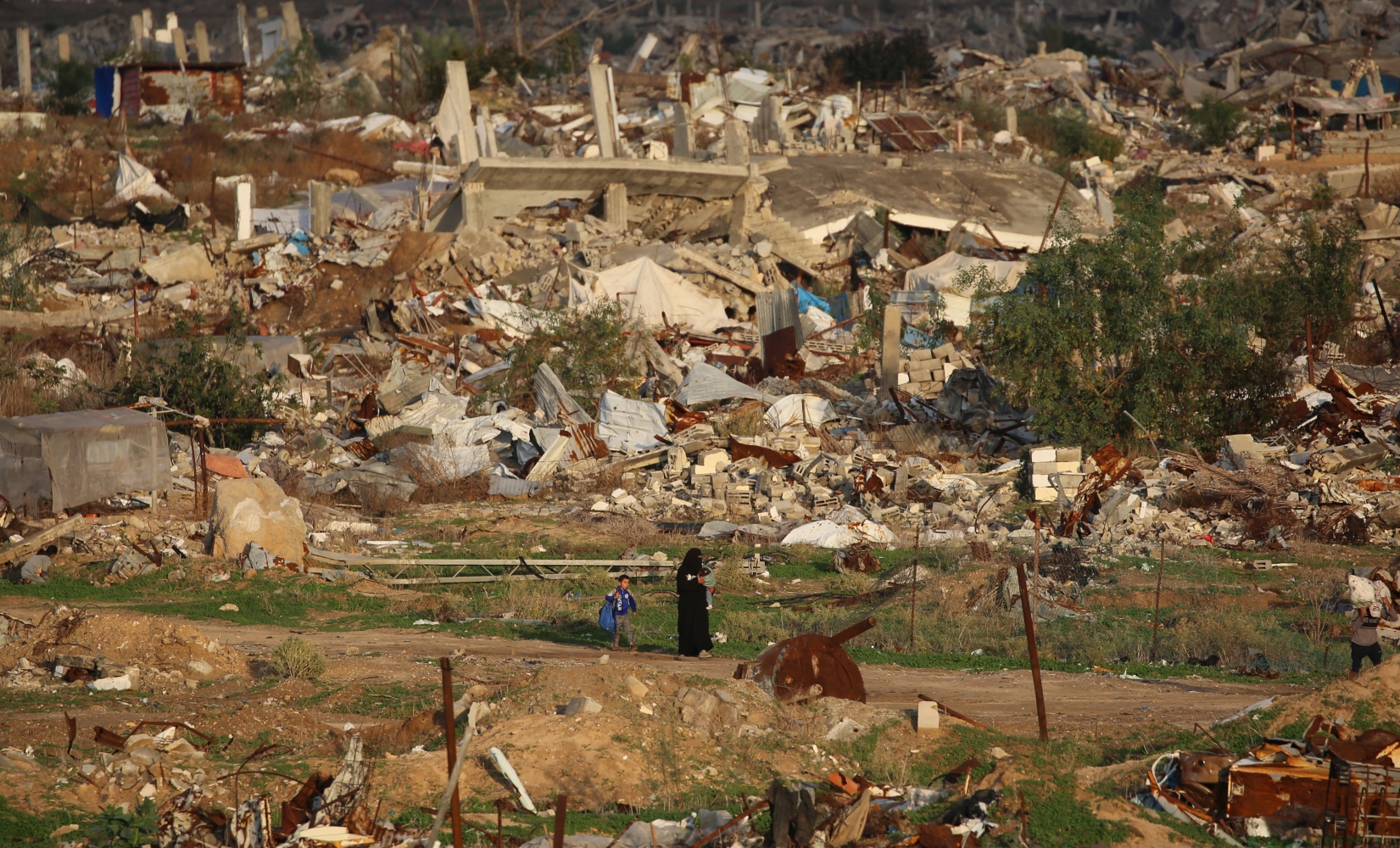
Secondly, Israel is still preventing or impeding lifesaving humanitarian aid getting into Gaza, a situation made more desperate by the winter storms that have led to makeshift Palestinian tents being washed away. The trickle of aid permitted before Oct. 10 has become slightly faster but it is not a flood. Most of the crossings are still closed. More than 9,000 children in Gaza were treated for acute malnutrition just in October.
In three vital areas, phase one has not been implemented. This needs to be addressed before further progress
Chris Doyle
Thirdly, Gaza is now firmly partitioned, with Israel taking almost 58 percent of the Strip under its full direct control, akin to Area B in the West Bank. Israel is even expanding this area and taking even more territory amid international silence. The Israeli army’s chief of staff Eyal Zamir has said that this “yellow line” will be a new border for Israel. This should have been a red line for the US and other powers, not least as the agreement stipulated that “Israel will not occupy or annex Gaza.”
Hamas controls the remainder of Gaza. It has not disappeared but it is not an immediate threat to Israel. If the aim is to remove it from meaningful control in Gaza, phase one has not worked.
Netanyahu would prefer to collapse the plan before phase two, to avoid concessions to the Palestinians. The Israeli military would then be able to smash Hamas without the fear of killing hostages.
Completing phase one matters. The next phase includes reconstruction in Gaza. How can proper, lasting reconstruction take place if Israel is still treating Gaza like a prison to which it holds the keys? Israel has, for example, agreed to open the Rafah crossing — but only one way, so that Palestinians can exit but not return. Emptying the enclave is a key aim of the Israeli right. Reconstruction would require the import into Gaza of massive quantities of steel, concrete, timber and other construction materials that Israel has been refusing entry for years as dual-use items.
The second phase also requires Hamas to cooperate with several major steps, including handing over its weapons and demilitarization. The absence of any trust in the process will undermine that. Without Hamas disarming, Israel will threaten to do so itself, essentially ending even this pseudo-ceasefire.
The absence of any credible Palestinian agency remains perhaps the greatest weakness of the whole plan
Chris Doyle
The proposed International Stabilization Force will not be likely to do this instead, as many states have made clear. Volunteers are in short supply. Hamas has stated it would not accept the force doing so and would resist its efforts.
Netanyahu expects Israel will carry out the disarming of Hamas, saying: “It can be done the easy way, it can be done the hard way. But eventually it will be done.” Be in no doubt, this will be a return to full-on genocide in Gaza. The Israeli leader is clearly very relaxed with that prospect.
Gaza still lacks the apolitical, technical body of Palestinians that will be charged with the day-to-day running of the Strip. The absence of any credible Palestinian agency remains perhaps the greatest weakness of the whole plan.
Overseeing all this will be the colonial-style Board of Peace. Trump has promised this will be set up by the beginning of 2026. Again, the membership of this body is unknown but, according to the US president, it will be “one of the most legendary councils ever. Kings, presidents and prime ministers — they all want to be on the peace council.”
The danger is that phase two will be kicked off based on the false assumption that phase one is complete and satisfactory. Even then, the fatal weaknesses of the whole plan remain: the lack of Palestinian agency; the complete disconnect with the other part of the Palestinian state, the West Bank; and the total lack of accountability. Even with the determination of the Trump administration to make it a success, the most likely prospect is that, in early 2026, the whole plan will collapse unless there are major revisions.
- Chris Doyle is director of the Council for Arab-British Understanding in London. X: @Doylech