
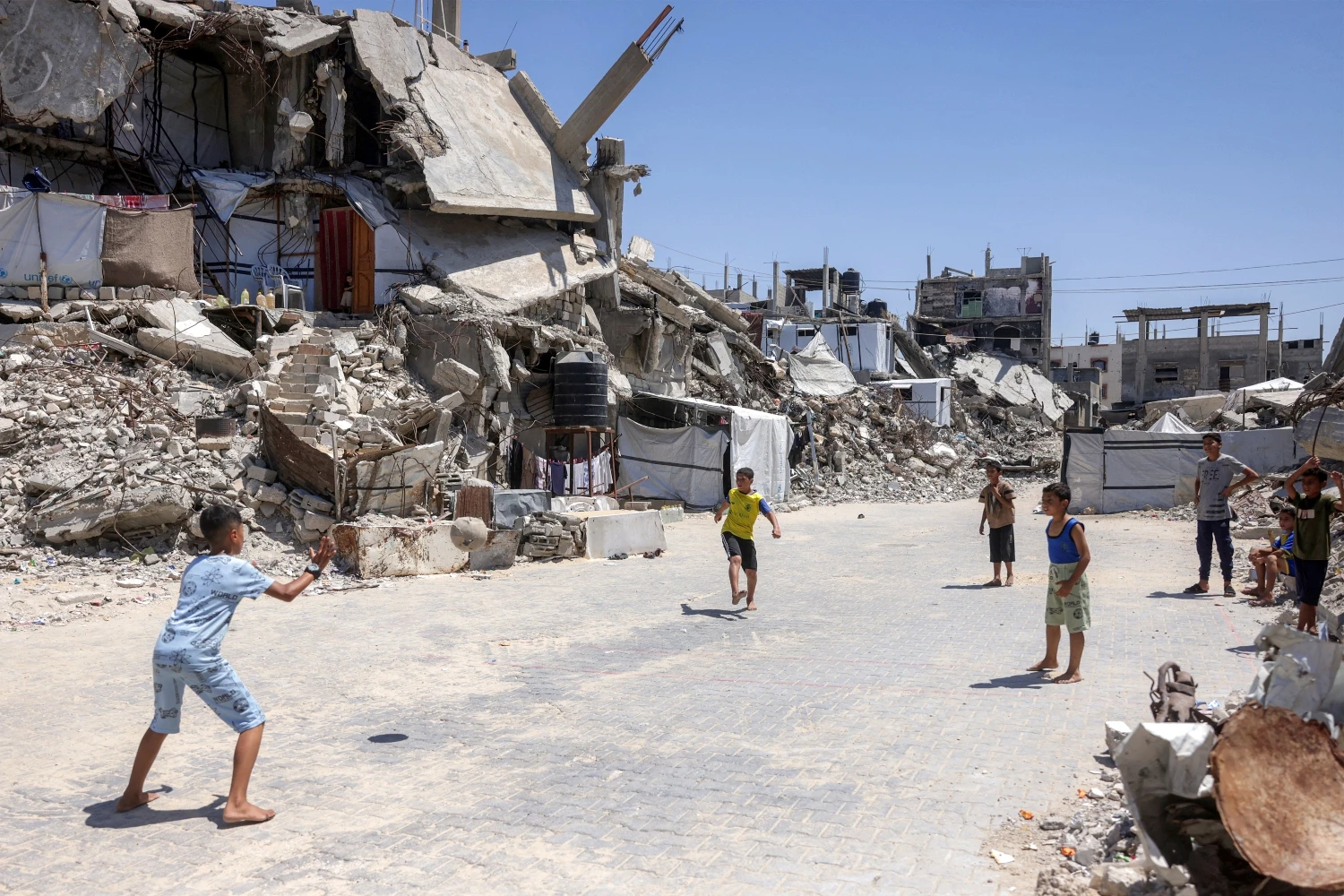

A quick look at the news from the Occupied Territories could lead a normal person to conclude that the West Bank and Gaza Strip are on the verge of an irreversible catastrophe — within days, weeks or months — amid threats of the total ethnic cleansing of more than 5 million Palestinians.
Israeli journalist Amira Hass this week warned that “the very existence of the Palestinian people between the sea and the river is now in danger.” In Haaretz, she argued that active forces are creating that danger: Israel’s military power and the institutionalization of obedience, weapons and violence as the default modus operandi — alongside indifference to the hell created in Gaza and the synergy between the army, government, religious forces and settler militias in the West Bank.
Yet, despite the Israeli rhetoric and the brutality, Palestinians are refusing to be baited into any actions that would provide a pretext for further Israeli war crimes. Their nonviolent resistance and their refusal to surrender to intimidation are also imposing costs on Israel, with more countries beginning to move beyond statements and applying pressure with real consequences.
No one should accept the crocodile tears of Israeli Prime Minister Benjamin Netanyahu, whose government continues to protect pogrom criminals and to promote settlement projects designed to suffocate Palestinian sovereignty. Among them is the newly announced tender for E1 — an initiative aimed at dividing the West Bank and blocking the possibility of a viable Palestinian state.
Palestinians are refusing to be baited into any actions that would provide a pretext for further Israeli war crimes
Daoud Kuttab
Former Palestinian Information Minister Nabil Amr has noted that Israel’s efforts have failed, largely because of the vital role of the Palestinian people themselves. He argued in a recent post that it is impossible for Israel to fully control the West Bank as long as Palestinians hold their land, assert their rights and continue to organize politically and socially.
While the world often focuses only on the daily war crimes, another story is unfolding — one that makes clear that the Palestinians are not disappearing.
The buildup to November’s Palestinian legislative elections is gaining momentum. The Palestinian Election Commission says that more than 85 percent of eligible Palestinians in the West Bank have registered to vote. Gaza and East Jerusalem are also participating in the electoral process, even if their voter procedures do not require the same registration steps.
Across factions, activists and political leaders are busy nominating credible candidates and cobbling together coalitions ahead of the Nov. 28 elections. On the surface, Israel wants Palestinians to react to violence; beneath the surface, Palestinians are building a political reality that cannot be erased by force.
Beneath the surface, Palestinians are building a political reality that cannot be erased by force
Daoud Kuttab
In Gaza, life under fire continues amid developments signaling shifting dynamics. For the first time since 1967, an international armed force is set to be deployed in the Occupied Territories, with an initial group of 200 personnel expected to expand into a broader contingent of up to 5,000 from Morocco and mostly Asian Muslim-majority countries. Whether viewed through the lens of security arrangements or international involvement, these steps underline that the occupation’s era of unilateral decisions is increasingly contested.
Meanwhile, resilience is not only political — it is also economic and cultural.
After the cancellation of work permits for Palestinian laborers following Oct. 7, 2023, many were left without jobs. At the same time, local producers faced restrictions accessing Israeli markets due to closure policies and tightened controls. There was a temporary shortage of produce but the community adapted by relying more on Palestinian markets and local supply chains.
But Palestinian agriculture’s growth is not merely a byproduct of the war on Gaza. For years, there has been a deliberate shift away from dependence on Israeli markets — through local choices to protect domestic production and reduce reliance on settlement goods. Even under ongoing restrictions that limit growth, the result has been greater self-sufficiency.
Signs of resilience can be seen in public life as well. An Aug. 31 art exhibition in Gaza brought together artists and art lovers. In sports, the Martyrs of Jabalia team won the first Peace Academy Volleyball Championship, defeating the Martyr Alaa Jamal Al-Barsh team 3-1 in the final. The tournament was held in the indoor sports hall of the Peace Sports Academy in the Halawa camp in northern Gaza and included eight teams representing displaced people.
On the international stage, the Palestinian national basketball team recorded four consecutive wins to reach the second round of FIBA Asia Cup qualifying, highlighted by an impressive 168-78 win over the Maldives — the highest margin of victory in FIBA Asia Cup qualification history.
To be sure, one must not dismiss the darkness of the situation. Palestinian resistance is not romantic; it is endured at real cost. When a Palestinian is shot, they bleed and die. Palestinians mourn their dead and they suffer like any human being. But their experience under occupation has taught them a hard truth: resilience — grounded in commitment to land, rights and independence — is not denial. It is strategy.
In 2026, Palestinians are proving that occupation can inflict pain but it cannot erase identity, extinguish organization or break the will to live freely. Whether freedom comes sooner or later, Palestine will be free — because the determined people of Palestine have refused to be uprooted from their own future. Light comes after the darkest hours.
• Daoud Kuttab is an award-winning Palestinian journalist and former Ferris Professor of Journalism at Princeton University. He is the author of “State of Palestine Now: Practical and Logical Arguments for the Best Way to Bring Peace to the Middle East.” X: @daoudkuttab


