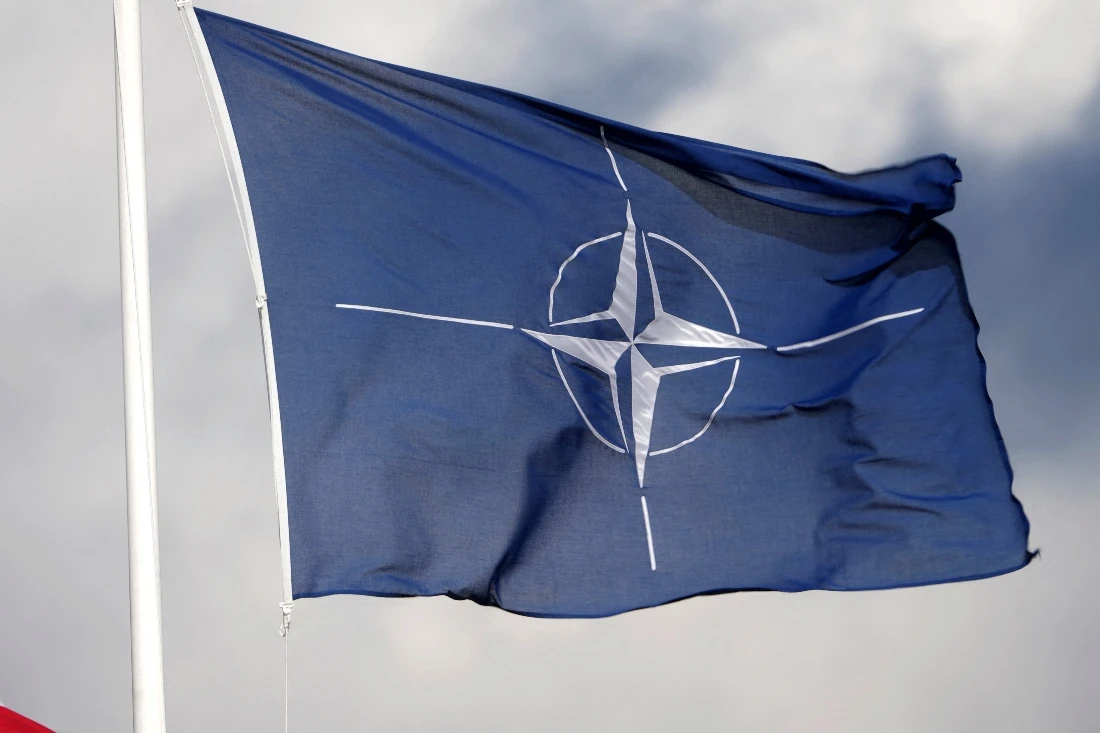
DUBAI: US President Donald Trump’s relationship with European allies has hit a new low, with NATO quietly drawing up a contingency plan to sustain itself should Washington walk away from the 75-year-old alliance, the Wall Street Journal reported.
Speaking to Fox News on Monday, Trump threatened once again to leave NATO, saying America must “re-examine” the alliance because European countries “weren’t there for us” during the war against Iran.
The remarks were the latest in a prolonged standoff over Europe’s refusal to join the US blockade of Iranian ports, open airspace to American warplanes targeting Iran, or participate in any military mission to reopen the Strait of Hormuz — through which 20 percent of global oil and gas supplies pass.
European allies said that they would only engage once the fighting stops, and are already working on a plan to reopen the strait independently through a conference co-hosted by France and Britain set for Friday.
Trump has since threatened to pull US troops from Europe and is weighing punitive measures against allies he considers unhelpful, including the withdrawal of some US troops.
What he may not have anticipated is that Europe has already begun preparing for exactly this scenario.
Plan taking shape in private
According to a detailed WSJ report, senior officials from the UK, France, Germany, Poland, the Nordic countries and Canada have been holding quiet side meetings and informal dinner discussions in and around NATO headquarters to sketch out what some are calling “European NATO:” a version of the alliance capable of functioning without the US.
The plans underscore Europe’s concerns that US is no longer a reliable partner, which accelerated after Trump threatened to seize Greenland from fellow NATO member Denmark, and are now renewed with rising tensions over Iran war.
The idea is to ensure that if Washington withdraws, or refuses to come to Europe’s defense, the continent does not find itself defenseless.
The plan has three broad ambitions; move more Europeans into the command roles currently held by Americans, build up European military capabilities in areas where the continent has long depended on Washington, and work out who provides the nuclear deterrent if the US steps away.
What the European NATO plan involves
The European NATO plan centers on gradually replacing American personnel in the alliance’s most critical roles, from air-and-missile defense networks to the logistics corridors that funnel reinforcements into Poland and the Baltic states.
The plan also calls for accelerating European production in capability areas where the continent has long relied on Washington, including anti-submarine warfare, space and reconnaissance capabilities, in-flight refueling and air mobility of troops and equipment at scale.
On weapons, Germany and the UK have already made a concrete move, announcing last month a joint program to develop stealthy cruise missiles and hypersonic weapons.
Conscription is also back on the table too. Several European nations that scrapped compulsory military service after the Cold War are reconsidering it, with Finland, which never abandoned the draft, held up as the model.
The most politically sensitive element is nuclear. After Trump threatened to seize Greenland, German Chancellor Friedrich Merz and French President Emmanuel Macron opened direct talks on whether France’s nuclear deterrent could be formally extended to cover Germany and other allies.
Underpinning all of it is a push to build European satellite, surveillance and missile-warning systems that could, over time, reduce the continent’s dependence on American intelligence, widely acknowledged as the hardest gap to close and the one that will take the longest.
Gaps remain
European officials are candid about how difficult the transition will be.
NATO was built from the ground up around American leadership. The Supreme Allied Commander for Europe has always been a US general. Washington’s satellite networks, missile-warning systems and nuclear umbrella form the bedrock of the alliance’s credibility, and there is no quick European substitute for any of them.
After Trump’s threat to leave the alliance, Finland’s President Alexander Stubb called the president directly to brief him on Europe’s plans to boost its defenses, according to the Wall Street Journal.
Retired US Admiral James Foggo, a former senior NATO commander, said that Europeans have capable officers and much of the hardware, but that years of underspending mean they need to move more quickly. “They have the capability,” he said. “But they need to invest and develop capabilities faster.”