- The head chef of Qartuli in Dubai also shares a steak recipe
DUBAI: Robert Tsitaishvili is the head chef of Qartuli, a Georgian restaurant in Downtown Dubai, where his goal, he says, is “to reinterpret Georgian culinary heritage for a contemporary audience.”
Tsitaishvili has more than 12 years of experience spanning hotels and restaurants across Georgia and internationally, with a background that includes pastry and confectionery.
His love for cooking developed gradually. “At first, I was simply curious about how ordinary ingredients could be transformed into dishes that evoke emotion and create lasting memories for people,” he told Arab News. “The more time I spent in the kitchen, the more I became convinced that this was not just a profession. I enjoyed every stage of the process.”
When you started out, what was the most common mistake you made?
I often paid excessive attention to complex techniques and impressive presentation. Experience taught me that the best dishes are often found in simplicity. Another important lesson was understanding that a good chef is not only good at cooking; communication with the team, delegation of responsibility, and listening to others’ opinions are essential. Early in my career, I believed that doing everything myself was more efficient, but over time I realized that building a strong team is one of the key foundations of success.
My mistakes taught me patience, discipline, and the fact that professional growth requires time, hard work, and continuous learning.
What’s your top tip for amateur chefs?
Remember that at the center of this profession is the human being. We are not just cooking dishes — we are creating experiences, emotions, and memories. Learn the fundamentals; technique is always more important than trends. And do not be afraid to do the simplest tasks. It is precisely at these stages that you learn respect for the product, organization, precision, and the small details that make a big difference in the future. Taste everything, focus on details, and if you always carry this sense of responsibility, success will inevitably follow.
What one ingredient can instantly improve any dish?
Salt, when it’s used with knowledge and moderation, enhances almost any dish. You can use the best meat, fish, or vegetables, but if the flavor balance is not properly adjusted, the dish will not reveal its full potential.
When you go out to eat, do you find yourself critiquing the food?
When I go to a restaurant, I try to stay in the position of a guest rather than a critic. For me, cuisine is closely connected to pleasure and experience, so the initial goal is always to enjoy the process, the atmosphere, and the flavors. However, as a chef, I naturally also observe details through a professional lens — not to simply criticize, but to understand how the overall experience is structured; how harmoniously the kitchen, service, and concept work together.
What’s the most common issue that you find in other restaurants?
When a technically well-executed dish lacks emotion. Everything can be prepared correctly, according to the rules, but it’s missing that “character” that makes a dish memorable. Often, the focus is placed too much on visual presentation or technique, rather than on depth of flavor and balance.
What’s your favorite cuisine or dish to order?
It is very difficult for me to name just one favorite cuisine, because my profession has given me the opportunity to closely explore many different culinary cultures. However, if I have to make a choice, Georgian cuisine would still be in first place. It’s unique because of its diversity, regional characteristics, and depth of flavors. Each dish has its own story, and this is exactly what makes it so special.
What customer behavior most frustrates you?
To be honest, very rarely does anything about guest behavior truly bother me, because I believe that a restaurant exists for the guest, and each person has their own taste, expectations, and perspective. However, what probably concerns me the most is when a dish is judged before it has even been tasted, based on a preconceived opinion. Sometimes guests already have a fixed idea of what a certain dish should be like and do not allow themselves the opportunity to experience something new or to understand the chef’s vision.
What’s your favorite dish to cook?
Dishes where simplicity is the true challenge; when you have to demonstrate skill through minimal ingredients and fine details — that’s where true mastery is revealed.
What’s the most difficult dish for you to get right?
A perfectly made risotto is one of the most challenging dishes for me. It requires full concentration, precise timing, constant control of texture, and exceptional attention to detail. It may seem simple at first glance, but even the smallest mistake becomes immediately noticeable.
As a leader, what are you like?
My leadership style can be described as a balance between discipline and support. A kitchen is a very intense environment, where clear structure, responsibility, and high standards are essential. Therefore, order and professional precision are very important to me. At the same time, I believe that a good leader should not be driven only by demands. Team development is important to me — I try to give people space to learn, grow, and find themselves in the process. I also see mistakes as part of development rather than just problems. My goal is to create an environment where the team feels both responsibility and support. I believe the best results are achieved when people work not out of fear, but with respect and motivation.
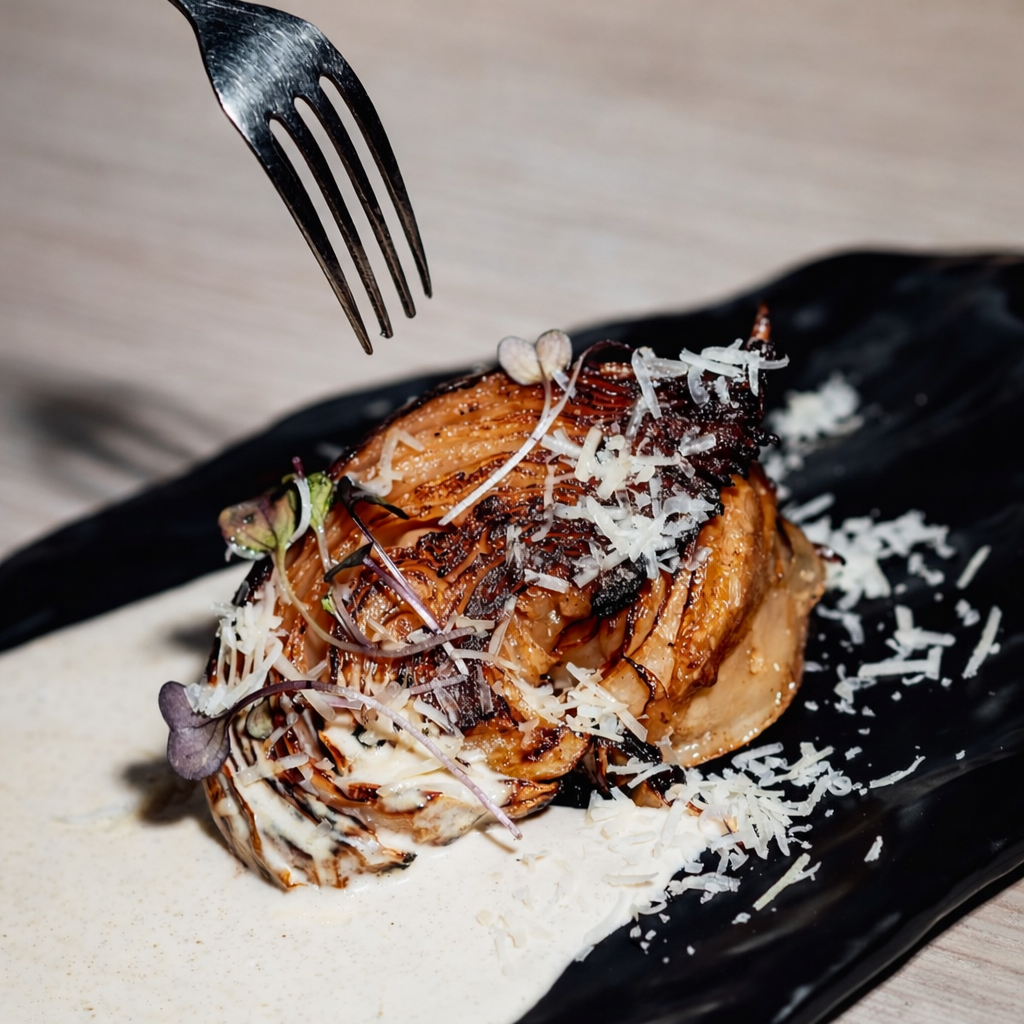
Chef Robert’s white cabbage steak with béchamel sauce and parmesan
Ingredients
For the cabbage steak:
1 medium white cabbage
3–4 tbsp olive oil
Salt, to taste
Black pepper, to taste
1 tsp garlic powder (or 1 fresh garlic clove)
For the béchamel sauce with Parmesan:
30 g butter
30 g flour
100 ml milk
100 ml cream
Salt, to taste
Black pepper, to taste
50 g grated Parmesan cheese
Pinch of nutmeg
Method
Cabbage steak:
1. Cut the cabbage into thick slices (2–3 cm) so it holds its “steak” shape.
2. Brush both sides with olive oil.
3. Season with salt, pepper, and garlic.
4. Heat a pan or grill.
5. Sear over medium heat for 4–6 minutes on each side, until golden and lightly caramelized.
6. Optionally, finish in the oven at 180°C for 10 minutes.
Béchamel sauce:
1. Melt the butter in a saucepan.
2. Add flour and mix well for 1–2 minutes to form a roux.
3. Gradually add warm milk and cream, whisking constantly to avoid lumps.
4. Cook until the sauce thickens.
5. Add salt, pepper, nutmeg, and grated Parmesan. Mix until smooth.
To serve
1. Place the warm cabbage steak on a plate.
2. Spoon the béchamel sauce over or beside it.
3. Optionally garnish with fried garlic, fresh herbs and extra Parmesan cheese.