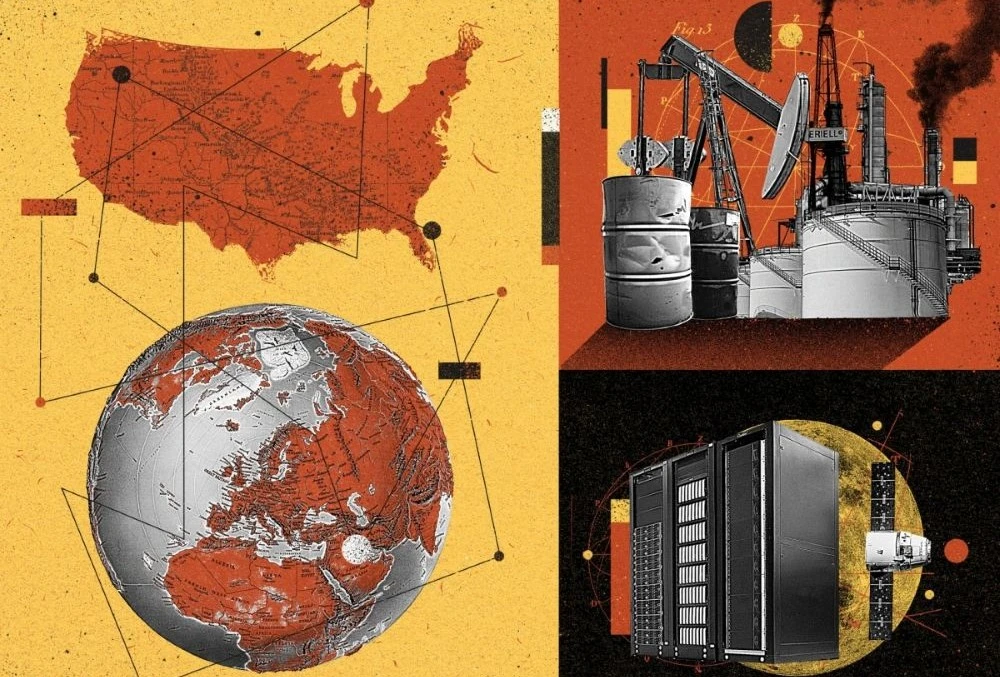
- As artificial intelligence reshapes global power, the US and Gulf states are forging a new strategic partnership built on chips, data centers, and digital infrastructure
The Gulf’s importance in US calculations is no longer measured only in barrels of oil, shipping lanes, and military bases. With the rise of artificial intelligence, the states of the Gulf Cooperation Council (GCC) are emerging as partners in the physical infrastructure underpinning one of the most consequential technologies in the global economy.
US Secretary of State Marco Rubio’s recent tour of the Gulf made this shift unmistakable. Traditional security files, from Iran to freedom of navigation in the Strait of Hormuz, remain central, but they no longer suffice to explain the depth of the relationship between Washington and the Gulf capitals.
Rubio’s June tour of the UAE, Kuwait, and Bahrain came at a sensitive moment in the region. It included a meeting in Bahrain with the foreign ministers of the GCC states, where the two sides reaffirmed their strategic partnership, Gulf security, and freedom of navigation, while stressing the need to address Iran’s missile programme and regional role.
On the surface, the visit looked like an extension of traditional US policy in the region, founded on reassuring allies, protecting maritime corridors, and monitoring regional balances. Yet viewing the visit through that lens alone leaves the picture incomplete.
Land and electricity
AI is often discussed as a world of software, language models, and digital applications. That image, however, conceals an enormous physical dimension. Artificial intelligence requires advanced chips, vast data centres, stable electricity, cooling systems, developable land, communications networks, long-term financing, and a stable political and security environment that allows this infrastructure to operate without disruption.
Here, the Gulf states possess advantages rarely found among many of Washington’s allies: financial surpluses, vast sovereign wealth funds, energy resources, land available for rapid development, and governments able to make major investment decisions quickly. Add to this a geographic position linking Asia, Europe, and Africa, and the region appears increasingly well placed to become a hub for AI infrastructure.
Market estimates suggest that the GCC states have around 106 operational data centres, with another 77 under development. Current data centre capacity in the Gulf exceeds 850 megawatts, while planned future capacity approaches 3.5 gigawatts. Around $8.5bn is expected to be invested in new data centres in the region by 2027.
These figures do not make the Gulf a direct rival to the larger and more mature American and European hubs, but they do reveal an important trend: the region no longer treats technology merely as a service to be imported, but as infrastructure to be built on its own soil.
This advantage becomes more significant when compared with Europe. European markets possess deep regulatory expertise, strong universities and research centres, and advanced companies across multiple sectors. At the same time, they face acute bottlenecks in electricity grids and energy supply. International estimates indicate that the waiting time to connect new data centres to electricity grids in the European Union can range from two to 10 years. In some major hubs, including Frankfurt, London, Amsterdam, Paris, and Dublin, the average wait can reach seven to 10.

The comparison does not mean that the Gulf has overtaken Europe in technology or scientific research. It points instead to a different reality. Europe is strong in regulation, markets, and expertise, while the Gulf can move faster in providing the physical foundations data centres require: land, energy, financing, and speed of decision-making. In the age of artificial intelligence, these elements matter no less than the software itself.
From consumer to partner
The Gulf’s transformation in artificial intelligence is not confined to the construction of data centres. It also reflects government preparedness and a clear political vision. The Oxford Insights Government AI Readiness Index measures the ability of 195 governments to use artificial intelligence in public policy, services, and regulation. In the 2025 edition, Saudi Arabia ranked first in the Middle East and 15th globally, while the UAE ranked 19th, placing two Gulf states among the world’s top 20. Bahrain came 48th, Qatar 54th, Oman 61st, and Kuwait 83rd.
A similar picture appears in Boston Consulting Group’s classification of AI readiness in the region. Saudi Arabia and the UAE stand out among the ‘AI contenders’—the countries closest to regional leadership in this field. Bahrain, Kuwait, Oman, and Qatar fall within the category of ‘AI practitioners’, meaning they have entered the stage of implementation and strategy-building, but are less advanced in the scale of their infrastructure, investment, and capacity for expansion.
These differences matter. All GCC states are moving to embed artificial intelligence in their economic plans. Saudi Arabia links AI to Vision 2030 and to the construction of a diversified economy less dependent on oil. The UAE has placed AI at the heart of a government strategy running to 2031. Qatar, Oman, Bahrain, and Kuwait are working on plans for digital transformation, modernising government services, and strengthening the knowledge economy.
In other words, the Gulf states do not treat artificial intelligence as a standalone technology sector. They see it as a tool for reshaping their economies beyond oil. It can improve the efficiency of public administration, support healthcare, education, transport and energy, open new avenues for investment and employment, and give governments sharper tools for data analysis and planning.
American chips, Gulf power
If the Gulf states hold an important part of the infrastructure AI requires, the US holds its most sensitive components: advanced chips, large models, cloud computing, and the companies capable of operating the system. Washington therefore views the Gulf not merely as a market that buys technology, but as a partner that can help finance, build, and operate part of the world's AI infrastructure.
This bargain is especially visible in the UAE. Washington and Abu Dhabi have announced an AI agreement that supports an Emirati investment framework in the US worth $1.4tn over 10 years.
More important still, the agreement includes an Emirati commitment to invest in, build, or finance data centres inside the US at a scale and power no smaller than the data centres the UAE builds on its own territory. The political and economic meaning is clear. Washington is not simply allowing the UAE's digital infrastructure to grow; it is linking that growth to corresponding investments inside the US and to guarantees designed to prevent American technology from leaking to rival powers.

The Stargate UAE project in Abu Dhabi gives this arrangement its clearest form. The project consists of a one-gigawatt computing cluster within a wider AI campus whose planned capacity reaches up to five gigawatts. The first 200 megawatts are expected to come online in 2026, with participation from G42, OpenAI, Oracle, Nvidia, Cisco, and SoftBank. The UAE provides land, energy, and investment, while American companies supply chips, models, cloud services, and digital security.
In Saudi Arabia, the same logic is taking shape. Humain, the company backed by the Public Investment Fund, has announced a partnership with Nvidia to build AI factories in the country with a capacity of up to 500 megawatts. The first phase includes a supercomputer comprising 18,000 Nvidia GB300 Grace Blackwell chips, with plans to deploy several hundred thousand advanced graphics processing units over five years. The US company AMD has also entered into a collaboration with Humain worth up to $10bn to roll out AI computing capacity during the same period.
It is seeking to build vast computing capacity linked to US technology. For Washington, this carries strategic weight. The more Gulf digital infrastructure is anchored in American chips, American cloud services and American standards, the smaller the space left for Chinese technological influence in a region of exceptional strategic importance.
A matter of national security
These deals cannot be separated from chip-export policy. The US regards advanced semiconductors as a matter of national security, not merely as commercial goods. Washington fears that the most advanced chips could reach China, whether directly or through third countries. For that reason, the Biden administration introduced a rule in January 2025 regulating the diffusion of AI and the export of advanced chips, with the aim of controlling global access to this technology.
Yet that policy did not close the door on the Gulf. Deals still emerged, including Microsoft's $1.5bn investment in the Emirati company G42, a transaction tied to security guarantees and the company's distancing itself from sensitive Chinese technology.
Under the Trump administration, the approach changed. In May 2025, the US Department of Commerce rescinded Biden's AI diffusion rule, and the administration began pursing direct deals with partners Washington considered more trustworthy. That same month, reports indicated that the US was nearing an agreement allowing the UAE to import 500,000 advanced Nvidia chips annually, starting in 2025.
This shift does not amount to a full liberalisation of chip exports. Rather, it marks a move from a broad, general policy to more selective understandings with specific partners. The Gulf, especially Saudi Arabia and the UAE, is trying to place itself within this trusted circle. The region wants access to advanced chips and models, while the US wants to ensure that this does not become a loophole in its policy towards China.
Cooperation is not confined to Saudi Arabia and the UAE. Qatar has signed a five-year agreement with the American company Scale AI to deploy AI across government services, with more than 50 potential use cases. Kuwait, for its part, has taken a different route, with the Kuwait Investment Authority joining the AI Infrastructure Partnership alongside BlackRock, Microsoft, MGX, and Global Infrastructure Partners. The partnership aims to mobilise $30bn in capital—a figure that could reach $100bn with debt financing.
What is unfolding is more than a passing wave of technology deals. AI is redefining the very nature of the US-Gulf relationship. The Gulf states, in turn, recognise that their ambition to build a post-oil economy cannot be fulfilled without access to advanced American chips, cloud services, large models, and technical expertise.
None of this means the road is free of risks. Data centres consume enormous quantities of electricity, water, and cooling resources, and they can place heavy pressure on power grids if they are not built according to long-term planning. Vast computing capacity alone is not enough to create a fully fledged AI economy. The region also needs skilled human talent, clear regulatory frameworks, data protection, domestic research capacity, and policies that balance innovation with privacy and security.