- Hayoun labels his work ‘Arab art, by and for the Arab peoples’
- Inspired by mother who worked 2 jobs, artist tells Arab News
DUBAI: Work by Los Angeles-based Arab-American artist Massoud Hayoun has been acquired by London’s Victoria and Albert Museum and the Fenix Museum of Migration in Rotterdam. Both were finalized this year and announced this month.
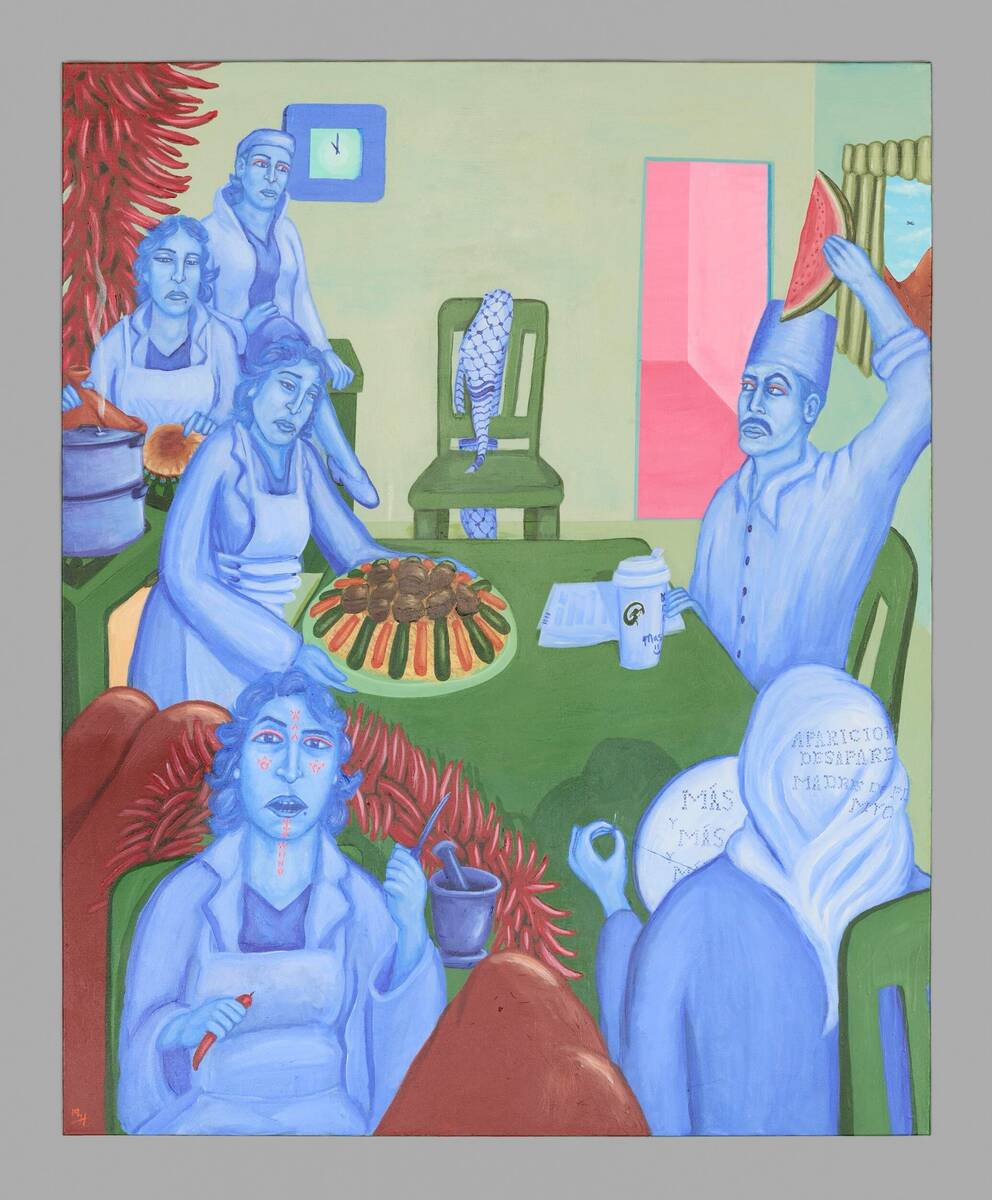
The V&A took “The Master’s Tools,” a 2025 acrylic painting, for its Middle East collection. Fenix acquired “409PC (Failure to Disperse),” a triptych about immigrants in Los Angeles.
Hayoun, who is of Tunisian, Moroccan and Egyptian descent, learned of the Fenix acquisition at a park with his mother.
“I told my mother that it was her tireless work — often two jobs at a time with little time off — that was in a museum,” he told Arab News. “The fruit of her labor is museum-grade.”
The painting, “The Master’s Tools” takes its title from Audre Lorde’s essay “The Master’s Tools Will Never Dismantle the Master’s House.” Hayoun described the painting as self-criticism.
“I often paint my grandmother making harissa as a symbol of indignation and opposition to gender inequality. But fundamentally, it’s still kitchen work,” he said. “If I really care about women, I should want more for my grandmother than backbreaking servitude.”
The work depicts his grandmother, Daida Boukhobza, a Jewish-Tunisian woman born in 1929 who raised him. It also features a watermelon and keffiyeh, symbols of Palestine that recur in his work.
“But symbols are hollow,” he said. “It’s very easy to think one has done their part by brandishing a watermelon on social media.”
The Fenix triptych draws on his family history. His grandfather was undocumented in the West for years, and his mother was born without a nationality.
Hayoun said galleries had earlier pushed him toward “flattening, hackneyed symbols of Arab culture.”
“First and last, this is Arab art, by and for the Arab peoples and our region,” he said. “The ultimate goal, beyond any museum in the West, is for my work to exist alongside other contemporary Arab artworks in our own region’s cultural institutions.”