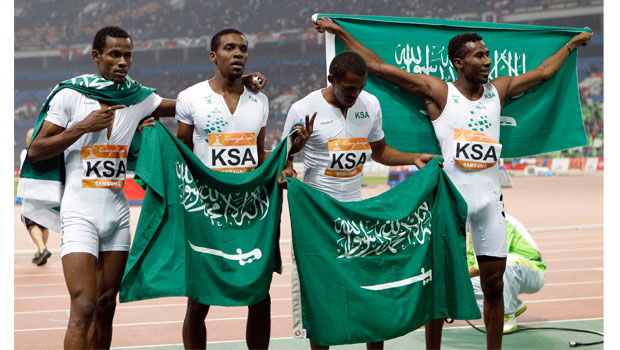
Mohammed Shaween, 24, bagged gold in the (1,500m) with a timing of 3:36,49 secs. Sultan Al-Habashi, 25, delivered the second gold in the (shot put) after throwing the iron ball over a distance of 20.57m. The third gold came in the (men's 4 x 400m relay) with the quartet finishing with a timing of 3:02.30 secs. The relay team consists of Mohammed Al-Salhi, 25, Ismail Al-Sibyani, 21, Mohammed Al-Bisfi, Adel Mahbub, Yousif Masrahi, 23, and Hamed Al-Bishi.
Silver medalists were Yasir Al-Nashri (100m), and Bandar Sharahili in the (400m hurdles). Yousif Masrahi (400m), Ali Al-Amri (3,000m steepchase), and Hussain Al-Saba (long jump) won the bronze medals.
Speaking to Prince Nawaf bin Mohammad, deputy head of mission of the Kingdom of Saudi Arabia to the 16th Asian Games and President of the SAAF, Arab News was told that late preparations led to a lower haul of medals. He said, "We usually bag more medals, but taking into consideration that we received the budget late this time caused us to delay in sending our athletes to train. However, we managed to do well, though it was not our best performance." For now he added, what we care is preparing the athletes to compete in the upcoming major events such as the 2012 London Games.
When it comes to media coverage, the prince said, "Unfortunately our mediamen have limited knowledge and are interested only in football. They should give equal coverage to other games. Our role is to bring more laurels to the country and this should be highlighted by the media giving us good reports in their newspapers."
The 2000 Sydney Games silver medalist hurdler Hadi Souan, who delivered the medal in the 400 meters hurdles in 47.53 seconds and who is a member at the Asian Youth Welfare Committee was pleased but not satisfied about the Saudi overall performance. He said that our athletes should not be judged by their performance in this event due to the pressure they underwent during training.
"In a short period of time, the athletics federation did wonders when it came to their performance compared to the other federations," said Souan. "If you want to be victorious, you need to plan ahead, bring the best coaches, work more, and prepare in advance without pressuring the athlete or the coaches."
Asian athletics coaching committee member and Saudi coach Saad Shadad said, "Thank God we were successful despite training for only three months. During this period, both the coaches and athletes were under tremendous pressure. But that's normal because the Asian Games are the third most important event and we wanted to be there." He added, that our team is capable and ready to compete in the South Korean World Cup and in the London Olympics.
Shadad said that Al-Salhi was tipped to win the gold in the 800m but failed to do so. "But again, he didn't have enough time to prepare to compete with world champions. Though it was the Asian Games, there were world class performers in the Qatari and Bahraini teams. This gave our athletes an opportunity to perform with the best in the world and to give off their best and that's what they always do," said Shadad.
According to Shadad, who was the first to claim the bronze medal for Saudi Arabia in the 3,000 meters steeplechase (Sweden 1995) with a timing of 8:12.95 seconds, the team underwent training in Taif, in Eastern Province, competed in the Athletics West Asian Championship and brought three gold medals, one silver, and five bronze. They also competed in the Arab Athletics Military Championship and led the championship with four gold medals, one silver, and one bronze.