
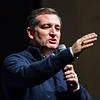

Senator Ted Cruz (R-Tex.) would be wise to avoid the mistake Ronald Reagan made early in his 1976 insurgent campaign to supplant President Gerald Ford as the Republican presidential nominee. Cruz needs a crystallizing justification — a signature issue.
Reagan only found one mid-way through his 1976 race, but he was able to use it to carry him to victory in 1980. Reagan’s populist call to hold on to the Panama Canal — “We built it! We paid for it! It’s ours! And we’re gonna keep it!” — resounded with voters in 1976. Cruz has an equally populist issue that could prove as successful: Campaigning against the US Supreme Court’s eminent-domain ruling.
Though many Republicans loath the infamous “Kelo v. City of New London” decision, which allows government use of eminent domain, front-runner Donald Trump strongly supports it. Cruz is already featuring eminent domain in a new ad. But he could be doing far more.
The canal issue struck a deep chord with the American people at a particularly anxious time in US history. The United States had lost its first war, as well as two presidents — one by assassination and the other through resignation. It appeared to be losing the Cold War to the Soviets and, with gas lines, inflation, national malaise, civic unrest, disco and leisure suits, it seemed to many that America’s day was past — 25 years ahead of schedule by the calculations of Henry Luce, who had notably labeled the 20th century “The American Century.”
Cruz now needs his own signature issue, one that will resonate with the American people.
Trump, a big real-estate developer, is adamantly in favor of the court’s Kelo decision. The ruling, many conservatives believe, upheld the conspiracy between big government and big developers to take property from private landowners on the premise that this would produce more tax revenue for government. The court, many conservatives insist, was intellectually corrupt in its decision, the developers economically corrupt in their arguments and the government morally corrupt in facilitating the illegal transfer of wealth. Yet, as Trump told Neil Cavuto of Fox News, “I happen to agree with it.” That’s the opening for Cruz. True conservatives know that private property has been considered sacred in America since 1787, and even before. It is, in many ways, a deeply American concept. The original draft of the Declaration of Independence, for example, contained the phrase “pursuit of property” before it was changed to “pursuit of happiness.”
“Kelo” came during the George W. Bush era, now regarded by many conservatives as an era of “big government Republicanism” — the era of the corporatization of the GOP. Thomas Jefferson’s admonition about a republic being the only form of government not at war “with the rights of mankind” was lost on the Bushies, as far as conservatives were concerned.
Cruz should emphasize that upholding private property is the essence of the modern conservative movement’s Jeffersonian principles. He should offer a way to address this — perhaps with a constitutional amendment, to restate the sacred property rights the framers intended. Due process, under the Fifth Amendment, has been pillaged, and left for dead.
This could set Cruz up as a champion of the people against corrupt government and corrupt corporations. It would place him on the right side of the Constitution — and Trump on the wrong side. It will be tangible evidence that Cruz is pro-Reaganism. He needs to campaign on this, making it his signature.
Jefferson viewed his 1800 election as the second American Revolution — and he indeed rolled back government, including the notorious Alien and Sedition Acts. Reagan regarded his 1980 win as yet another upheaval of the people over the state.
With Cruz, a 21st-century revolution could take now hold, as the public rejects President Barack Obama’s continual government overreach. Championing private-property owners is not only the right thing to do politically — it is the right thing to do.
— REUTERS


