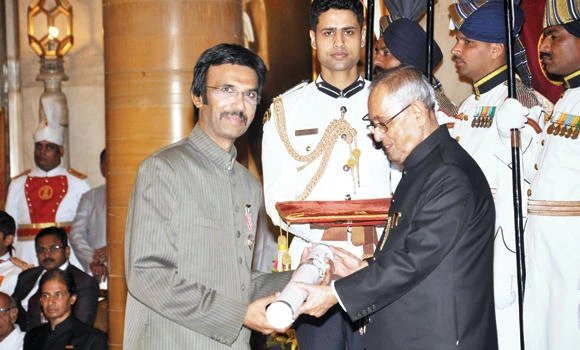
“For a love story, I could have staged Romeo and Juliet but I wanted to do something different that local people could relate to. Perhaps, a slice of history, and that would make a difference,” says Mohammed Ali Baig, an Indian theater personality and art filmmaker, who was recently awarded India’s prestigious civilian award Padma Sri.
There are only a few art lovers in South Asia who are going all out in their efforts to trace and keep alive the region’s rich heritage and culture. Baig is one of them.
His ‘Heritage Theater’ is today internationally acclaimed and he was feted for the same in Lahore, Pakistan, in 2008, in Paris in 2010, and in London in 2013. He has expressed his desire to perform in the Gulf region as well. With epic performances at the Indian city of Hyderabad’s historical monuments like the Charminar, Golconda Fort, Qutub Shahi Tombs, Chowmahalla Palace, Taramati Baradari and others, he has pioneered a unique genre. This genre of Urdu theater has not just revived serious, meaningful theater in Hyderabad but has also brought to center stage Hyderabad’s and Deccan’s rich centuries-old diverse culture and heritage, popularizing it amongst today’s young generations.
The Hyderabad-based Baig was bestowed with India’s fourth highest appellation, the Padma Shri award for his indispensable contribution to theater.
Drama runs in Baig’s blood, which is why his ‘Heritage Theater’ is a great hit.
It is tough to continue a legacy, especially if your father was a doyen in Hindustani theater.
His grandfather, Mirza Mehmood Ali Baig, played in the Prince of Berar Azam Jah Bahadur’s polo team. He was a partner in the second largest stud farm in the subcontinent.
His father Qadir Ali Baig was involved in serious theater movement till 1984 and his family’s contribution to the city’s equestrian, artistic and cultural scene is the stuff that legends are made of.
“My father went to Aligarh Muslim University, The cultural milieu there influenced him into Urdu theater. ‘Darwaze kholdo’, Kishan Chander’s post-Partition work on national integration, was staged by him in the then Bombay. The grandfather of Indian cinema, Prithviraj Kapoor came to watch it for a few minutes and stayed on for two-and-a-half hours” recalled Baig.
“My father wrote five plays in Urdu published in a book entitled ‘Resham Ki Dor’. These plays invariably depict the importance of national integration as they deal with the sacrifices of one religious community in favor of the other. The events in the work described rise above and surpass the barriers of religious bigotry and succeed in achieving greater human values transcribed in all religious texts. His plays were as critically acclaimed as they were highly popular with the masses. Some of the larger-than-life historical pageants and socially meaningful plays that he produced, directed and acted in included ‘Darwaze khol do’, ‘Burf ki minar’, ‘Sakharam binder’, ‘Aadhe adhurey’, ‘Lehron ke rajhans’, ‘Tana Shah’, Kohinoor ka lutera’, ‘Bahishkaar’, ‘Jai Baba Gopinath’, ‘Thank you Mr. Glad’, ‘Quli Qutub Shah’, ‘Mahboob’, ‘Budh kaam shudh’ and several others. He made the very first teleplays for Doordarshan in the days of black and white television: ‘Raksha Bandhan’, ‘Aasra’ and ‘Humayun’. He broadcast his plays on radio, and took the most successful stage ones to Delhi and Mumbai.
“I never aspired to be an actor or a theater person. It happened by accident when I came to Hyderabad to mark the 20th anniversary of my father’s demise and there I felt I should take his art legacy forward,” said Baig.
His father staged ‘Quli Qutb Shah’ on the ruins of Rani Mahal in Golconda fort in Hyderabad. Baig has managed to stage plays at Taramati Baradari as well as at Khilwat Mubarak where a play on Nizam VII Osman Ali Khan was staged.
The same play, ‘His Exalted Highness’, was staged at the magnificent 150-year-old Chowmahalla Palace as well.
As much as heritage venues have acted as ambient backdrops to the majestic stories unfolding onstage, ‘Heritage Theater’ has played an instrumental role in popularizing monuments like Taramati Baradari, Qutub Shahi Tombs, Falaknuma Palace and Chowmahalla Palace. Today, one appreciates the beauty of these heritage sites in relation to the Foundation’s spectacular productions, which is a proud accomplishment, he said.
The ‘Qadir Ali Baig Theatre Festival’ that the Qadir Ali Baig Theatre Foundation conducts annually is one of the most prestigious theater events in the sub-continent, a landmark event in Hyderabad, and a much eagerly-awaited engagement on the country’s cultural calendar.
The festival, curated and designed by Baig, brings together the biggest assembly of artistes from across the country and overseas, performing over a fortnight in as many as six different languages. It is a proud moment for Hyderabad, where a son’s tribute to his father has become a revival movement. Every year, theater lovers and national luminaries pay tribute to Qadir Ali Baig, gathering in Hyderabad from various parts of the world.
The Qadir Ali Baig Theatre Foundation is now globally credited for its theater revival model for Hyderabad. Baig and his home productions have been feted at high-brow international festivals and prestigious theater venues in India and abroad from Lahore to Lyon, Osaka to Orlando.
The foundation’s own productions have been invited to and have been performed at some of the most prestigious international festivals and venues, and its celebrated theater revival movement is acclaimed and feted globally.
What began as a reciprocal gesture in 2006 with Pakistan’s Peerzada Theatre has now taken shape of an active exchange between Qadir Ali Baig Theatre Foundation and professional theater companies in other countries. Some of the foundation’s ventures in its Global Theatre Initiative include: Qadir Ali Baig Theatre Foundation’s ‘Raat Phoolon Ki’ written, directed by and featuring Mohammad Ali Baig staged in Lahore in 2006 and Pakizatni Peerzada Theatre’s ‘Nawab Sahib Qibla’ staged in Hyderabad the same year.
French actress Anne Bressanges was brought in by the foundation with her play ‘Lecon D’Anatomie’, German theater’s Victoria Hauke and Olaf Reinecke performed ‘Else’ and a Dance-Theater Workshop for the city’s performing artistes took place in the previous years.
Baig was invited to France by its government in 2010 to share his theater revival model and ‘Heritage Theater’ modalities with French theater companies. His trip included exchange sessions with leading European theater stalwarts and the repertories of Ariane Mnouchkine, Peter Brook, Philip Genty, Patrice Chereau, Footsbarn Theatre and Moliere’s theater, ranging from Classical and Contemporary, Circus and Puppet Theater, Physical and Dance Theater to Props, Costumes and Theater Architecture.
2011 saw UK’s Paddy and Frederika Hayter conducting workshops with Baig on space and body movements, on the use of masks in theater, and the acting techniques of Jacques Lecox, one of the finest theater gurus of the world in theater history.
Following these enriching sessions, Hyderabad was audience to Lahore-based Ajoka Theatre’s Madeeha Gauhar, a contemporary dance workshop and the performance of renowned European choreographer Dominique Boivin and Phillipe Priasso from France in 2011.
Qadir Ali Baig Theatre Foundation co-created and co-produced ‘Forty Winks’ with France-based Footsbarn Theater that opened in Hyderabad in August 2011. The unique production was conceptualized and designed by Baig and performed by Paddy Hayter, along with Baig.
The foundation shares a warm relationship with Footsbarn Theater, who brought their internationally-acclaimed play ‘Indian Tempest’ to Hyderabad in 2013, where they also conducted Shadow Play and Voice workshops. Footsbarn Theater recently invited the foundation to stage ‘Quli – Dilon ka Shahzaada’ during their festival ‘Hérisson en Fête’ in France in July 2013.
— [email protected]
Mohammed Ali Baig – icon of Indian theater movement