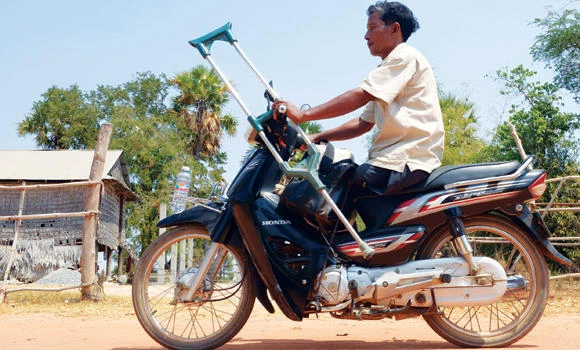
When the phone rings, former Khmer Rouge soldier Ken Mon grabs a bag stuffed full of medicine, jumps on his motorbike and heads for an impoverished Cambodian village with the haste of any diligent local doctor.
Yet the 55-year-old Mon has no formal medical training.
While “doctor” is a self-granted title for Mon, he — and others like him — are the only source to treatment for thousands of poor residents in Ang Ro Ngeang village, about 70 kilometers south of Phnom Penh.
Undeterred by his lack of qualifications, Mon drives ten minutes down a bumpy track in Cambodia’s southern Kampong Speu province, arriving at the home of Chei Tana, 27, who complains of crippling stomach pains.
“You have a lot of air inside your stomach,” he explains after examining his patient, giving him a packet of antacid pills.
Mon is one of hundreds of unlicensed doctors treating patients across a country whose medical system was eviscerated under the brutal Khmer Rouge regime of the 1970s and is yet to build a comprehensive public system.
Seventy percent of Cambodians seek health care from the private sector — including from pharmacies, illegal doctors or traditional healers, known as “Kru Khmer” — according to a 2012 survey by the World Health Organization.
Self-taught doctors, a Khmer Rouge legacy in Cambodia