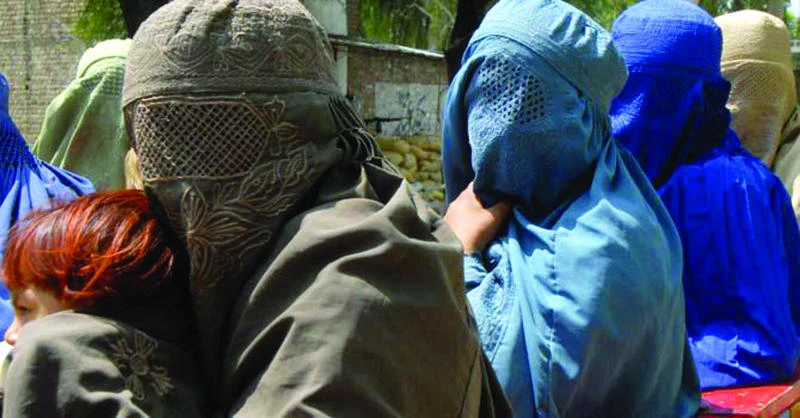
Next month’s elections will mark the first democratic transition of power in Pakistan, but Taleban threats, social taboos and poor organization may deprive millions of women their right to vote.
Out of a population of 180 million, 37 million women and 48 million men are registered to vote in the May 11 polls in a country that has been ruled by generals for half its life and where military coups have repeatedly interrupted democracy.
But in the conservative northwest Khyber Pakhtunkhwa province, adjoining tribal areas on the Afghan border and southwestern province Baluchistan, few women voted at the last election and officials fear it will be the same again.
“We waited the whole day... but not a single woman turned up because of a ban imposed by tribal elders,” remembers Badama Begum, a 33-year-old teacher who worked at a polling station in 2008 in the northwestern district of Mardan.
Election authorities set up a separate station staffed only by women to guarantee around 350 registered female voters complete privacy, but it was a waste of time.
“We closed the polling station in the evening, returned the blank ballot papers and empty boxes to the election commission, and left,” she said.
In 2008, not a single vote was cast at 564 of 28,800 women’s polling stations — 55 percent of them in Khyber Pakhtunkhwa, officials said. In the most conservative areas, officials estimated women’s turnout at 10-15 percent of those registered.
That year, 76 women ran for parliament and 16 won seats. The election commission says there are more women candidates this time, but had no precise number.
Registering to vote is a routine process conducted by officials who go door-to-door to compile a list of adults with ID cards in each household.
But this in itself leaves millions of women deprived from getting chance to vote.
Women’s rights activist Farzana Bari estimates that at least 11 million eligible women will not be able to vote simply because authorities have not granted them national identity cards.
The elections themselves present further barriers to women.
“Our society does not allow us to bring our women to vote,” said Sharif Khan, 50, a solar energy dealer in Miranshah, the main town in the tribal district of North Waziristan, the most notorious Taleban and Al-Qaeda stronghold in Pakistan.
“We are afraid of the Taleban. They oppose women voting, so why should we take the risk?” he asked.
Literacy rates are low, even lower for women. General disillusionment also runs high in some of the most remote and deprived parts of the country.
“Women in our area don’t even know how to vote,” said Miranshah cloth merchant Adam Khan, 35.
“Our MPs do nothing for our welfare. So it’s not just our women, I won’t vote this time either,” he fumed.
In urban areas, politicians lay on transport to ferry voters to and from polling stations, but in the countryside it becomes more complicated when women are not allowed to travel without a close male relative.
Aware of the problem, the election commission tried to introduce reforms that no candidate could win with less than 10 percent of the women’s vote in his constituency, but it was rejected in Parliament, said spokesman Khurshid Alam.
He says the commission will try to enforce legislation against those who try to stop women from voting, although it remains unclear how.
“Preventing a person from casting his vote falls in the purview of corrupt practices and is punishable by three years in jail and fine of rupees 5,000 ($ 50) or both,” Alam told AFP.
Khalida Bibi a 39-year-old housewife from the northwestern town of Dargai told AFP that she was hopeful that a tough election commission would have some impact.
“My name was on the voters’ list for the 2002 and 2008 elections, but I couldn’t vote because on both occasions local people decided that women would not,” she said.
“I hope I will succeed this time because the election commission has warned against any ban on women voting,” she added.
Taleban may bar tribal women from Pakistan vote