
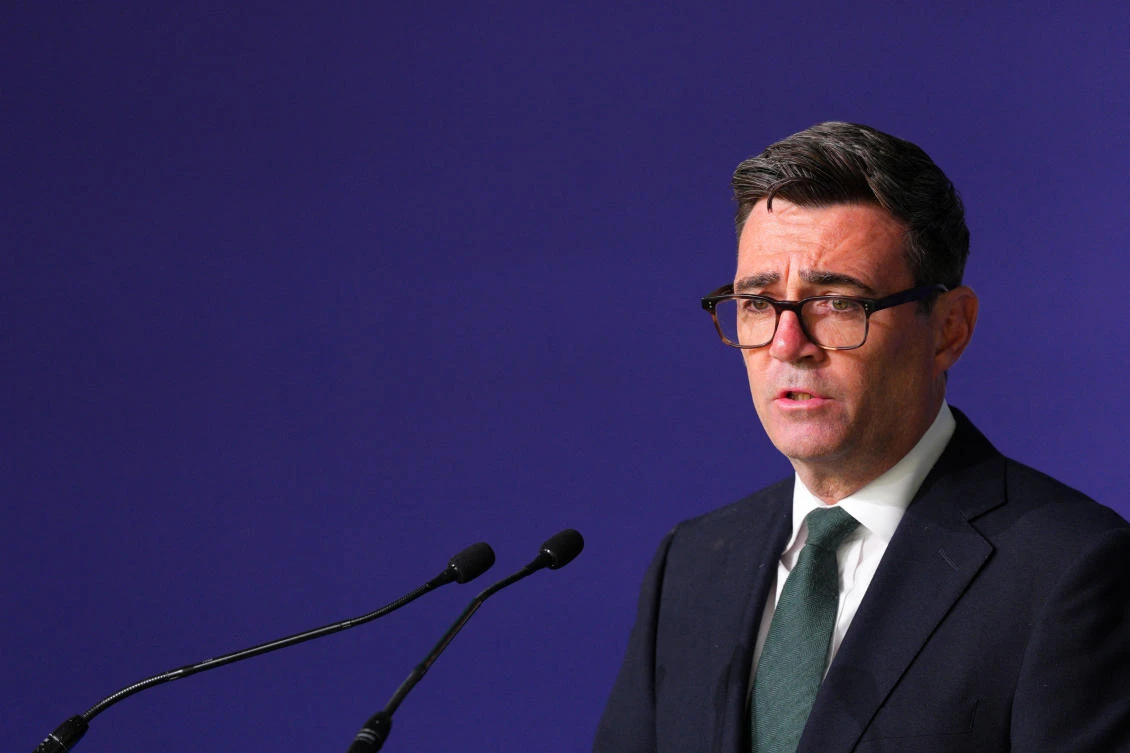

New UK Prime Minister Andy Burnham and his politics might not be to everyone’s taste but, whatever one thinks of him, in his short time in office he has demonstrated a combination of boldness, vision and political astuteness. Nowhere is this more evident than in his determination to put relations with the EU back at the heart of his foreign policy agenda.
At first glance, this might look like political suicide. A decade after the British people had their say in a referendum and voted, albeit by a narrow margin, to leave the EU, few would relish revisiting the years of acrimony, both at home and with Brussels, that preceded the UK’s eventual departure at the end of 2020.
Nevertheless, contrary to the arguments of those who oppose reopening the debate on relations with the EU, two very simple realities cannot be ignored. First, Brexit has caused obvious damage to the UK economy and to its relations with its closest neighbors. Second, for any politician with sound political instincts, few issues currently enjoy greater public support than closer relations with Europe.
The implication, however, is not necessarily to jump straight into a debate about full EU membership. Rather, it is to begin an honest conversation, acknowledging that leaving the EU has failed to deliver any worthwhile benefits to the country and that the decision must therefore be revisited with an open mind. Moreover, there is more than one path and more than one pace at which closer relations with the EU can be rebuilt, even if one suspects, or perhaps hopes, that the PM and most of his senior Cabinet ministers would ultimately favor full membership.
There is more than one path and more than one pace at which closer relations with the EU can be rebuilt
Yossi Mekelberg
Just as importantly, even the most ardent Brexiteers must acknowledge that the international political and economic landscape has changed dramatically since Brexit was conceived. The wars in Ukraine and the Middle East, alongside increasingly complex transatlantic relations in recent years, make closer engagement between London and Brussels all the more necessary.
Virtually all major pollsters and opinion polls suggest that more than 60 percent of Britons support rejoining the EU. Furthermore, 70 percent would favor, at the very least, a closer relationship with the bloc. Nearly a quarter of those who voted for Brexit also admit to regretting their decision.
Furthermore, the evidence of the economic damage caused by Brexit is increasingly difficult to dispute. Research by the Office for Budget Responsibility, alongside work by the UK in a Changing Europe think tank, has concluded that tariff barriers and trade frictions have reduced long-run UK productivity by about 4 percent, with overall gross domestic product per capita estimated to be 6 percent to 8 percent lower.
Evidence of this kind makes it almost irresistible for a prime minister and a government that originally opposed Brexit, some of them very publicly, to go all guns blazing in an attempt to restore EU membership. However, reopening the debate on Europe would inevitably and immediately revive one of the most toxic subjects in British politics: open borders and immigration.
This is hardly an issue on which one can expect a measured or constructive public conversation, particularly when anti-immigration parties, from the Conservatives to Reform UK and Restore, are competing to outdo one another in presenting themselves as the most credible defenders of closed borders and in stoking hostility toward migrants. For this reason, determined but incremental progress is probably the more realistic approach.
A major obstacle facing Burnham in advancing the cause of full EU membership, or even pursuing a rapid reversal of Brexit, is his lack of a direct electoral mandate. He was not even standing as an MP, let alone leading Labour, at the time of the last general election. He can, of course, create a more constructive and amicable atmosphere with his European counterparts, reach agreements on specific issues and gradually build toward what might be described as “ever-closer relations.”
Burnham was not even standing as an MP, let alone leading Labour, at the time of the last general election
Yossi Mekelberg
Such an approach would be consistent with Labour’s 2024 election manifesto, which promised to reset the UK’s relationship with the EU and reduce trade barriers, while ruling out a return to the single market, the customs union or freedom of movement. At the Labour Party conference in the autumn — his first as prime minister — Burnham declared that “Brexit has done more harm than good.” Contrary to some convenient interpretations, this was not an acknowledgement that leaving the bloc had brought any meaningful benefits.
Recognizing his vulnerability over the question of democratic legitimacy, Burnham must honor his party’s electoral commitments on Europe. At the same time — while negotiating new agreements with Brussels to mitigate the damage inflicted by Brexit within the constraints of what was promised to the electorate — he has already hinted at the need for an “honest discussion” about EU free movement and the possibility of including a referendum on Europe in his party’s next election manifesto.
Although a general election is not due until the summer of 2029, it could come considerably earlier if Burnham judges that the political circumstances favor him and his party. If that happens, a serious debate about Britain’s future relationship with Europe, including the possibility of rejoining, might not be a distant possibility.
For the UK, it is also important to recognize that this is not simply a question of what it wants but of what the EU is prepared to accept as well. Many across the Channel are still reeling from Brexit, which caused both practical and reputational damage. Nevertheless, with a new openly pro-European and more assertive British prime minister, discussions with the EU’s 27 member states appear more constructive and are progressing faster.
An agreement to remove Brexit-related checks on food and animal product imports and exports, covering everything from sausages and cheese to leather goods and flowers, would bring considerable relief to British farmers and exporters. Many have seen their produce deteriorate or go to waste because of complex regulations and delays holding up shipments destined for European markets. In return, the UK would agree to observe and adapt to EU regulations governing plant, animal and food trade standards. As an additional benefit, British pet owners would see the return of pet passports for the transport of animals to the EU.
A willingness to reduce fees for EU students, making it more affordable for British students to study across the Channel in return, would also represent a welcome step toward closer people-to-people ties and, potentially, greater mobility.
A British return to the EU would be desirable for all the right reasons, not least for security as much as economic considerations. But it is far from inevitable. Above all, the EU represents a political concept unlike any other in the history of the nation-state. It is living proof that countries that once fought vicious wars against one another can overcome deep-rooted animosities and find common ground as human beings, as societies and as progressive liberal democracies, working together for the greater good.
The UK, as one of the world’s leading democracies, should be at the heart of that project.
Yossi Mekelberg is a professor of international relations and an associate fellow of the MENA Program at Chatham House.
X: @YMekelberg


