
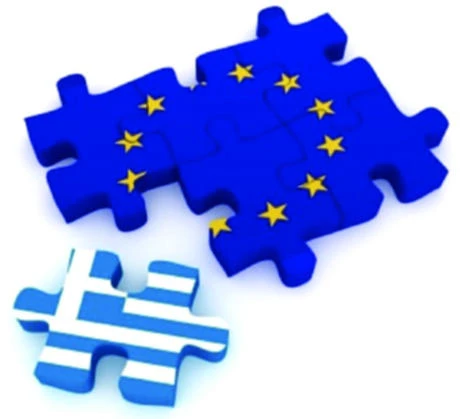

Greece has carried on its back a crippling debt load for the last five years. How crippling? Very crippling. And this was evidenced by the fact that last Wednesday Athens missed a crucial debt payment to the International Monetary Fund (IMF) of $1.7 billion, making it the only developed country to ever be in default to the international monetary body.
How profound is that national humiliation for Greeks? Very profound. Jacob Kierkegaard, senior fellow at the Peterson Institute for International Economics in Washington, suggested that this would put Greece in “ignoble” company. “Greece is joining countries we would normally regard as failed or failing states,” he said. The symbolism is crushing for the proud people of a country that introduced Europeans, and the rest of us around the Mediterranean basin, to democracy and philosophy, mathematics and science, theater and cosmology.
Eurocentric notions aside, countries in the past that had missed payments to the IMF have traditionally been impoverished and badly governed ones in Africa, the Middle East and South Asia, like Sudan, Zimbabwe, Iraq, Afghanistan and Somalia. To compound the problem — and the national humiliation — of the people of Greece is the fact that their European creditors, including bond holders and the European Central Bank (ECB), where the teller there has long since nailed the window shut to the Greek government, are no longer willing to continue extending emergency loans, or bailouts, that over the last several months had propped up Greek banks.
Countries in the euro zone have made it clear that no deal with the Greek government, led by Alexis Tsipras, could be negotiated until Greece introduced severe and very painful, austerity measures in their economy
The leftist Tsipras responded by, well, “going to the people,” as it were, asking them to vote in a referendum this Sunday on whether to accept the euro zone’s demands — or, as some Greeks call them, “dictates.” In other words, eat humble pie and take it on the chin, or defy the European Union (EU) and effect a “Grexit,” an exit from the zone, after which the country would revert back to using the drachma, its currency until 2001.
All of which brings us to the core issue in this crisis: What are the implications for the euro zone, for the EU and, indeed, for world markets were Greece and Europe choose to go to divorce court?
First, a word about the dream that Europeans had sought to turn into reality following the devastation of the two dreadful wars they launched on their continent — and later far beyond — in the first half of the 20th century. What better guarantee is there against war, the argument went at the time, than commerce? Countries that traded with each other, that shared one currency, that debated their problems in one parliament, countries whose people traveled across common borders, and freely worked in each others’ lands, are not likely to go to war against each other.
So enter the euro, the symbol of that fraternity of well-meaning nations.
But this ignored the fact that these countries are not homogeneous. They are the product of diverse historical, cultural, social, linguistic and political experiences.
Ask Emile, my French friend in Washington, what he thinks of the EU, and his vehement, even dismissive response would be: “I’m French, I don’t want to be European!” And wait till the winter of 2017, when the people of Britain vote in a referendum on whether to stay in or leave the EU (Britexit). According to a poll by the European Commission’s Eurobarometer, a kind of European Pew Institute, Europeans in EU countries have felt less and less attached to their “identity” as Europeans in recent years — 67 percent in 2007 against 56 percent in 2014.
As Robert J. Samuelson, the influential Washington Post columnist who has written extensively on the world of finance, put it in his column earlier this week: “Adopting the euro was supposed to be an irrevocable commitment. It was a political statement that a continental Europe is bigger and more important than any of its member nations. Once a country drops out, that premise is shattered. A Greek exit would raise the possibility that other countries in the same situation — high debt and nonexistent or dismal economic growth — would suffer the same fate.”
Yet, Grexit, by all accounts, would not rattle EU markets, let alone world markets. Greece’s economy is relatively small, comprising just under two percent of the euro zone. In other words, if Greece’s economy sinks further — which appears likely — and its people vote to exit the zone, this will hardly hurt a lot of people in Europe and the US. Germany’s exports to Greece, for example, total a minuscule 2 percent of its GDP, and US exports to the troubled Mediterranean nation of 11 million amounts to — hold on to your hat — one thousandth of one percent of the US economy.
I for one agree with Greek, and other, proponents of the call for Grexit and the reintroduction of the drachma. Leaving the euro zone — though not necessarily at this time the EU — would dramatically enhance exports and tourism, and encourage the local economy to grow at its own pace, while simultaneously discourage expensive imports.


