The United States has been a traditional ally of the Kingdom and their relations are very important as the two friendly countries share close partnership.
Saudi-US relations have stood the test of time and are now developing into a partnership spanning the fields of politics, economics, education, technology and other areas of human endeavor.
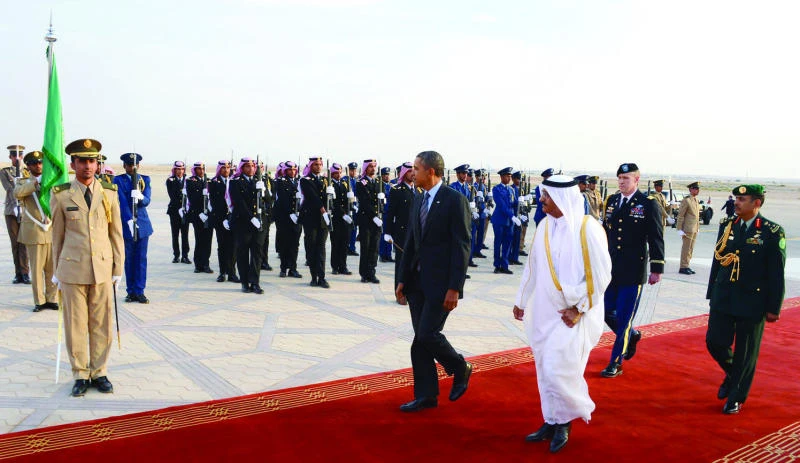
Enhancing the historic ties, US President Barack Obama is on a visit to the Kingdom to meet Custodian of the Two Holy Mosques King Abdullah to bolster bilateral cooperation and decide the future course of action on many regional and international issues.
The visit assumes significance in terms of the geopolitics of the Middle East as the Kingdom is a key player in the region. The outcome of the talks between the two leaders will set the tone for the next step toward a solution of such regional issues as the Syrian crisis, Iran nuclear deal and Palestinian issue.
Public expectations are high with the high profile visit as many believe that after some strain in bilateral ties in recent months, Obama will now seek to ease the concerns of America's traditional ally on important regional issues.
The Saudi-US relation is historic. The first US citizens to travel to the Kingdom were Christian missionary doctors, who won the good will of King Abdul Aziz, the founder of the unified Kingdom of Saudi Arabia, as they treated him for his illness.
Following that life-saving treatment, the House of Saud gave preference to American delegations over others.
Acknowledging the services of the US medical mission, King Abdul Aziz said in Riyadh on Jan 10, 1937: “I love your country and admire your president (Franklin D. Roosevelt), and am very grateful for the services which members of your mission have shown me and my people. You come wanting only to help us.”
He developed closer ties with the US as the two countries went ahead with full diplomatic relations in 1933 and since then have been close allies, partners as well as friends.
The US need for oil and the Kingdom’s desire for a balanced economy had resulted in strong relations after the promises that had been made by American oil explorers that Saudi Arabia could have a very good chance of finding oil and the Kingdom accepted the US offer of oil exploration.
As a result, in May 1933, the California Arabian Standard Oil Company, renamed as the Arab American Company (ARAMCO), started exploration in the country.
While bilateral cooperation was growing, the Arab-Jew conflict in 1936 affected the relations as the US favored the establishment of an independent Jewish state at the cost of the rights of the Palestinians.
Later, US President Franklin D. Roosevelt sent a letter admitting that the US supports the establishment of a Jewish state in Palestine, but it was not in any way responsible for its establishment. That restored the relations.
Bilateral cooperation scaled new highs during the Gulf War with the President George H.W. Bush coming to the rescue of Kuwait.
The relations reached their peak when King Abdullah visited the United States thrice in 2002, 2005 and 2008 and it was reciprocated by President George Bush, who made two quick visits to the Kingdom in 2008. This was the first time a US president visited a country twice in less than four months.
The two nations have taken their relationship beyond oil diplomacy with King Abdullah allocating funds for young Saudis to study in the United States and have an appreciation other cultures. Saudi students form the fourth largest group of international students studying in the US.
A relationship that has stood the test of time