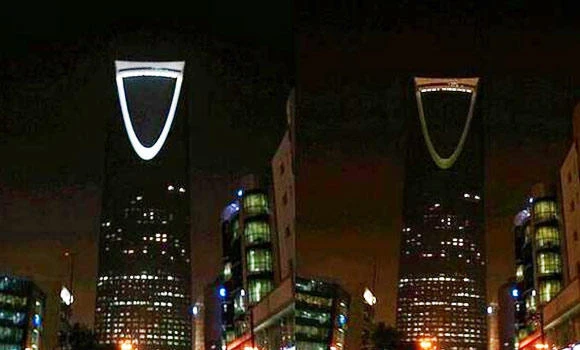
Five major Saudi cities joined the global environmental event, “Earth Hour,” by switching off lights in their buildings for a whole hour on Saturday.
The event was conducted by the World Wildlife Fund (WWF) globally at 8:30 p.m. local time.
In the capital Riyadh, the landmark Kingdom and Faisaliah Towers and King Fahd and Olaya roads switched off their lights, in addition to seven other main roads.
The Saudi team, led by professor Ajlan Al-Ajlan, said the event sees millions of people across the globe switch off the lights at the same time every year to raise awareness on the importance of energy conservation.
The Riyadh Governorate, the Saudi Electricity Company (SEC) and the Ministry of Labor and Health Services Council in Riyadh were at the forefront in this awareness campaign, switching off lights in their buildings and surrounding areas under directives issued by Riyadh Gov. Prince Khaled bin Bandar and his deputy, Prince Turki bin Abdullah bin Abdul Aziz.
The Riyadh Municipality also took part in the global event under the leadership of Mayor Abdullah Al-Moqbil.
“Residents expressed their solidarity with the international community to preserve and protect the environment and advocate for the rationing of energy,” said Al-Ajlan. Activities were carried out in association with the event for the first time in Saudi Arabia at King Abdullah Park in Malaz.
“This will mark the beginning of an era of energy conservation, which is expected to spread in other major cities in coming years,” he said.
There was also a photo gallery highlighting the event with the participation of an SEC-sponsored pavilion, which was conducted against a backdrop of dancing fountains.
As many as 10,000 lanterns were switched off in the Eastern Province.
The Hail region also confirmed their participation, in addition to the Royal Commission for Jubail and Yanbu (RCJY), and Najran Cement Company and the General Directorate of Water in Jazan.
The main aim of the global event is to urge residents to use energy sparingly in order to avert further global warming.
A step toward conservation