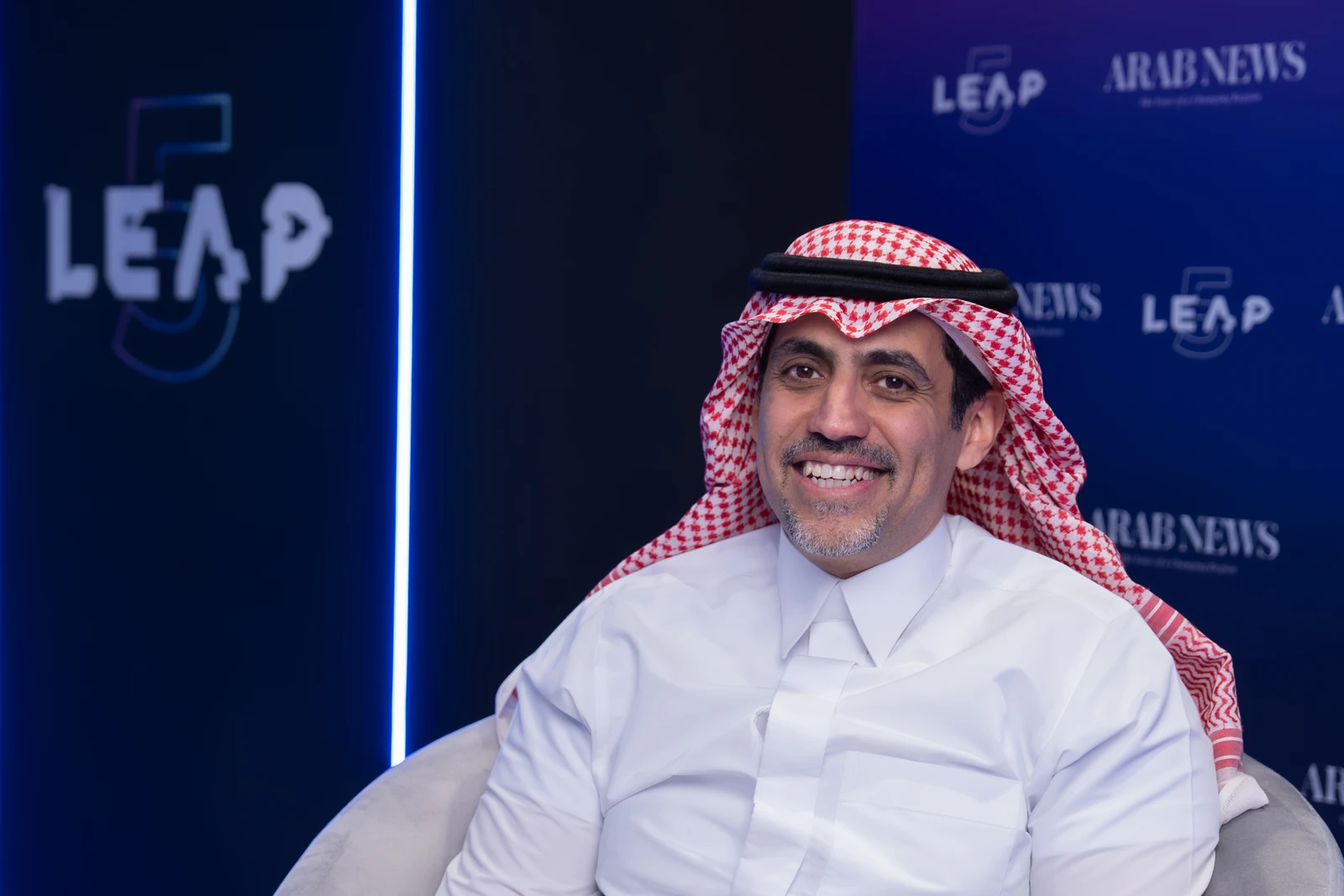

- Education is vital, Ayman Al-Rashed tells Arab News at LEAP
- 88% of CEOs say adoption continuing to be ‘biggest barrier’
RIYADH: If LEAP 2026, the Middle East’s largest platform for technology, has taught us anything, it is that artificial intelligence is on its way to new horizons, from dancing robots to self-driving vehicles, and it seems that the use of the tool has advanced far beyond our daily tasks.
But here is the catch, in the workplace, adoption is proving to be the biggest challenge today, whether it is in data infrastructure, control of assets, governance, or other areas.
Ayman Al-Rashed, regional vice president of IBM, told Arab News recently: “More than 80 percent of Saudi CEOs actually started to introduce AI into the workflows that they have. And 88 percent of the CEOs say that adoption still continues to be the main challenge.”
“And when we think about more than 80 percent introduced AI, we only have 24 percent of the people using it. So, AI is there, but adoption is still not there. The opportunity is the actual challenge: how do you increase adoption?”
The first step in adoption is providing education on the usage of the technology at hand, he explained. Two employees may ask AI to perform the same task in different words that would yield different results.
“Overcoming that is making AI understandable: how it works, how we govern what it does, the guardrails, the data that it has, the access that it has in there, the skillsets for the people. Giving people that understanding and usage of AI is probably the biggest barrier.”
Responsible AI is becoming increasingly important as businesses deploy more powerful AI systems. Security and governance are built into their strategy as they think about responsibility in building their AI tools, the executive explained.
“We’ve also been working diligently in Saudi Arabia with government agencies, and SDAIA (Saudi Data & AI Authority), they’ve adopted the seven principles of responsible usage, and we’ve worked on those seven different principles.
“Those principles consist of integrity and fairness, privacy and security, reliability and safety, transparency and interpretability, accountability and responsibility, social and environmental benefits, and humanity.
“It’s not something that we communicate only to the clients, but we give them the actual tools to be able to use it responsibly.”
He added: “Sometimes people think that when you think about using something responsibly, it means introducing governance, and that means that you suppress innovation.”
“It’s not the case. You can still have good governance, good understanding, and good sovereignty, while you still have fully unleashed innovation.”
As we consider the evolution of this technology, from generative text tools to fully functional systems, we start to see a rise in the use of a certain buzzword: AI “agents.” These are tools that take a certain task within a workflow and execute it while still using intelligence.
Al-Rashed said: “This is basically the evolution that we see in this LEAP, and this is something that we, as IBM, have been working hard on, which is how do we go from assistants to actual agents where the work is being executed?”
“How can an agent work properly and unleash the real value that we expect out of it?”
During the event, IBM announced that through their work with King Abdullah Financial District, they have developed a tailored system under their software portfolio IBM Maximo.
This is a unified asset and facilities management solution that brings maintenance, inspections, and reliability together in one place for critical equipment and infrastructure, using AI to help improve asset uptime, performance, and value.
“They’ve registered that in the Saudi Authority for Intellectual Property under KAFD’s name, not under our name, and they’ve been using it.”
He added: “This was a big deal for us because we wanted our clients to understand that they don’t necessarily need to go use our software and platform as is. They can take that, tailor things on top of it, and go register it themselves.”
As Saudi Arabia invests heavily in becoming a global AI and technology hub, companies are making moves to take the Kingdom from being a major adopter of AI to becoming a global developer and exporter of AI solutions.
What this company in particular has done is establish an IBM Software Lab.
“IBM has not opened one in many, many years, and in the entire region — we’re speaking about the Middle East and Africa — is the only one,” Al-Rashed said.
“Some of our flagship software, it’s not just used in Saudi but all over the world, is actually being developed here. And a big part of that is AI,” he said, mentioning that it is being developed by Saudi nationals.
A big motivator for the software lab is not only to develop systems that IBM and clients can use, but also to bolster local talent, then used across the globe.