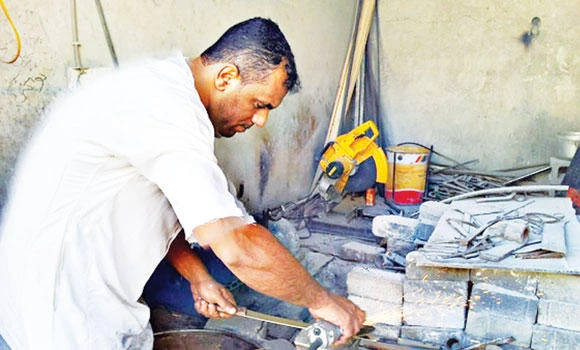
Being a Saudi, Hussain Al-Mubarak is a rarity in blacksmithing, a field dominated by expatriates in Al-Ahsa.
One particular street in this Eastern Province city has more than 40 workshops. One of these workshops is owned by Al-Mubarak. He has been in this trade for the last 28 years. He said blacksmithing has been a hobby and heritage for him since his childhood and he received a number of offers to work for many companies, but he refused because of his love for the place and fear that they would not appreciate the quality of his work.
Al-Mubarak has participated in a number of heritage festivals, including the biggest at Janadriya.
According to him, he is the only Saudi on the famous street and has to compete with expatriates. He opens his workshop at 6 a.m. and closes at 6 p.m. after making a number of axes, sickles, swords, hammers and other accessories in demand.
He is armed with a number of modern tools, such as a mechanized blower and high-tech equipment to carry iron and coal. Al-Mubarak has urged young Saudis to learn the trade, “as it is a delightful profession for those who can acquire the skill.”
Mubarak said: “In the past, the street was very narrow, with barely some room for a donkey to carry iron. Then the street was expanded. At first, I used to be a blower and then a beater of the hammer, and gradually started making simple tools until I mastered the art,” said Al-Mubarak.
The street comes alive during Eid Al-Adha with people ordering new knives and swords for slaughtering animals. The demand for scythes rises during the months of Moharram and Safar because it is the season to cut palm-fronds.
When dates become ripe and are ready for harvesting, sickles are in great demand. Orders are low in the summer, he said. “A sickle needs one hour to make,” he said. “First, the iron is heated and hammered, and then a wooden handle is fixed to it. The last stage of sharpening the blade requires 15 minutes,” he explained.
Al-Ahsa iron man molds notion Saudis don’t take up tough jobs