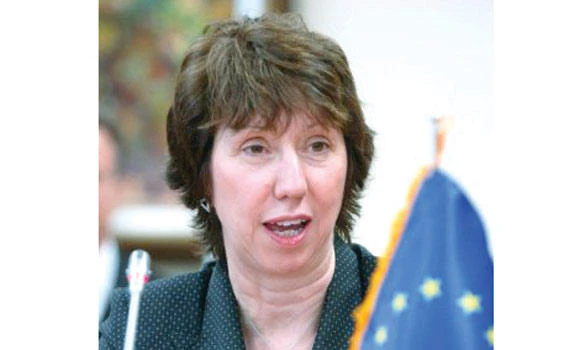
Catherine Ashton, EU foreign policy chief, will hold talks with top officials from Saudi Arabia and the Gulf Cooperation Council (GCC) on a wide range of key regional issues, including Syria and Iran, later this week.
“Ashton, who begins a five-nation Gulf tour today, is likely to arrive in the Kingdom on Tuesday,” said Maja Kocijancic, a spokeswoman for the EU High Representative for Foreign Affairs and Security Policy, via telephone from Brussels yesterday.
Ashton’s crucial dialogue with Gulf leaders would cover themes like bilateral cooperation with individual GCC states, the Syrian crisis and the Iranian nuclear agreement, besides several other major regional issues and strategies, said Kocijancic.
In fact, the EU shares “the goal of genuine transition in Syria through the Geneva II process,” said Ashton in an interview with the Kuwait News Agency (KUNA) prior to her arrival in the Gulf region.
The EU foreign policy chief said that she would also discuss the political situation in Egypt during upcoming meetings with leading GCC officials.
On Syria, she said, “the EU looks forward to the second UN Humanitarian Conference on Jan. 15 and EU plans to respond generously.”
She hopes her visit could help lay the foundations for a close, frank and open political dialogue between the EU and Gulf states.
Adam Kulach, head of the Riyadh-based EU delegation, said: “Ashton’s talks will focus on key regional issues, in addition to prospects of bilateral cooperation.”
Kocijancic said that Ashton would visit the Kingdom, the UAE, Kuwait, Oman and Qatar during this trip, scheduled from Jan. 12 to Jan. 16. The EU established bilateral relations with GCC countries through a cooperation agreement signed in 1988.
The agreement seeks to strengthen stability in the Gulf and the Middle East region. It also seeks to facilitate political and economic relations, broaden cooperation on energy, industry, trade, science, technology and the environment. An EU-GCC ministerial meeting took place in Manama on June 30 last year. The next ministerial meeting is due to take place in 2014 in Europe.
Senior EU and GCC officials now feel that it is time for relations between the EU and the GCC to make a qualitative leap forward. In addition, the 28-member EU has forged closer ties with the EU on the commercial front. The EU, in fact, remains a significant trading partner for the GCC. Major EU exports include machinery, railway equipment, aircraft, medical equipment, power plants and services such as engineering and education.
GCC exports mainly constitute shiploads of oil and natural-gas, aluminum, petrochemicals, and a few non-oil commodities, including dates.
Ashton to discuss key regional issues with high-ranking Saudi officials