School supply sales typically soar at this time of year.
There are 4,918,577 students enrolled in 26,934 schools in the Kingdom. These include 301,213 students in 501 foreign education syllabus schools, according to last year’s Saudi academic statistics.
A business executive from a leading business that sells school supplies told Arab News that the volume of sales for school supplies is estimated at over SR2 billion. The official, who chose to remain anonymous, said the cost of school bags occupies a major share in this figure and there are only two leading firms who have since monopolized the school supplies sector across the Kingdom.
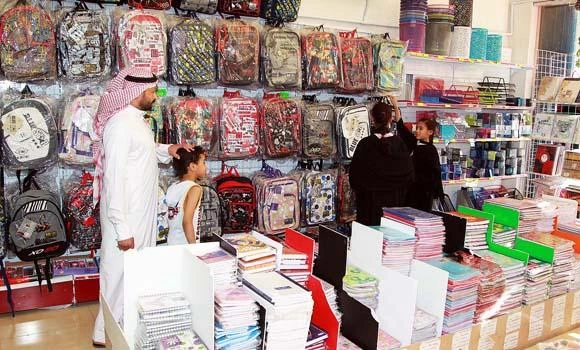
Stationary shops, supermarkets and garment shops selling school supplies and tailors that stitch uniforms have begun seeing the increased footfall of parents and their helpers shopping for supplies such as school bags, shoes, uniforms, lunch boxes and stationary items apart from text and notebooks.
All leading hyper and supermarkets and bookstores have launched promotional campaigns. Parents can be spotted at major super markets carrying school bags along with their children.
School bags that are manufactured in China are selling well among expatriates and Saudis. Most of these contain logos of popular characters such as Ben10, Fulla and Spiderman. Many parents have expressed their concern about the poor quality of the bags, which may not last long.
The size and weight of a bag also matters. Some school bus drivers often object to large and heavy bags that make getting on and off the bus a hassle, said Jitender, who works as school bus driver for the Indian International School in Jeddah.
For South Asian expatriates, schools are merely reopening as their academic year began in the March. “I decided to purchase a set of uniforms and a school bag at the end of the summer vacation,” said Pakistani mother-of-three Parveen Saleem, who hails from Karachi.
A salesman at Al-Dieny Book stores, the largest seller of Indian syllabus books in Jeddah, said that sales are limited to supplementary items, as their prime season is over.
For Saudis, other Arabs and a section of the expatriate community that follows the British curriculum, September brings a new academic year and parents have to embark on a huge shopping spree. Egyptian expatriate Hussain Ali said, “I have to buy everything, from pencils to shoes.”
Textbooks are being distributed free of cost to students belonging to the Saudi Ministry of Education’s schools.
Garment shops sell a wide range of school uniforms and tailoring shops also receive a significant number of orders for girl uniforms, as most Saudi and Arab expatriate parents prefer to purchase handmade uniforms rather than readymade uniforms.
Other than Ramadan, the school re-opening season is the only occasion when these sections witness an increase in sales. “We have been busy since the end of Eid Al-Fitr. After five days, our season is over,” said Zakir Hussain, a Bangladeshi tailor for ladies’ garments at the Zahra Ladies tailoring shop in Jeddah.
He added that most tailors and parents show confusion over the correct uniform for their daughters.
The Ministry of Education has postponed the introduction of a new uniform for girl students across the Kingdom for another two academic years.
Garment shops have already stocked adequate varieties to cater to the needs of South Asian expatriate children attending various schools, said Shazan, who works in Shehnaz garments, a leading garment shop that sells Pakistani cotton uniforms in Jeddah.
Back-to-school sales soar ahead of new academic year