RIYADH: Turkey is one of the world’s leading tourist destinations not only for its breathtaking scenery but also for its fabled historic past and varied cultural attractions that have held visitors spellbound due to their sheer immensity.
This explains the big tourist arrivals in the country this year. The first three months alone saw an increase of five percent from the record performance of 37 million last year.
During the January to March period, the top three tourists-sourced arrivals by nationality were Germany with 548,083 (representing a 12.1 percent share of the total), followed by Iran with 435,516 (9.1 percent share) and Georgia with 336,883 (7.44 percent).
To sustain the headway that the industry has made this year, the government has launched a new program called “Tourism Strategy of Turkey — 2023”, which aims to develop a greater number of tourist destinations in the country.
These will be in addition to the many attractions which Turkey has been known for and the reasons why tourists from various countries have repeatedly visited the country.
“Being there, time seems to stand still as you commune, as it were, with age-old attractions that have drawn many tourists from far and wide,” posted a tourist on the Internet.
Awaiting foreign visitors are the famed attractions which have continued to evoke awe and wonder in the hearts and minds of foreign tourists. One of these is Hagia Sophia in Istanbul.
“It is one of the attractions I admired during a visit to the country a few years back. Being there inevitably makes you travel in time to the distant past and imagine what it could be like back then,” said an European tourist.
Hagia Sophia was originally a basilica constructed for the Eastern Roman Emperor Justinian I in the sixth century. A masterwork of Roman engineering, the massive dome (31 meters or 102 feet in diameter) covers what was for over 1,000 years the largest enclosed space in the world.
It was converted into a museum in 1935 and is now one of the country’s top attractions.
Another is Goreme Fairy Chimneys in Cappadocia. It is famous for its weird and wonderful natural rock formations and unique historical heritage.
One of the best places to see are these strange formations in Göreme town in Capadocia. It is located among a large number of tuff cones, called fairy chimneys. The fairy chimneys have been formed as the result of wind and water erosion of two different volcanic layers:
Due to the ease of carving into the tuff, many of the fairy chimneys have been hollowed out over the centuries to create houses, churches and storage facilities.
Another attraction is the Library of Celsus in the city of Ephesus. It is a popular tourist attraction on the west coast. Some of the structures can still be seen, however, including the Great Theater and the Library of Celsus.
The library was built around 125 AD to store 12,000 scrolls and to serve as a monumental tomb for Celsus, the governor of Asia. The façade was carefully reconstructed in the 1970s to its present splendid state from the original pieces.
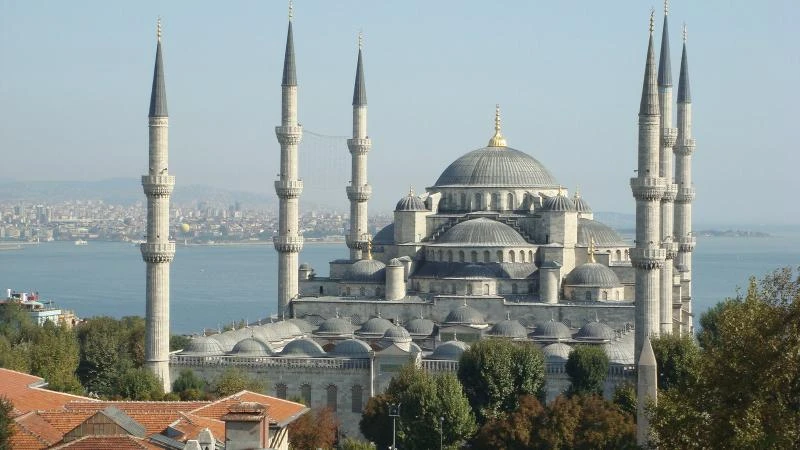
The Blue Mosque has also been a crowd drawer. With its six minarets and sweeping architecture, the Sultan Ahmed or Blue Mosque in Istanbul impresses from the outside.
“While still used as a mosque, the Blue Mosque has also become one of the most popular tourist attractions in Istanbul. It was built between 1609 and 1616 and like many other mosques contains the tomb of the founder,” a Turkish diplomat said.
Inside the mosque, he said, the high ceiling is lined with the 20,000 blue tiles with different patterns that give the mosque its popular name.
Oludeniz is another attraction toward which many foreign tourists have gravitated. Ölüdeniz is a small village located on the southwest coast on the Aegean Sea. It has a secluded sandy bay at the mouth of Ölüdeniz, on a blue lagoon. This beach is famous for its shades of turquoise and remains one of the most photographed beaches on the Mediterranean.
“Ölüdeniz is also regarded as one of the best places in the world to paraglide due to its unique panoramic views. Being there is indeed a memorable experience. While still there, you’re already planning to go back,” an Asian foreigner said.
Mount Nemrut is another attraction that should not be missed. It is a 2,134 meter-high mountain in southeastern Turkey, near the city of Adiyaman. In 62 BC, King Antiochus I Theos of Commagene built a tomb-sanctuary flanked by huge statues of himself, two lions, two eagles and various Greek, and Persian gods on the mountain top. The main attraction is watching the sunrise from the eastern terrace which gives the body-less heads a beautiful orange hue and adds to the sense of mystery of the place.
Bodrum Castle is another attraction that walks you through the corridors of time. Located in the city of Bodrum in southwest Turkey, Bodrum Castle was built by the crusaders in the 15th century. It is one of the world’s best preserved monuments dating back to medieval times. The castle now operates as a museum, with the focus on the Museum of Underwater Archaeology. It overlooks the internal marina of Bodrum filled with sailing crafts.
Pamukkale is another experience that brings you, as it were, to another dimension. Pamukkale, meaning “cotton castle” in Turkish, is an unreal landscape in western Turkey and famous for its white terraces.
The terraces are made of travertine, a sedimentary rock deposited by water with a very high mineral content from the hot springs. People have bathed in its pools for thousands of years. The ancient Greek city of Hierapolis was built on top of the hot springs by the kings of Pergamon. The ruins of the baths, temples and other Greek monuments can be seen at the site.
Patara Beach, at 14 kilometers, is one of the longest stretches of sandy beach found anywhere in the Mediterranean. The beach is backed only by ancient Lycian and Roman ruins and swooping dunes with no buildings visible except for a small café. Patara Beach is also the breeding ground of the endangered Loggerhead turtle. The nearby village of Patara was the birthplace of St Nicholas, the 4th-century Byzantine bishop who later passed into legend as Santa Claus.
Finally, don’t miss the Aspendos Theater. It is one of the best preserved ancient theaters. It was built in 155 AD during the rule of the Roman Emperor Marcus Aurelius and could seat between 15,000 and 20,000 spectators. Because the stage area was later used as a roadside inn in Seljuk times, it was continuously repaired and maintained. Thus, the Aspendos Theater has been able to survive without losing almost any of its original qualities.
Breathtaking scenery fascinates travelers