Public parks with neatly manicured grass, lush green foliage with chirping birds and amenities for kids are important. Over the years, they used to be a haven for families.
However, many of these public parks look deserted or in extreme disrepair. City residents claim that there’s hardly any grass in them to sit on. The trees have been cut and the birds twittering from their boughs are likewise gone. That’s why, they said, many don’t go to these parks anymore.
Their complaint is not without justification if one were to remember what the American conservationist and national park crusader John Muir said, “Everybody needs beauty as well as bread, places to play in and pray in, where nature may heal and give strength to body and soul alike.”
The condition of neighborhood public parks throughout Saudi Arabia is poor. Public parks that often just occupy no more than a few thousand square meters are often deserted and maintained poorly. Grass has long died away. Children’s play equipment are broken and unsafe. Many parks have debris and trash strewn about.
Interviews with municipality officials and neighborhood residents point to changing times as an emphasis has been placed on amusement parks and huge centerpiece parks that can accommodate hundreds of people at a time.
Further, fast-food restaurants have convenient and comfortable indoor playgrounds for children, taking away the specialness of a neighborhood park.
A resident in Riyadh said, “These public parks seem to have outlived their usefulness. The well-trimmed green is gone and the amenities have not been increased. In a park there could be only one seesaw for two kids to play on. How about the other kids who also want to use it?”
A random survey showed that one public park in Malaz district had been destroyed. Diggings had been made and mounds of earth could be seen inside. Some of the trees had been cut; others had been uprooted.
The concrete slab on the ground had been broken into pieces and piled in different areas inside the park. Nowhere in sight were workers to give it a face-lift. The few amenities for children were also gone.
A Jeddah expat said, “There is a public park in our neighborhood along Madinah Road. One can not take his family there as workers are digging inside it for an underground sewer.”
In Madinah, Abu Ali, a Saudi company executive, said that as a boy he used to play in a park in neighborhood. But this park is deserted now.
In Makkah, residents had earlier deplored the neglect of the parks. As a result, they had been looking outside the city for recreational facilities. For this reason, the public parks look deserted.
“I am surprised they are not taking care of the parks,” resident Ibrahim Mahdi told a local daily. “We are not taking advantage of the public parks. There are no wardens to open the parks and nobody is taking care of them,” he said.
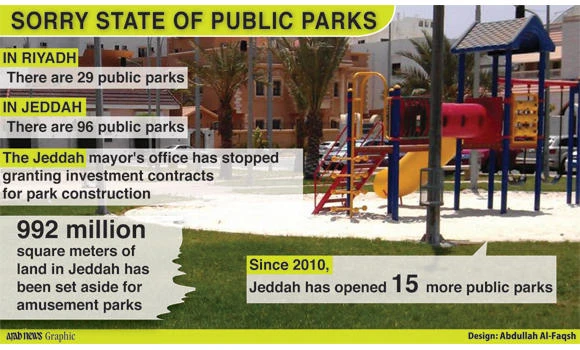
Abu Abdulaziz, who works for a printing firm, said that there were 29 recreational facilities, more or less, in various parts of Riyadh. However, he said, new parks had been developed and residents gravitate toward these.
“The Wadi Hanifa was inaugurated in April 2010 by then Riyadh Governor and now Crown Prince and Defense Minister Prince Salman,” he said.
He said this park is beautiful with scenic surroundings and where families could sit by the lake inside it to pleasantly pass away the evening hours.
In Alkhobar, families enjoy the parks near the Corniche. “There are many parks where families could visit on weekends for relaxation. These are clean and well-maintained. Visitors make sure that they don’t litter the grounds,” said Flor Catanus, finance officer at a law firm.
Edward Rodriguez, a spare parts manager at a local establishment, added, “If there are public parks that look neglected, it’s because these are remote. There are new parks near the city with modern facilities .”
One example, he said, is the Cobra Amusement Park.
There are still those who visit the public parks. But they complain that these had been neglected. Early this year, Jeddah residents criticized investments monopolizing more than 90 percent of public parks but provide poor services.
The Jeddah mayor’s office issued a statement that it had stopped granting investment contracts for these parks, while only continuing with the existing investments that comply with the terms and conditions of the contracts and withdrawing the violators.
Abdulaziz Al-Nahari, the mayor’s spokesman, said that the public parks secretariat had allocated a special budget for operating and maintaining 96 public parks in Jeddah alone.
“The yearly budget of the mayor’s office allocates a proportion to establish parks but nonetheless we are keen to hold strategic partnerships with the public sector with defined specifications,” he said.
He also said that Prince Majed Park would be further developed since it lacks amenities.
A former official at the secretariat said that the idea of investing in public parks had always been rejected.
“Investors build a wall surrounding the area they invest in, with a cafe and restaurant, which results in the total failure of the concept of investing in public parks in the country,” he said.
Indeed, public parks are necessary. Then Deputy Premier and Commander of the National Guard Crown Prince and now Custodian of the Two Holy Mosques King Abdullah donated 2.992 million square meters of land located along the Gulf of Salman in Jeddah for amusement parks.
Even private individuals contributed to create public parks. Hadia Latif Jameel agreed to establish, develop and maintain a public park on Prince Muhammad bin Abdul Aziz Street in Al-Andalus district for the next 20 years.
An unknown phi
lanthropist also donated a public park and sports club in Al-Qurayat district in the southern part of Jeddah, where since 2010, 15 more parks have been opened to the public.
In this connection, we’re reminded of what the late US President John F. Kennedy said, “It is our task in our time and in our generation, to hand down undiminished to those who come after us as was handed down to us by those who went before, the natural wealth and beauty which is ours.”