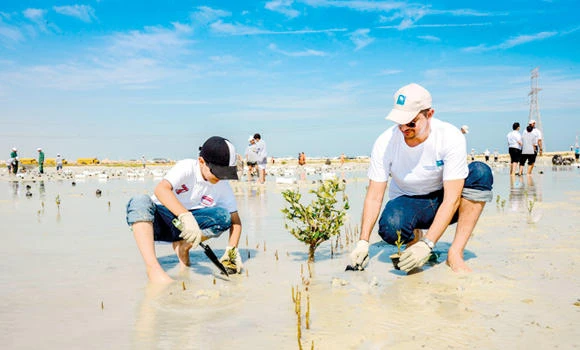
Saudi Aramco in Ras Tanura recently launched a campaign under the slogan “we plant the future with our own hands.”
Tamim Al-Matouq, head of the company’s corporate social responsibility (CSR) division, said that the goal of the event was to plant 10,000 mangrove shrubs at Ras Tanura and Tarut Bay.
Al-Matouq said: “The campaign is designed as a way to promote awareness of the importance of mangrove trees and the preservation of the marine environment.”
He said: “It also helps increase interaction and communication between volunteers and company employees, as well as boosting physical participation through schools and charitable societies.
“Participants in the campaign included 750 students from various age groups and school grades from Dammam, Ras Tanura, Safwa and Um Al-Sahek, in addition to 50 volunteers from the Rahima Volunteer Club (RVC) and several company employees.”
Essam Z. Tawfiq, general manager of public affairs, said this environmental campaign “is an extension of previous annual campaigns." "It is one of the cornerstones of Saudi Aramco’s citizenship value and part of the company’s comprehensive plan to create an environmental safe haven for mangroves on the Eastern Province’s coasts as a means of environmental protection,” he added.
The campaign also strives to develop and enhance the spirit of citizenship through the physical participation of young and old alike in the environmental preservation of this precious part of the Kingdom’s coasts while advancing Saudi Aramco’s continuous efforts to promote the concept of volunteer work among the members of society, he said.
Abu Khadra said that the company helps educate its employees and their families who live near the coasts, as well as other beach patrons, on how to deal with environmentally sensitive areas and the importance of preserving such areas.
Hesham Al-Musaiid, manager of Saudi Aramco’s environmental protection department, said Tarut Bay and its beaches are considered environmentally sensitive areas for wildlife as the bay is one of the most important areas for hatching and nursing young fish on the Kingdom’s eastern coast.
“Mangroves are intertidal zone plants that form a safe haven for wildlife. They are a nesting place for marine and migrant birds and a rich environment for the reproduction of shrimp and fine marine organisms, which, in turn, represent a source of food for other fish. They are an important part of the natural cycle,” he said.
Children chip in to preserve mangrove