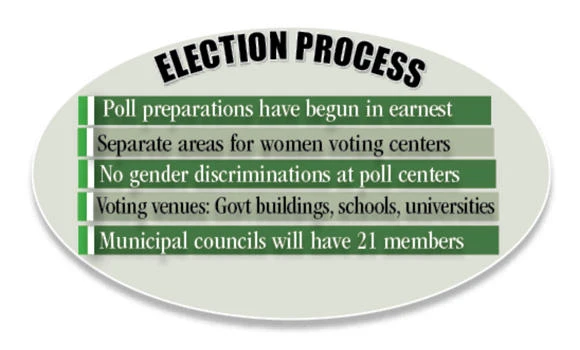
Municipalities around the country have started preparing separate areas for women to participate as voters and candidates in the upcoming municipal council elections.
Various government bodies designed the areas based on Islamic principles, according to a report in a local publication recently. These include separate entrances, balloting centers, rest areas and offices with support staff.
The men have similar areas because the government does not discriminate between men and women, according to a source quoted by the publication. They would have to perform the same functions once they are on the councils, the source said. Voting would take place in government facilities including municipal buildings, schools and universities, the source said.
Those not eligible to participate include employees of the Ministry of Municipal and Rural Affairs, notaries, mayors, sheikhs, members of the Bureau of Investigation and Public Prosecution, provincial trustees, Shoura Council members, development commission members, and municipal investors or contractors, he said.
Mayor of Al-Qatif Ziyad Maghrbil said preparations for women voting centers have started in his region. Plans are also underway to set up the area where the municipal council would operate, with separate entry points and offices.
Several women in the governorate said that women can contribute to society across all disciplines including education, culture, social affairs and health, according to the report.
A municipal source in Baha said there would be 21 members on the municipal councils after the next elections in November because it would include women, and have wider powers.
Members of the public Talal Majmmi, Al-Baraa Okor, Saud Al-Masood and Suleiman Talibi said municipal councils previously did not carry out the tasks assigned to them, perhaps because of administrative difficulties. Councils should tackle problems with the country’s roads and illegal workers, they said.
Yahya Twaity, Abdulmajid Shrouq, Ibrahim Al-Maskati, Anqri Mohya and Naif Mshouli said these councils have not addressed the problems of citizens. This includes poor services, and expatriate hawkers on the streets who obstruct traffic, and disturb shoppers at local markets and worshippers at mosques.
Civic polls: Separate areas for women being set up