Bilateral cooperation between Bangladesh and Saudi Arabia is rooted deep in history, culture and religious bonds.
For the past 38 years, both Bangladesh and Saudi Arabia have undertaken a journey of shared values that has led us to where we are, a journey of cooperation and mutual trust that has enhanced our bilateral ties, and a journey of friendship that has imprint in our hearts for now and the years to come.
Bangladesh believes in religious harmony and tolerance and plays a vital role in maintaining peace in the trouble-prone parts of the world being the number one contributor to the UN peacekeeping force.
Bangladesh, a vibrant democracy, is making sustained efforts to spread the message of tolerance, peace and moderation of Islam and in this regard strengthening cooperation with Saudi Arabia is crucial.
Saudi Arabia, being the birthplace of Islam and home to Islam’s two holiest mosques in Makkah and Madinah, is the most brotherly and revered country for the 150 million people of Bangladesh, of whom nearly 90 percent are Muslims.
Saudi Arabia has a special place in the hearts of the people of Bangladesh and they always remember the contributions made by Custodian of the Two Holy Mosques King Abdullah and his government during “our times of need”. Around 1.2 million Bangladeshis working here felt proud to be a part of the development activities of the great country.
Bilateral relations between the two friendly countries have endured the test of time.
Bangladesh’s relations with Saudi Arabia are multifaceted.
Interactions between the peoples of the two countries date back to more than thousand years.
Arab traders used to visit Chittagong port since the early days of Islam.
Now is the time not only to reinvigorate these ties but also to explore possibilities of further expanding them to newer areas like investment, tourism and cultural exchanges.
Over the last 38 years, Bangladesh-Saudi friendship has not only endured the vicissitude of time, but also been consolidated and prospered.
We have been maintaining good momentum of high-level exchanges and contacts, deepening our mutual trust.
The last three years have seen a significant increase in the high level visits by ministers, parliamentarians and senior officials from Bangladesh.
The end of 2013 (November 21-24) witnessed a visit of Prime Minister Sheikh Hasina to Saudi Arabia as the Royal Guest of King Abdullah to perform Umrah and Jiarrah.
She led a 60-member delegation, which included her sister Rehana Siddique and former Foreign Minister Dipu Moni and top officials from different ministries.
In 2013, there were as many as seven ministerial visits from Bangladesh to Saudi Arabia.
Ministerial level visits in 2013 include the Bangladesh Foreign Minister’s visits to Saudi Arabia in April, May, June and August, the Expatriates’ Welfare and Overseas Employment Minister’s visits to Saudi Arabia in July and the Cultural Affairs Minister’s visit in March.
During the foreign minister’s visit to the Kingdom on May 4-5, she held a fruitful and effective bilateral meeting with her counterpart Prince Saud Al-Faisal.
In addition to bilateral meetings with her Saudi counterpart, she called on Crown Prince Salman, deputy premier and minister of defense, and Labor Minister Adel Fakeih.
The foreign minister also handed over a letter from the prime minister addressed to the King.
The visit of the foreign minister was the most significant and successful in enhancing our existing bilateral relations.
Immediately after her visits, the Saudi government declared a general amnesty to expatriate Bangladesh nationals on May 10 2013 and Bangladesh nationals were allowed to transfer iqamas and change their professions.
Dipu Moni, MP, also paid another official visit to Saudi Arabia on June 18-22, 2013.
During her visit, she held talks with Nizar Obaid Madani, state minister for foreign affairs, and handed over two letters of thanks from the president and the prime minister of Bangladesh addressed to the King.
She appealed to the Saudi leaders to allow Bangladeshi workers here to correct their employment status and change their iqamas.
During the meeting, matters of mutual interest were discussed and the foreign minister also requested him to extend the amnesty period to the expatriate Bangladesh nationals.
The Foreign Minister also met the Second Deputy Prime Minister Prince Muqrin and requested to extend the amnesty period.
Moreover, the visit of Expatriates’ Welfare and Overseas Employment Minister Khandker Mosharraf Hossain, MP, to Saudi Arabia on July 6-12 added impetus to our bilateral relations in the field of manpower exports.
Continued on Page 14
The two sides reviewed the entire gamut of bilateral relations with special focus on cooperation in the field of human resources.
The issue of iqama transfer for all Bangladesh workers in the Kingdom figured prominently in the discussions.
Both sides identified and acknowledged areas of mutual concern and were convinced that joint efforts would help overcome the existing challenges and broaden the horizon of cooperation.
The visits of the Foreign Minister and the Expatriates’ Welfare and Overseas Employment Minister were also very significant and successful in enhancing our existing bilateral relations.
In response to their requests, the Saudi government extended the general amnesty for another four months (up to November 3) to expatriate Bangladesh nationals.
Under the provision of the general amnesty, Bangladesh nationals were given opportunity to legalize their status by transferring their iqamas and changing profession during the period from May 11 to November 3.
As a result, 7,99,186 Bangladesh nationals have benefited out of which, 4,36,473 changed their sponsors, 3,30,975 changed their professions and 31,738 returned to Bangladesh on final exit during general amnesty.
Bangladesh Cultural Affairs Minister Abul Kalam Azad made an official visit to the Kingdom on March 11-14 to attend the opening ceremony of the yearlong celebrations to mark Madinah as the capital of Islamic culture.
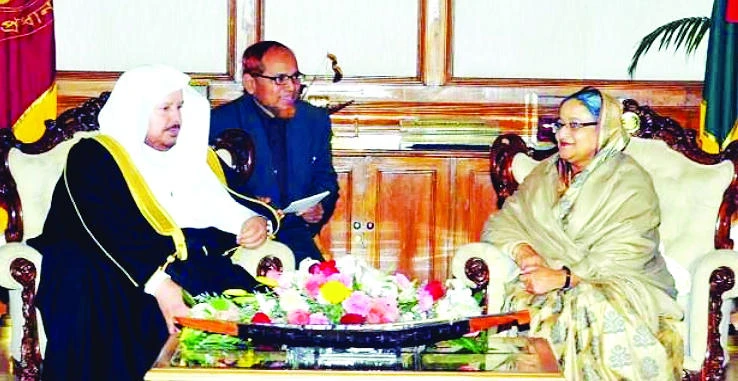
The high-level visit from the Saudi side in 2013 started with the visit of the Speaker of the Shoura Council Abdullah bin Mohammed bin Ibrahim Al-Sheik, who led a 13-member delegation Bangladesh January on 6-9.
A high-level Saudi delegation comprising representatives from the Ministry of Foreign Affairs, Ministry of Interior and Ministry of Labor of Saudi Arabia visited Bangladesh from March 30 to April 4 in connection with the status of human resources of Bangladesh to be exported to the Kingdom.
The high-level visit between the two countries in 2014 started with the visit of Health and Family Welfare Minister Mohammed Nasim, MP, who led a six-member delegation for his official visit to Saudi Arabia on February 7-9 2014. During the visit, the Health and Family Welfare Minister held a bilateral meeting with Saudi counterpart, Dr. Abdullah Al-Rabeeah.
The visit of the health minister to the Kingdom was very significant and provided opportunity to exchange views with his Saudi counterpart.
The visit of the health Minister set a stage for fresh thrust in our existing bilateral relations, particularly in the field of health sector cooperation.
On February 16 2014, a bilateral meeting at the level of ministers between the two countries was held to sign the Haj management agreement.
After the meeting, Bangladesh Religious Affairs Minister Principal Motiar Rahman, MP and Haj Minister Bandar bin Hajar signed the Haj agreement with the provision of 1,01,758 pilgrims to perform Haj from Bangladesh in the year 2014.
The State Minister for Youth and Sports of the Government of Bangladesh, Shri Biren Sikder, MP led a three-member delegation to attend the second Islamic Conference of Youth and Sports Ministers held in Jeddah on March 17-18, 2014.
All these visits have added new momentum and generated greater enthusiasm to the existing close relations between the two countries.
These exchanges of high-level visits also signify the intention of both the governments to encourage and maintain cooperation across all sectors between Bangladesh and Saudi Arabia.
The 10th session of Saudi-Bangladesh Joint Commission (JC) meeting, which was the first JC meeting in almost five years, has provided further impetus in our bilateral relations.
The 10th session of the Joint Commission (JC) meeting, which was held on February 25-26 2013 in Riyadh, provided a platform for multifarious engagement with Saudi Arabia in securing tangible benefits in terms of economy, trade, investment, education, culture, human resource development, manpower cooperation and other development cooperation.
Bangladesh and Saudi Arabia have signed several Memorandums of Understanding (MoUs)/Agreements to facilitate collaboration in diverse fields over the years.
Bilateral relations particularly in the field of trade and commerce have received a new thrust after the recent signing of the avoidance of double taxation agreement.
Another epoch-making agreement on Reciprocal Promotion and Protection of Investments has been finalized and is expected to be inked shortly and this treaty would herald a new era in facilitating investments in both the countries.
Saudi Arabia is one of Bangladesh’s longstanding development partners.
Since formal recognition of Bangladesh by Saudi Arabia in 1975, bilateral relations between the two countries have grown steadily in depth and dimension.
Beyond the ambit of political relations, cooperation between the two countries in economic fields has developed substantially.
Saudi Arabia has been consistently extending financial and technical assistance to Bangladesh in various fields. Bangladesh has received economic assistance in various sectors including rural infrastructure development, health, rural electrification, communication, irrigation, disaster/post disaster relief and rehabilitation in the form of grants and loans.
Bilateral trade between the two countries increased steadily over the last couple of years and there is a potential for further improvement in bilateral trade as two countries have much to offer to each other.
According to latest statistics, the annual two-way trade rose to $961.34 million in FY 2012-13 as against $922.33 million in the FY 2011-12.
The Kingdom mainly imports readymade garments (knits and woven), frozen food, dry food, fresh vegetables, various spices and curry powder, melamine items while it exports oil, petrochemicals and fertilizers in large quantities.
Saudi large-scale investments in Bangladesh basically started with the establishment of Saudi Bangladesh Industrial and Agricultural Investment Company (SABINCO) in 1984 with its headquarters in Dhaka.
The company was set up with a view to promoting Saudi investments in Bangladesh. It has so far financed 50 projects in 11 sub sectors including textile, cement, fisheries and chemicals.
A number of Saudi entrepreneurs have already shown keen interest to invest in power generation plant in Bangladesh.
There is also scope for Saudi investments in information technology, manufacturer of ceramic products, pharmaceuticals, and the development of tourism projects in Bangladesh.
Saudi Arabia has also been providing invaluable assistance over the years toward our country’s socio-economic development.
Bangladesh has been benefited from the close and productive cooperation with the kingdom in diverse fields.
Saudi Fund for Development (SFD) has been providing economic assistance to Bangladesh since 1975.
Bangladesh has so far received a total of SR1,566.31 million as economic assistance from Saudi Arabia.
The priority sectors of the SFD assisted projects are infrastructure development, roads and railways, irrigation, rural electrification, fertilizer, health etc.
The Shitalakha Bridge project, Maghbazar–Mouchak flyover project and Shikalbaha 225 MW Dual Fuel Project are SFD assisted on-going projects in Bangladesh.
These projects have been seen as a sign of renewed attention of the Kingdom to Bangladesh’s socio-economic development.
Bangladesh always attaches great importance to its ties with the government and the people of Saudi Arabia.
The existing brotherly relations between Bangladesh and Saudi Arabia, which are based on common Islamic values and mutual respect, have been further cemented by the valuable contributions of our expatriates, who have been playing very important and significant role to the economic development of the two brotherly countries.
The Kingdom is still the most valued destination for the Bangladesh workforce.
Around 1.2 million Bangladesh nationals are now employed in the Kingdom, which positively contributes to enhanced people-to-people contacts.
They develop an understanding and appreciation of Saudi values, traditions and customs.
The government of Bangladesh has adopted a proactive, concerted and action oriented comprehensive policy guideline considering the importance of the export of human resources to the national development of Bangladesh.
Taking this into consideration, the Bangladesh government has undertaken multifaceted steps and programs to expand the scope for overseas employment opportunities and to promote transparency and ensure qualitative changes to the recruitment process.
The aims of this policy are also to minimize migration costs of sending Bangladesh workforce to world labor market and create an environment for accessibility of aspirant workers to migration process from all areas of the country.
As a result of the timely and target oriented policy of the government, Bangladesh workforce in the world labor market has now not only earned admiration for the country but contributed significantly to the national development of the country.
More than 8.9 million Bangladesh workforce including skilled and semi-skilled, professionals like doctors, engineers, paramedics, nurses, teachers, bankers, IT workers spread worldwide including Saudi Arabia with their competence.
These excellent relations between Bangladesh and Saudi Arabia may be attributed to the fact that both countries share many common perspectives, values and commitments.
Today there is contact between an impressive range of individuals and institutions in almost every sector of our two societies.
Bangladesh hopes to build on the achievements of the past to set up a future of even closer co-operation and understanding both at the bilateral and multilateral levels between Bangladesh and Saudi Arabia and their peoples to herald a defining moment of raising our relationship to a new pedestal in the coming years.
Dhaka keen to tighten Saudi bonds