The Ministry of Municipal and Rural Affairs has taken steps to enhance the capabilities of its laboratories for chemical and microbiological analyses of food and water so that they provide true and accurate results.
The ministry’s laboratories support municipal laboratories by giving directions, offering technical support, analyses of samples for comparison, in addition to holding conferences and workshops for the development of municipal laboratories.
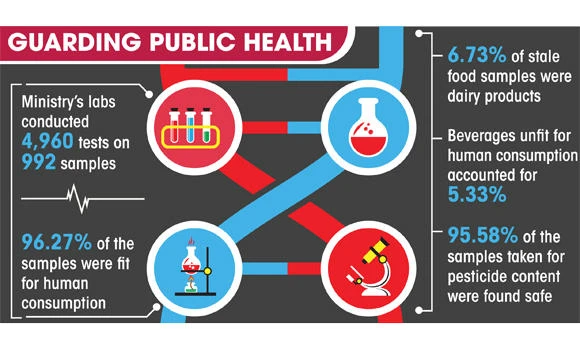
The ministry’s microbiological laboratories conducted 992 sample analyses with 4,960 tests. The results showed that 96.27 percent of the samples were fit for human consumption while 3.73 percent were unfit. A further breakdown showed that 6.73 percent of stale food samples were dairy products while juices and beverages unfit for human consumption accounted for 5.33 percent; rancid sweets and sugars accounted for 3.88 percent. It also showed that 1.72 percent of samples were meat and meat products, and grain and related products accounted for 3.88 percent.
The laboratories also identify the active ingredient in pesticides to determine the extent of compliance with what is written on their labels. This aims to get safe food products free of pesticide residues or within internationally permitted limits of pesticide residue. The Ministry of Municipal and Rural Affairs said the total number of samples that arrived for testing in its laboratories last year reached 226, while tests were conducted on each sample for the detection of 200 pesticides. The analyses showed that 95.58 percent of the samples were safe to consume.
Efficiency of govt labs enhanced