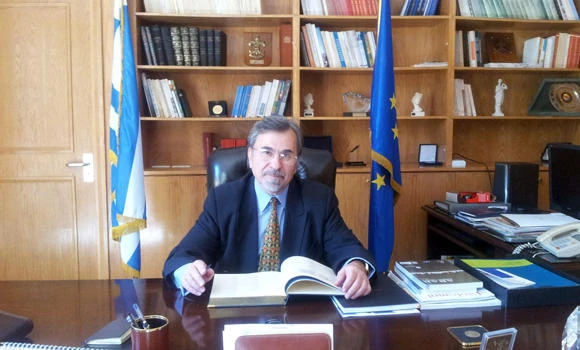
This year, I celebrate the National Day of my country for the first time in Saudi Arabia, a most friendly state with which we have shared similar historic destiny.
Greek and Saudis, the Arab world in general, have common elements in their history through centuries. We had similar fights, a joint combined past.
Both of us are proud of our origins and our contribution to the world history and civilization, sharing knowledge and sciences, culture and education.
We have a lot of similarities in character and behavior, and last but not least, we share the same taste of food.
Each of the two peoples live in a crucial point of world geography, in a strategic peninsula which imposes upon us privileges and obligations.
We want to live peacefully in our land which, however, we know how to defend. Along with our neighbors, We seek a life in harmony and mutually fruitful cooperation in all fields, for a common progress with full respect to our traditions, to our culture heritage, to our faith.
We, the Greeks, belong to a group of nations, the European Union (EU). We have the presidency of the EU council for this semester.
Saudi nationals belong to another important group of states — the Gulf Cooperation Council which has its headquarters reside in Riyadh.
The two institutions have a lot of fields to work together and Greece, as acting Presidency of EU, is ready to cooperate in this direction in a spirit of mutual understanding and benefit.
All the countries live in a turbulent world with a lot of challenges in the political and economic level.
In Saudi Arabia, people enjoy a prosperous economic development that gives us a lot of opportunities for cooperation.
In Greece, we go through an unprecedented economic crisis which demands a lot of sacrifices from our people.
After a protracted period of deep recession, the Greek economy is showing signs of recovery.
The Greek economy, after years of prosperity, during which the twin deficits and debts rose to unsustainable levels, ultimately culminating in a crisis of unprecedented scale and depth, is now stabilizing.
The country has come a long way in terms of adjustment.
We have ultimately succeeded in overturning the twin deficits into twin surpluses — a primary fiscal surplus and an external surplus.
We now face the challenge of turning the incipient signs of stabilization into dynamic growth built on solid foundations. This, today, is the main item on the national agenda, the only way to ensure that the sacrifices of the past years will not have been in vain.
The frontrunners in this effort will be dynamic firms that shift their activities to new products and markets, generating a virtuous circle of growth.
We are focusing our attention on structural reforms and we are speeding up their pace. Because only through such reforms can an environment conducive to sustained and healthy growth, as well as to economic and social progress, be created.
We look to our future with hope and confidence and we ask from our friends and partners trust and solidarity.
I think that we have gained already the psychological battle of our economy. We go on.
— Ioannis Christofilis
Ambassador of Greece
Greece sees more gains from Saudi partnership