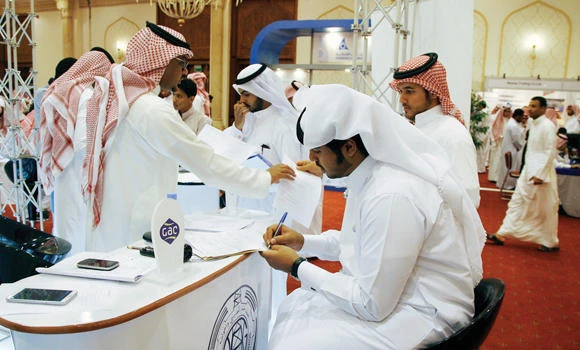
JEDDAH: The new Job Creation and Combat Unemployment Commission will for the time being receive a 20 percent allocation from the Human Resource Development Fund.
This is in addition to the commission’s investments and other aids it receives as well as tax exemptions from the General Customs Department. This will be the case until a budget for the commission can be created through a royal decree.
The law of 16 articles has been introduced by the Council of Ministers, defining its goals and including activating coordination between the public and private sectors, especially those related to the job market, and strengthening the relations between them relating to job creations and combating unemployment.
It’s working on sectors that can generate employment and motivate the labor market to create jobs and competition in different areas of the Kingdom for new employment, and develop capabilities and create a national labor force that can become productive and able to deal with the nature of the labor market that changes and leads to sustainability.
The commission has its own responsibilities and can recommend policies and plans for job creation in government and private sector projects, and it will study the problems of unemployment of the state and recommend what it considers to be appropriate.
The commission will continue to recommend “motivational policies” inside the labor market, increase job opportunities for nationals in the government and private sectors, and follow up on mechanisms, coordination between programs, and those linked to employment, recruitment, rehabilitation and training.
The commission will have a role in developing policies and regulations for employment at the national level and forward these to the Council of Economic Development Affairs. It will also support field studies in the labor market to identify challenges facing national and migrant workers.
The commission will support coordination between educational and training institutions to create the right outputs and what is needed by the private sector; it will apply the right policies related to that sector and evaluate them with regards to unemployment and provide appropriate opportunities while limiting recruitment, in coordination with the concerned parties.
The commission is required to coordinate, follow up and create a wide database, and support the woman’s program related to learning, training and rehabilitation. In addition, the commission will annually work with the Human Resource Development Fund when there is renewal of residency and work permits of foreign workers, to take necessary action. It also will represent the Kingdom in international organizations relating to labor and unemployment.
The system states that 18 members will be appointed to the commission. The president of the Council of Ministers will appoint the chairman who will appoint its governor and vice chairman in addition to 14 members from the government sector at no less than a grade 15 ranking from the ministries of finance, economic and planning, labor, education, health, trade and industry, the Economic Cities Commission, Industrial Cities and Technology Areas Commission, Investment Authority, Insurance Organization, Training and Vocational Organization, HRD Fund, head of the Council of Chambers, and three members from the private sector also chosen by the Council of Ministers which will also set their bonuses.
HRD Fund will allocate budget's 20% to new commission for job creation