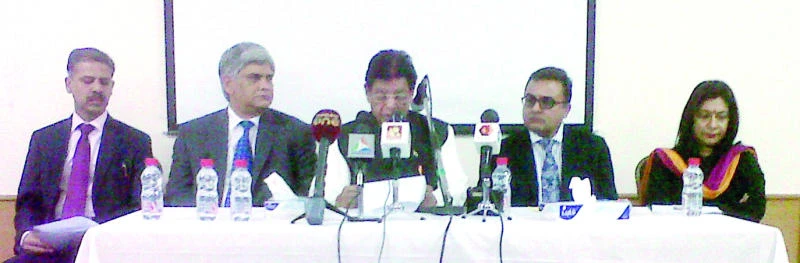
Haj Minister Bandar Hajjar has been requested to restore the quota of Indian pilgrims to 170,000, according to Indian Minister of State for External Affairs E. Ahamed, who met him on Sunday to sign the bilateral Haj agreement for Haj 2014.
Ahamed also met separately Rafat Badr, chairman of South Asian Pilgrim Establishment, and witnessed the signing of a subsidiary Haj agreement between the establishment and the Haj committee of India.
“We have been allotted a quota of 136,020 for Haj 2014, same as last year, which is due to 20 percent cut in quota for all foreign pilgrims, because of the ongoing Haram expansion project,” Ahamed told a press conference at the Indian Consulate on Monday.
He said that of the total 136,020, the Haj committee has been allotted 100,020, whereas the private tour operators (PTOs) have been allotted a quota of 36,000.
He said the request to restore the quota is to accommodate at least half of the Haj applicants.
“Last year, there were more than 300,000 applicants for 121,420 seats for the Haj committee,” he said.
He said that since there will be difficulty in hiring local manpower for Haj operations because of Nitaqat, the Haj minister has been requested to allow hiring of local manpower directly as was done in previous years.
At the meetings in Jeddah, the minister was accompanied by Ambassador Hamid Ali Rao; Qaiser Shamim, chairman, Haj committee of India; Mridul Kumar, joint secretary (Gulf and Haj), Ministry of External Affairs; Consul General Faiz Ahmad Kidwai; A.K. Kaushik, director (Haj); Ataur Rahman, chief executive, Haj committee of India; Puja Jindal, director, Ministry of Civil Aviation; Mohammed Noor Rahman Sheikh, deputy consul general; and A.D. Souza of Air India.
“We offered assistance in the planned introduction of the electronic path system from the forthcoming Haj, to which the minister agreed and we also made several suggestions to make the system effective, and providing metro train facilities at the holy sites for all pilgrims,” Ahamed said.
Kidwai, the consul general, said that the electronic part is a huge exercise which when completed will be a major advancement. “We are studying it and will confirm on April 1 whether we will implement it for Haj 2014.”
Ahamed said that the other issues discussed included making spaces around metro stations in Muzdalifah free to make the Haj arrangements much better.
He said that the Saudi side also brought up some issues to improve Haj arrangements such as finalizing the flight schedules early, avoiding movement of bulk Hajis from Makkah to Madinah on Dhul Qada 25, and stay of 50 percent of Hajis in Mina till Dhul Hijjah 13.
The consul general said because of the ongoing demolitions the availability of accommodation close to Haram is very limited. He explained that most of the new accommodation that is coming up are hotels near Haram.
“Being expensive, these are not regular pilgrim accommodation,” he said. “Moreover, hotel type of accommodation is not available for the full Haj period of 75 days. They operate on a 15-day cycle. Most of the PTOs put their pilgrims in hotels for 15 days and then shift them to some other place, which is not possible for Haj committee pilgrims.”
According to him, Azizia has become a very good alternative. “The quality of buildings there is good, and there is a regular 24-hour bus service almost right up to the Haram,” said Kidwai.
India calls for restoration of Haj quota