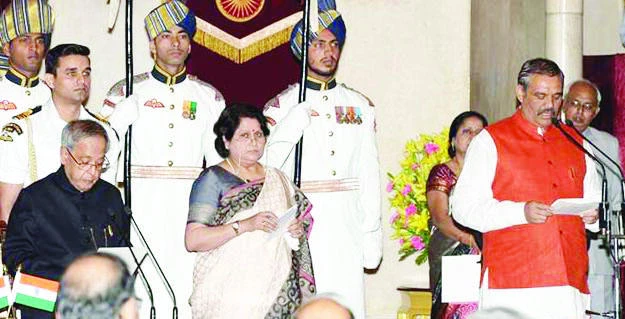
An Indian expatriate who once worked as a construction worker in the Kingdom has surprised everyone, from political pundits in India to expatriate colleagues here, by taking oath of affirmation in the newly expanded federal Cabinet of Prime Minister Narendra Modi.
Modi expanded his Cabinet on Sunday and brought in 21 new faces with political calculations in his choice of ministers, which political analysts believe is aimed at spreading the ruling BJP’s footprint in the upcoming elections of certain states.
But what came as a surprise package for many is the inclusion of first-time member of Parliament (MP) Vijay Sampla, a 53-year-old leader from the northern Indian state of Punjab, who has a very humble background of working as a farm hand and then as a laborer and electrician in the Eastern Province.
“I remembered and recalled my days as a laborer mixing cement with concrete at construction sites in the Eastern Province when I was administered the oath of office as minister by President Pranab Mukherjee,” said Sampla.
“I can’t forget the time when I spent a significant part of my early life in the Kingdom where I worked as a laborer, plumber and also as an electrician from 1979 to 1990 in the Eastern Province,” he said.
“I was the lone Indian worker in a construction firm known as Al-Ammar Establishment, which is owned by Ibrahim Hussain Al-Ghosaibi of Alkhobar. I used to live at Raka on Alkhobar-Dammam road,” he recalled.
“I worked in Al-Ahsa, Al-Khafji and Jubail as well, aside from Alkhobar and Dammam. I used to work very hard in the hot summer seasons at constructions sites, which I can’t forget,” he added. “Al-Khafji and Al-Ahsa were then villages and were growing into towns,” he said.
Sampla said: “I learned a lot from my employer Al-Ghosaibi in the Kingdom, which helped me a lot.”
According to Monday’s Times of India, the urge to fight for the rights of the downtrodden soon brought him back from Dammam to Jalandhar in 1991 and he frequently started attending meetings of the Hindu fundamentalist Rashtriya Swayamsewak Sangh (RSS).
Fortunately for him, the status of his village, which was until 1997 in general category, was changed to reserved category. He decided to take a plunge into village politics, fought the village panchayat elections and was elected as the first Dalit sarpanch (head) of Sofi. He was this year elected to Parliament from Punjab.
Sampla’s dramatic rise to power evoked a mixed response in the Indian community across the Kingdom.
Nisar Ahmad, who works as a laborer at a construction site here, expressed his jubilation saying that even a person with humble backgrounds like Sampla can rise to power and prominence.
However, Ataullah Khan, a social studies teacher, believes that by appointing Sampla as a minister the BJP is in fact eyeing the Punjab Assembly election in 2017, where it will likely play the Dalit card to woo the scheduled caste (SC) community in the state. Sampla is a Dalit, an underprivileged community in India.
Rafeekul Islam, an Indian from Uttar Pradesh, said: “I am happy for him, but I wish he had joined any secular party rather than a rabidly communal party like the BJP.”
Mohammad Shanawaz, a bank executive, said Sampla’s appointment would serve the BJP’s purpose to convey a political message that they support lower sections of people, whereas the reality is it is nothing short of vote bank politics targeting nearly 32 percent Dalit votes in Punjab. “Sampla seems to provide a Dalit face for the party, which wishes to walk out of its alliance with Shiromani Akali Dal (SAD) in the state and go alone in the election, especially after its victory in the recent Maharashtra and Haryana state elections,” he said.
Indian minister’s EP link excites expats