In the plains of Arafat, pilgrims are greeted even from a distance by two significant landmarks. One is the majestic Nimira Mosque and the other is Jabal Al-Rahma or the Mount of Mercy.
Jabal Al-Rahma is a small hillock and it is from this platform that Prophet Muhammad, peace be upon him, delivered his unforgettable farewell sermon, enunciating far-reaching religious, economic, social and political reforms.
A small white pillar atop the hillock denotes the place where the Prophet stood more than 14 centuries ago. It is the wish of every pilgrim to reach Jabal Al-Rahma and pray in its vicinity.
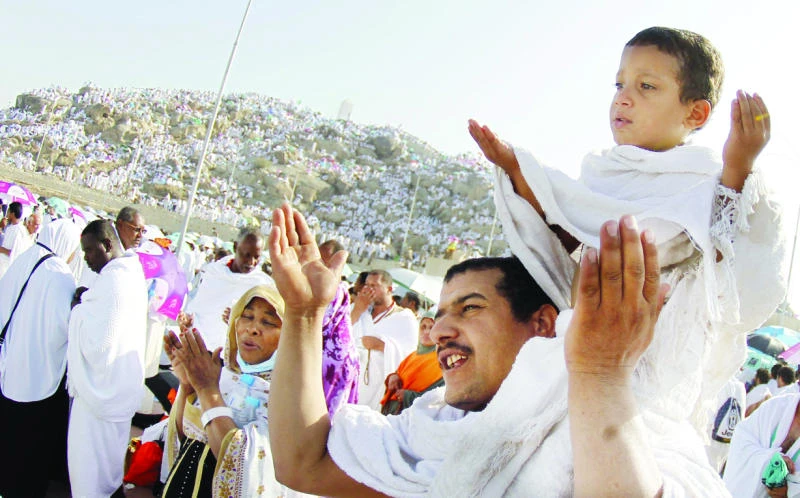
On Monday, the scene was no different. Pilgrims, including the elderly and women, were climbing the mount and trying to secure a good location to pray and supplicate.
“This is the place from where our Prophet addressed us and so it is emotionally significant for us to get as close to it as possible,” said Sarah Sharaya, en elderly pilgrim from Egypt. “This is out of our reverence for our beloved Prophet.”
Osman Mustafa, from Khartoum, Sudan, said: “There is nothing greater than walking in the footsteps of the Prophet. I wish all Muslims can also follow all that the Prophet said from this place centuries ago.”
Many scholars repeatedly advise pilgrims not to attach any significance to the place, but pilgrims from all countries are instinctively drawn to the Mount of Mercy like iron filings to a magnet.
“This is such a vast plain, and one can stay anywhere,” admitted Rahat Farooqui, a young Pakistani pilgrim. “But I get a spiritual high when I come close to the Jabal Al-Rahma. It reinforces my faith in Islam and my undying love for our Prophet.”
Early in the morning the mount was filled with the faithful, wearing the white ihraam. The searing sun was no deterrence for the spiritually charged pilgrims. From distance and from the pictures, the Jabal Al-Rahma looked like a vast sheet of multicolored cloth, thanks to the hundreds and thousands of multi-colored umbrellas that the pilgrims use for shade.
In Arabia, Jabal Al-Rahma is also called as Jabal Al-Dua or the Mount of Prayers.
Black rocks surround the hillock, which is about 300 meters tall and in the center. The white pillar on top of it measures seven meters.
From the mount, one gets a panoramic view of the vast plains of Arafat.
Although to stand at the top of the mountain is not among the duties of Haj, many pilgrims believe that it is among the rites of Arafat. This is a misconception because standing in Arafat means spending time prayers and supplication anywhere within the boundaries of Arafat.
The plains of Arafat are surrounded by an arc of hillocks and the Arna Valley. It covers an area of 10 square kilometers, and it is uninhabited except during Haj. With the exception of some government buildings, there is no other construction in the area.
Standing in Arafat, known is Arabic as wuqoof-e-Arafat is the most important pillar of Haj.
Jabal Rahma draws pilgrims ‘like iron filings to a magnet’