Construction works of Jeddah’s long-term drainage solution projects are progressing round the clock, according to a municipal official.
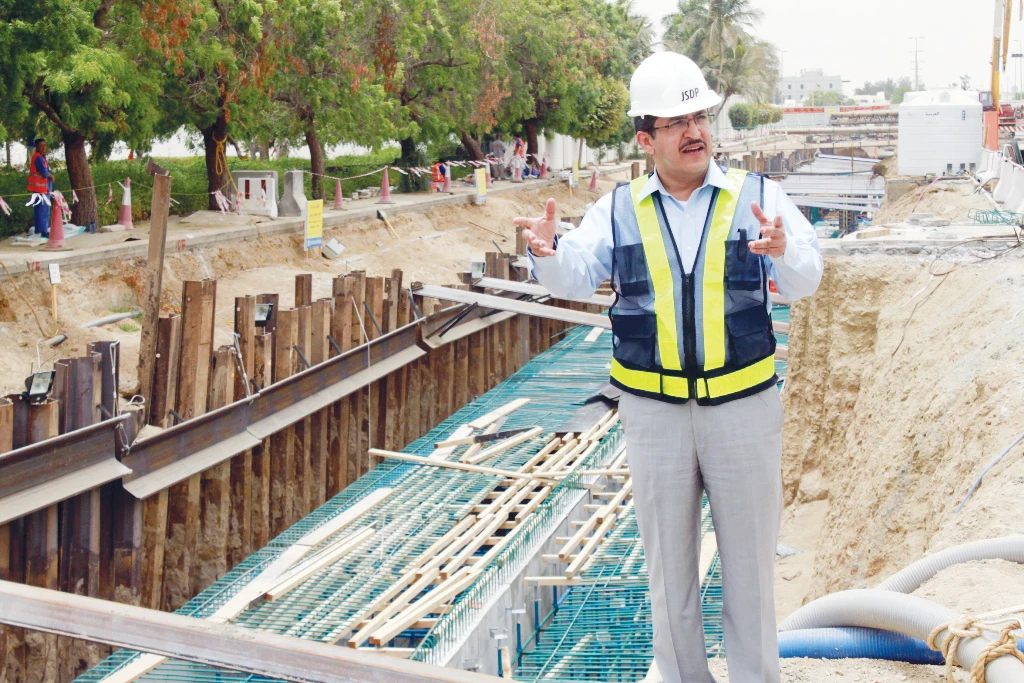
Ahmad Al-Sulaim, director of the drainage department at the municipality, said that more than two million hours of work have been spent on implementing the projects within the last 88 days since awarding the contracts in March this year.
“A total of 4,986 workers, supplied with 1,697 heavy equipment, are engaged in implementing the project at 44 worksites. As many as 57 engineers and 24 Saudi supervisors are managing smooth conduct of the project,” he said, adding that the teams have overcome the toughest phases while implementing the projects.
They managed to pump out more than 20,000 cubic meters of underground water as part of implementing the project, he said.
The permanent drainage solution projects include construction of five dams, expansion of existing canals in the northern, southern and eastern parts of Jeddah and construction of a new canal along King Abdulaziz International Airport. Two Saudi and two international companies have been awarded contracts worth a total of SR 3.39 billion to implement these projects.
Nesma Company won a contract worth SR 803 million to build four dams in Wadi Ghaya, Wadi Um Hablain, Wadi Daghbaj, and Wadi Briman and another contract worth SR 372 million to build a dam in Wadi Ghalil and renovate the southern floodwater path. The second contract valued at SR 143 million was awarded to the China Communications Construction Company to renovate the northern floodwater path.
Snamprogetti Saudi Arabia Company of Italy has won the biggest contract, valued at SR 1.319 billion, to construct a rainwater drainage system for the new Jeddah airport. Saudi Pan Kingdom for Trade, Industry and Contracting (SAPAC) won a SR 751 million contract to renovate the eastern floodwater path.
The four were picked from 13 companies that were pre-qualified to present tenders for the projects. The Alkhobar-based SNC-Lavalin Arabia was appointed as the neutral agency to ensure quality of work while implementing these projects.
Al-Sulaim said that most of the digging and foundation works for the construction of five dams have already been completed. “Walls to prevent leakage of water and damaging to the foundation were also finished. Nearly 22 percent of the dam construction works was complete,” he said.
According to Al-Sulaim, 20 percent of the digging and construction works of northern, southern and eastern drainages have also been completed. Digging and construction works of 9 km drainage canal from the 34 km canal along the airport were also over.
Makkah Gov. Prince Khaled Al-Faisal is closely following up on the implementation of the long-term drainage solution projects. While chairing a meeting of the executive committee for implementing the drainage projects at his Jeddah office last month, he appreciated great efforts being made by the concerned government agencies and officials as well as companies to complete the projects within the stipulated period of time. The governor also watched separate video presentations made by the companies, which were awarded contracts to implement the projects on March 28. These projects are expected to be completed in the first quarter of 2013.
A total of 14 emergency projects to deal with rainwaters and flashfloods in Jeddah were completed in December last year. The municipality completed these ad hoc projects within 110 days. These projects included refurbishing the Umm Al-Khair and Al-Samir dams in addition to the treatment of 12 water-collection areas in various parts of Jeddah.
Though constructed within the ad hoc projects, the two dams are in fact part of the permanent solution schemes. The Umm Al-Khair dam was built at a height of seven meters and a length of 1,100 meters and was linked to the northern valley pass via an open canal, which is 730 meters long and 33 meters wide. The Al-Samir dam was also linked to the northern valley pass by an open canal, which is three kilometers long and 40 meters wide.
Jeddah was hit by torrential rains and devastating floods in November 2009 and in January 2011 that killed more than 130 people and destroyed thousands of homes and vehicles. The poor drainage system was blamed for turning the flood disaster into a catastrophe.
Jeddah flood projects progressing on schedule