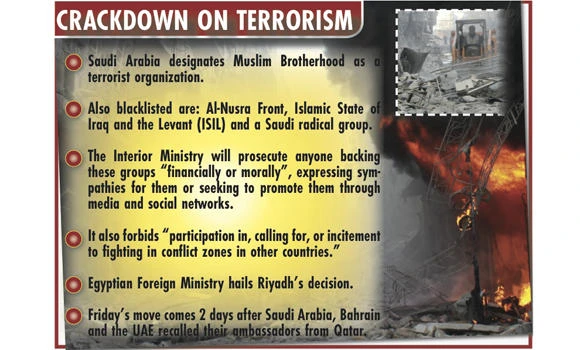
Saudi Arabia has declared the Muslim Brotherhood a terrorist organization and banned it and other organizations effective from March 8, according to an Interior Ministry statement.
The ministry issued a list of banned organizations that includes the ‘Saudi Hezbollah’ movement, the Islamic State of Iraq and Syria, the Al-Nusra Front, Al-Qaeda in the Arabian Peninsula, Al-Qaeda in Yemen, Al-Qaeda in Iraq, and the Houthis in Yemen, the Saudi Press Agency reported, quoting the ministry.
The ministry stated that the ban includes organizations that have similar ideologies and known for their terrorist and violent behavior; and are on the lists of the UN Security Council and other international organizations.
The Kingdom banned these organizations based on the recommendations of a committee set up under a Feb. 3 royal order.
The committee consists of the Ministries of Interior, Foreign Affairs, Islamic Affairs, and Justice, the Court of Grievances and the Board of Investigations and Public Prosecution.
The committee has to prepare and periodically revise lists of movements and organizations that threaten the religious, ideological, intellectual, political and national security of the country.
The recommendations have received royal approval, and will come into force from March 8.
The committee warned Saudi citizens and expatriates not to get involved with organizations inside and outside the country that promote extremist views.
The Kingdom has banned sacrilege in any form, including questioning the basic tenets of Islam, challenging the rulers of the country, and calling for or issuing religious edicts to fight in other countries.
Citizens and expatriates should also not join, support, sympathize with, or promote such groups. They should also not hold meetings for such organizations inside or outside the Kingdom.
The ban covers the promotion of these ideologies and activities in all print and electronic media outlets, including circulating the slogans, logos or any other symbols of such organizations.
It is also prohibited to make donations in cash or kind to these organizations, or harbor any of their members or promoters inside the Kingdom or abroad, the statement said.
It is not allowed to communicate with or contact organizations, movements or individuals hostile to the Kingdom. Citizens should also not pledge loyalty to any foreign country, or maintain contact with it to endanger the unity, stability and security of the Kingdom and its people.
The Kingdom has also banned participating in and promoting sit-ins, demonstrations, gatherings, and statements for any cause or activity that would threaten the unity and stability of the Kingdom.
It is also not permitted to attend conferences, forums and meetings inside or outside the Kingdom targeting the security and stability of the community, and with the aim of stoking sedition.
It is also not permitted to abuse other countries and their leaders, or inciting other countries and organizations to attack the Kingdom.
The ministry said the Saudi government would punish those found guilty of violating these orders, including holding them accountable for past actions.
On Friday, Egyptian Foreign Ministry spokesman, Badr Abdelatty, reportedly said that Cairo approved of Riyadh's move to declare the Brotherhood a terrorist organization.
“We hail it, we welcome it,” he said.
“It is in the right direction.”
The royal order also gave Saudis fighting abroad another 15 days, from the date of this statement, to hand themselves over to the authorities.
Custodian of the Two Holy Mosques King Abdullah last month decreed jail terms of up to 20 years for citizens who fight in conflicts abroad.
KSA tightens noose on Brotherhood terrorism