Standard contracts for housemaids must address the issue of runaway workers, said Hattab Al-Enezi, spokesman for the Labor Ministry.
“The runaway phenomenon (known in Arabic as ‘huroob’) will be solved via this standard contract, which will be signed by the two countries,” said Al-Enezi. “In addition, any assault on employers is a criminal act that is punishable by the Kingdom’s laws.”
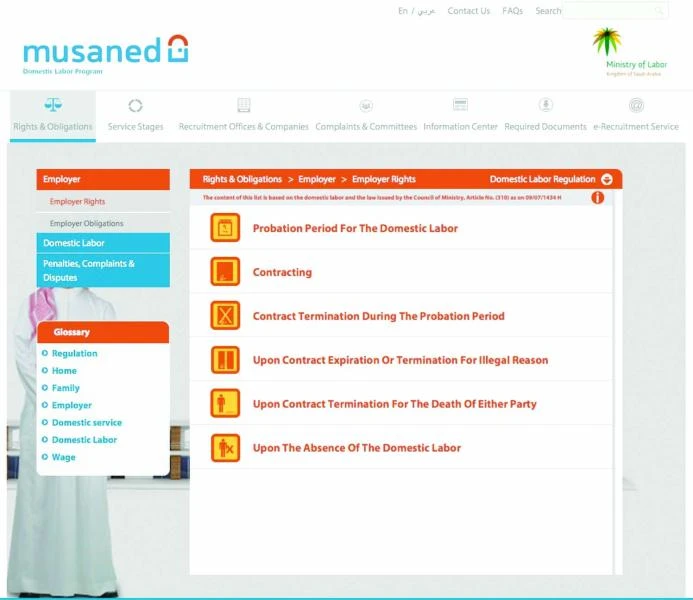
Al-Enezi pointed out that the Labor Ministry website had introduced a domestic labor program called “Musaned” (Arabic for support), which aims to familiarize both workers and employers with their rights and obligations.
The website highlights the privileges that domestic workers are entitled to, including health care, contract renewal, paid sick leave and days off.
The program will also provide information on service providers, such as recruitment offices.
The agreements signed by labor-exporting countries with the Kingdom take into account the best interests of both employer and employee, said Al-Enezi.
“Workers should not refuse tasks without legitimate reason in accordance with Article 6 of the domestic workers’ labor law,” he said. “Workers must also maintain respect of their employer and his family members, in addition to respecting Islam and the laws and regulations of the country.”
The terms of the agreement span five years and can be extended automatically for the same period, he said.
Recruitment offices in the Kingdom, however, are incurring huge losses due to the imbalance in the content of the agreement and the “Musaned” program.
Yahya Al-Maqboul, chairman of the Recruitment Offices Committee at the Jeddah Chamber of Commerce and Industry, said that workers and investors in the recruitment sector are facing challenges in light of these new rules, which has affected their income.
The Ministry of Labor is in the process of extending support to recruitment offices, he said. “Nevertheless, we will accept whatever decisions are made on this matter.”
Maid contracts to address runaway issue