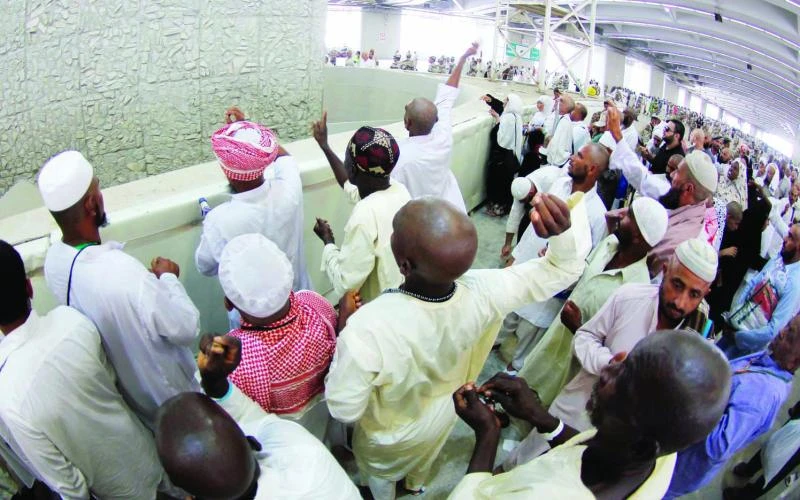
Mina's Al-Jasr hospital has treated hundreds of mostly elderly patients suffering from dehydration and chest infections over the past few days, the facility’s director said here on Wednesday.
Hasan Zahrani told Arab News that on the first day of the ritual stoning of the devil, the hospital handled 320 pilgrims with these ailments, including some who fainted in the heat.
The Al-Jasr hospital is the largest medical facility in Mina. Arab News saw ambulances arriving every four to five minutes with ill patients.
Zahrani said that five surgeries and 1,224 laboratory tests were carried out on Wednesday. The hospital has 500 staff members working around the clock.
The hospital will close after Dhul Hijja 15 and all inpatients will be transferred to Mina Emergency Hospital.
There are 15 hospitals with 3,256 beds providing services for pilgrims in Makkah and the holy sites. These hospitals are equipped with emergency services, intensive care units and operating theaters.
This is in addition to 175 health centers — 75 in Makkah, 46 in Arafat, 44 in Mina, six in Muzdalifah, and two inside and on the rooftop at the Ajyad entrance of the Grand Mosque. There are seven seasonal health centers at different entry points in Makkah.
There is a special airstrip for air ambulances from Mina and Arafat for critical cases. All Ministry of Health hospitals are connected to a central system to track patient’s data.
Hunt on for pilgrim smugglers
Makkah Gov. Prince Khaled Al-Faisal has ordered city security officials to track 100 criminals who smuggled pilgrims into Makkah during this year’s Haj.
The smugglers marked out routes and resting places through the Al-Hada Mountain close to Makkah, and even installed ropes in certain steep areas.
None of the pilgrims had permits to perform Haj. They faced severe health and other risks coming through the mountainous terrain. Prince Khaled said the perpetrators face severe punishment.
150 Saudi women working on trains
The Ministry of Municipal and Rural Affairs has for the first time employed 150 Saudi women to usher pilgrims and help them board Mashaer Train over a period of five days. The supervisor said that the women will use sign language instead of speech to avoid argument and confusion and to ease the movement of pilgrims.
The women began operations between camps and ensured that female pilgrims wore the designated bracelets on their wrists and the ticket to board the Mashaer Train.
This is in line with the ministry’s new mechanism this Haj season for pilgrims’ safety, which involves strict controls when boarding the train through the electronic gates.
Mina hospital treats hundreds of elderly patients