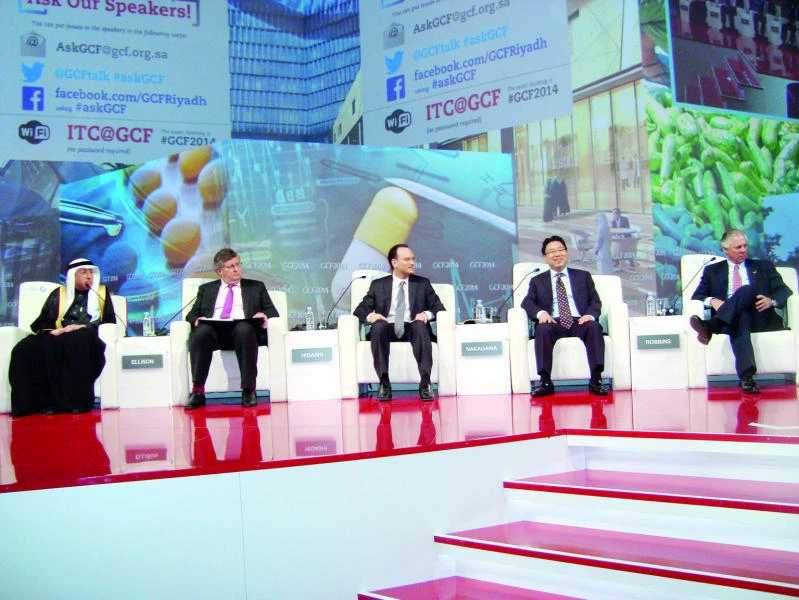
Checking the increasing incidence of obesity in the Kingdom is one of the major challenges being faced by the health sector, Deputy Health Minister for Planning and Development Mohammed Hamzah Khosheim told delegates at the Seventh Global Competitiveness Forum which concluded in Riyadh on Monday.
Khosheim was delivering the keynote address on behalf of Health Minister Dr. Abdullah Al-Rabeeah at a session on “Live Longer, Stay Longer.”
The deputy minister, stating that the ministry faced several challenges in the implementation of its programs, said the other issues that the ministry was faced with included the ageing Saudi population that had crossed one million, increasing number of traffic accidents, smoking and high incidence of diabetes.
Obesity, he said, was mainly on account of food consumption by people beyond their body requirement. “Some decades ago, one would probably find one obese child in a classroom, but today, the situation is such that there are at least 10 children in a class of 30 who are obese,” he said.
He said the ministry had launched an awareness campaign at the school level to check this problem. “People must reduce the intake of salt and sugar in their food and also undergo regular medical check-ups at the nearest Primary Healthcare Center to check impending diseases,” he said, adding that the ministry had also embarked on a massive development program to cater to the increasing health needs of the people in the Kingdom.
The other panelists in the session included Dr. Robert Robbins, president and chief executive of the Texas Medical Center, James Nakagawa, chief exeutive and chief care architect, Mobile Healthcare Limited and Mitch Higashi, chief economist, GE Healthcare.
Over 1,000 delegates attended the three-day event which was sponsored by the Saudi Arabian General Investment Authority (SAGIA).
During the course of the conference, SAGIA signed two agreements to promote entrepreneurship and investment in the field of health care with King Abdulaziz City for Science and Technology (KACST) and King Abdullah University of Science and Technology (KAUST), and Emaar, the Economic Cities Authority and with the Ministry of Health respectively.
Kosheim said the number of hospitals in the Kingdom will go up from 272 to 357 in the next five years. The numbers of beds in government hospitals will also go up to 38,970 during the same period with the number of nurses in these hospitals touching 194,000.
He said the primary objective of his ministry was prevention of diseases. “We are keen on implementing preventive measures since the treatment of these diseases cause a heavy burden on the annual budget of the ministry,” he said.
Obesity remains as primary challenge for health sector