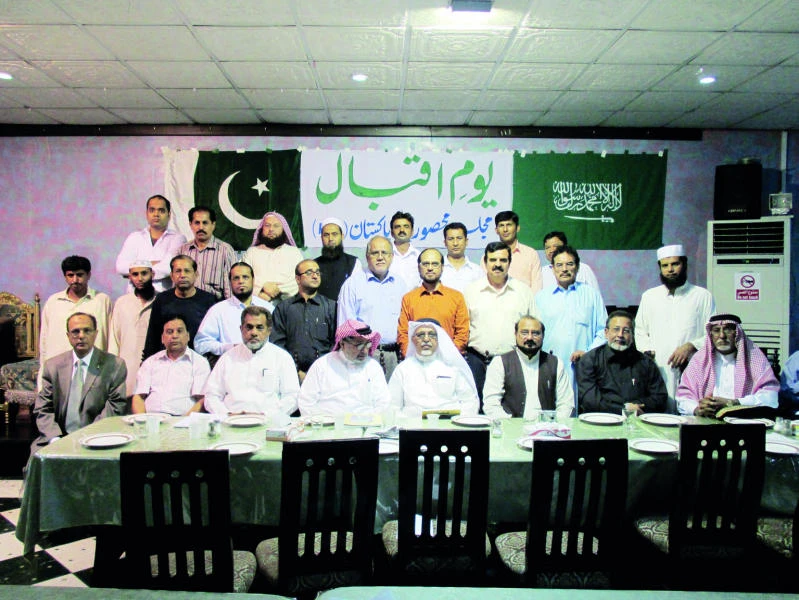
The Jeddah-based Pakistan Repatriation Council (PRC) reiterated its demand Saturday to establish an Iqbal Research University in Pakistan that would be in line with legendary poet Mohammad Iqbal’s philosophy.
PRC convener Ehsanul Haque said this at a community function to mark the 136th birthday of Allama Iqbal.
Paying homage to the poet-philosopher, former Saudi diplomat and columnist Dr. Ali Al-Ghamdi said Iqbal was a multifaceted personality. “I’m not sure which aspect of him I should discuss here — Iqbal the poet, Iqbal the philosopher, Iqbal the leader or Iqbal the religious guide,” he said. “The idea of Pakistan was first germinated in the mind of Iqbal,” said Al-Ghamdi. “One finds frequent references to Prophet Muhammad (peace be upon him) and Hijaz in his poetry,” he said. The diplomat lamented the fact that Iqbal was not being remembered “the way he deserves to.” “It’s our duty to impart Iqbal’s ideas, his poetry and philosophy to new generations,” he said.
Al-Ghamdi, who has been supporting the PRC in its mission to do justice to more than 300,000 stranded Pakistanis, said these poor people have been living a miserable life for more than 40 years only because of their love for Pakistan. “It is therefore the duty of Pakistan to explore ways to bring them back to their country,” he said.
Al-Ghamdi wondered why Pakistanis and other expatriates in Saudi Arabia were neither learning nor making any attempt to speak the Arabic language. “This is surprising because Arabic is your language; it is the language of the Holy Qur’an,” he said.
Saeed Farha Al-Ghamdi, the guest of honor at the event, who once represented the Kingdom on the International Civil Aviation Organization Council, in Canada, underlined the importance of learning Arabic and urged everyone to impart the knowledge of Arabic to their children.
The function began with the recitation of the Holy Qur’an by Qazi Abdul Majeed. Sher Afzal won praise for his melodious lines in praise of Prophet Muhammad and his recital of Iqbal’s poetry. Poet Zamurrad Saifi launched a satirical attack on the so-called piteous state of Muslims in general: “Iqbal hamara hai, Qayad bhi hamara hai; phir sonch pe kyun apni, ghairon ka ijara hai.” (Transliteration: Despite philosophers like Iqbal and other leaders, why are our minds obsessed with foreign influences)
Syed Shahabuddin, member, PRC, noted the diminishing importance of Iqbal’s philosophy to just a day of remembrance. Tariqe Mahmood lamented the gradual decline of Pakistan in global significance. He attributed this to a lack on the part of the Pakistani leadership to understand Allama Iqbal’s vision where the values and character of a government are of paramount importance. Shamsuddin Altaf felt that Iqbal’s philosophy “is the panacea for the problems facing the Ummah.”
Shaikh Muhammad Luqman demanded inclusion of Iqbal’s works in the curriculum and said “it’s important to instill the values and teachings of Iqbal in the new generation.” Muhammad Ashfaque Badayuni in his flowery speech stressed on a studied approach of Iqbal to awaken the Muslim society. Among the resolutions adopted at the end of the function was the reactivation of the Rabita Trust which has been lying defunct since the government of Pervez Musharraf froze it in 2011.
The PRC also urged for an early solution to the Kashmir problem, which it said could be in line with the UN resolution that facilitates plebiscite, a proposal which was acceptable to India too.
Shahid Nayeem, president, Pakistan Journalists Forum (PJF), Maqboolur Rahman Abbasi, member, PJF, Ghazanfar Hassan of Engineers Welfare Forum, Khalid Jawed Mohammad of PES and Aftab Hussain of WAMY among others attended the function.
PRC demands Allama Iqbal research varsity in Pakistan