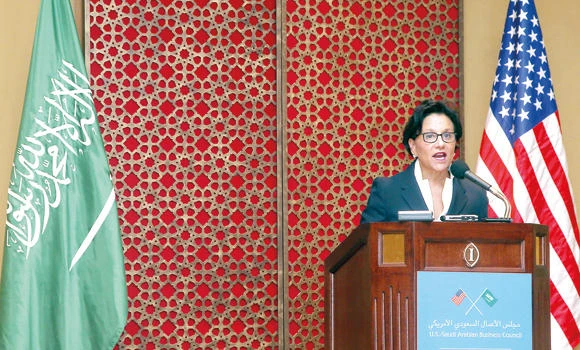
US-Saudi relations will remain forever strong, said Penny Pritzker, US secretary of commerce, on Tuesday while announcing the upcoming visit of American President Barack Obama in a few weeks time.
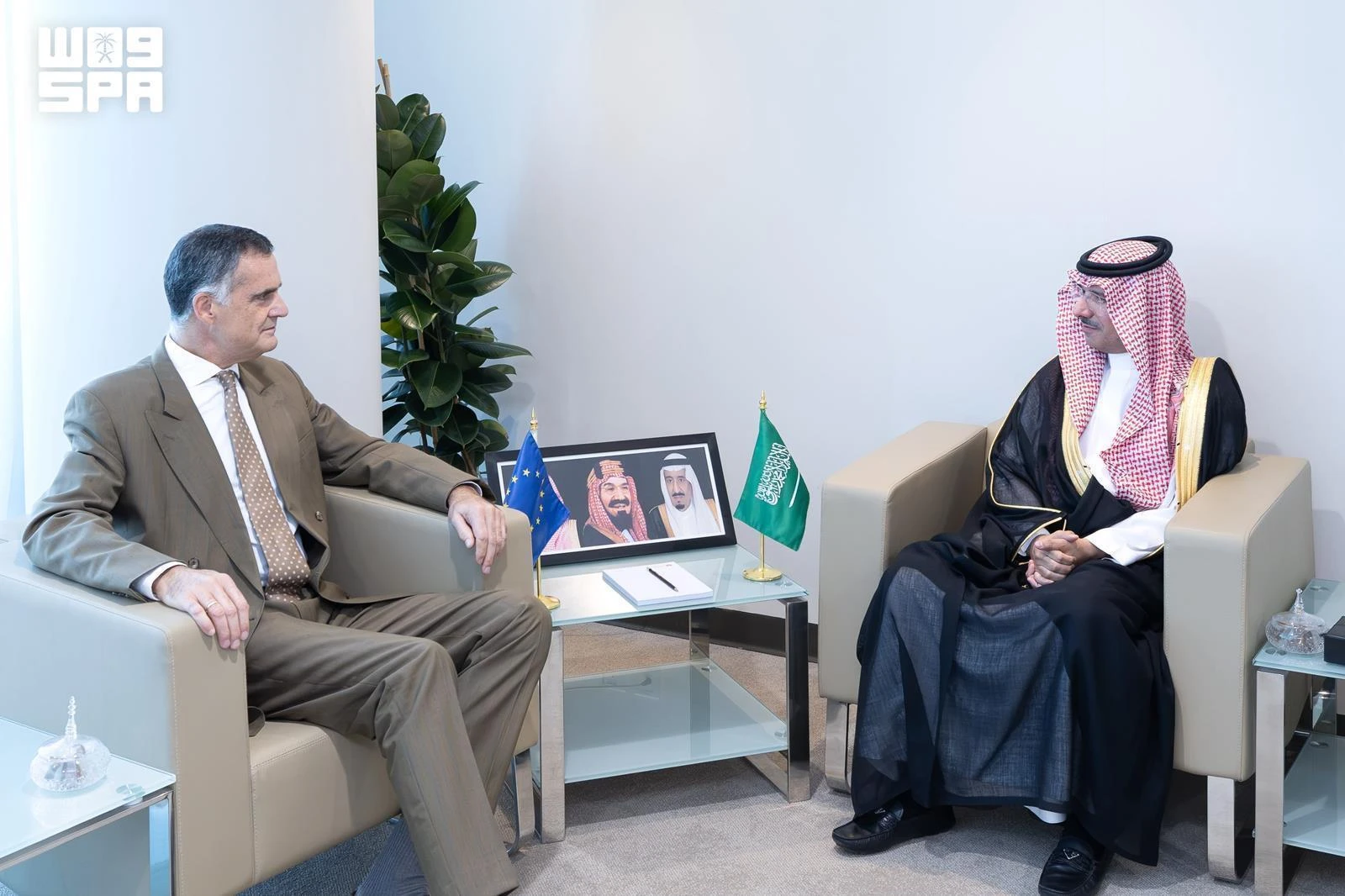
Prince Muqrin, second deputy premier, later received the US secretary of commerce and the accompanying delegation at his palace.
During the meeting, they discussed issues of common interest in addition to aspects of bilateral cooperation.
Pritzker, who is leading a trade delegation comprising 21 American companies, was hosted at a luncheon by the Saudi-US Business Council at the Riyadh Intercontinental Hotel on Tuesday.
More than 150 guests were present during the reception, held in honor of the visiting US official.
Other dignitaries who were present included Abdulaziz bin Salman, assistant minister for Petroleum Affairs at the Ministry of Petroleum and Mineral Resources, and Prince Abdulaziz bin Ahmed.
Edward Burton, CEO and president of the Saudi-US Business Council, and Mohamed Al-Mady, vice-chairman and CEO of SABIC and co-chairman of the Saudi-US Business Council, delivered the opening and introductory remarks.
During the past 10 years, bilateral trade between the two countries has increased from $26 billion to $74 billion. Some 120 US companies entered the Saudi market last year alone.
“We are key strategic allies and our security relationship remains crucial. In fact, Saudi Arabia recently purchased 72 F-15s, the largest purchase of its kind in history,” she said. “Our two nations are strongly committed to preserving stability throughout the Gulf. While we acknowledge that even close friends may sometimes disagree, that will never shake the foundation of our friendship.”
“Our commitment to this relationship will not change even as the United States becomes more energy self-sufficient,” he said.
She stressed that America is well aware of the importance of the stability of global energy markets for the country, its allies and an interdependent global economy.
“US and Saudi businesses have been building strong links between our countries for eight decades,” said Pritzker.
“Exactly 76 years ago last week, the California Arabian Standard Oil Company, a predecessor of ARAMCO, struck oil near present-day Dhahran. This revealed the largest source of crude oil the world had ever seen, a discovery that would forever change Saudi Arabia and the Middle East. A few years later, in 1942, General Electric would begin supplying machinery to Saudi Arabia for oil expeditions. In 1945, King Abdul Aziz and President Franklin Delano Roosevelt met on board the USS Quincy in the Suez Canal. It was a historic moment that launched a friendship which continues to this day,” she said.
Pritzker said that there was overwhelming interest from among US companies to join this mission.
“In fact, 80 companies had originally applied and we had to whittle that down to a delegation of 21,” she said. “These companies possess world-class expertise in renewable energy, architecture and infrastructure. This is a fantastic group. Perhaps the most exciting aspect of the US-Saudi relationship is the vibrancy of our commerce. Saudi Arabia is America’s 10th largest trading partner in the world.”
Two-way trade last year reached $71 billion.
Monthly exports from the United States to the Kingdom topped $2 billion dollars in December for the very first time. There is strong and growing demand for American cars, aircraft, machines, renewable energy technologies and large-scale infrastructure, she said.
The Commerce Department is responsible for helping American companies enter and grow in foreign markets.
“Over the past four years, I am pleased to say that our Commercial Service Department has helped nearly 500 firms build their businesses and sell goods and services here in Saudi Arabia,” said Pritzker.
For example, she said, an American startup company named Uber launched a new mobile-app, enhancing taxi services in Riyadh, just a few days ago.
Demand for water utilities is expected to grow 10 percent annually in Saudi Arabia as the population continues to expand and American franchises make their way into the region, she said following her meeting with officials from the Ministry of Water and Electricity.
“I applaud Saudi leaders for their plans to invest more than $150 billion over the next two decades to upgrade this infrastructure. American firms hope to be part of these projects. They have deep experience and expertise that can help our Saudi friends gain consistent and affordable access to water and power,” she said.
“We also met with officials from the King Abdullah City for Atomic and Renewable Energy. Saudi Arabia has an ambitious goal of delivering nearly half of its energy from alternative sources, with nearly one-third of that from solar. I am very pleased that several solar companies — FirstSolar, AREVA Solar, and SolarReserve — are part of our delegation,” she said.
The Saudi government has made significant progress in protecting intellectual property.
The Kingdom has expanded penalties for copyright violators, reduced illegal software use and hired new patent examiners whom the US Patent and Trademark Office will help train.
Another example of government-to-government collaboration is in the area of commercial law.
“The Commerce Department is working with the Ministry of Justice and the Ministry of Commerce to create a legally conducive environment that supports entrepreneurs. I strongly believe innovators need to be free to try, fail and try again,” she said.
Saudi-US relations to remain strong