Saudi Arabia plays an important role in the economy of the United States, largely because of its position as one of the most influential members of the Organization of the Petroleum Exporting Countries (OPEC), and because of its progressively growing trade and investment relations.
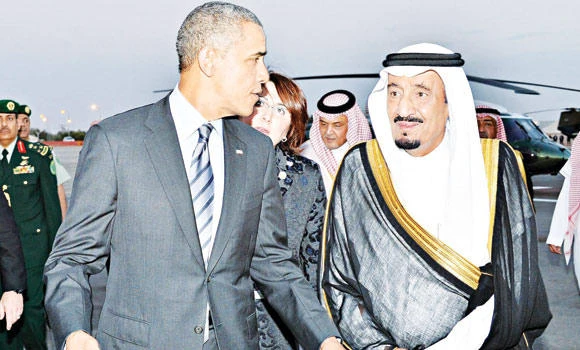
"The total trade between the US and the Kingdom exceeded SR282 billion in 2013, representing 14 percent of the total global trade volume of Saudi Arabia," said a report of the state-owned Central Department of Statistics and Information of Saudi Arabia (CDSI) here Thursday. The report was released by the CDSI to coincide with the visit of US President Barack Obama to the Kingdom.
Saudi exports to the US totaled SR199 billion last year, while its imports exceeded SR83 billion, with the balance of trade in favor of the Kingdom, said Tawfiq Al-Rabiah, minister of commerce and industry, while speaking to Al-Eqtesadiah, a sister publication of Arab News, here on Thursday. These statistics indicate that many companies of the two countries have forged closer ties, while several others are eager to do so.
"The US also remained the largest trading partner of Saudi Arabia in 2012 with trade exchange between the two countries standing at SR287.1 billion or 14 percent of the overall trade between the Kingdom and other countries, said the CDSI report.
Aside from consumer goods, high tech tools and heavy equipment, the Kingdom has benefited from technology transfer and expertise of many American engineering, construction, financial and consulting firms active in Saudi Arabia.
Today, thousands of US citizens live and work in the Kingdom, which hosts one of the largest overseas American communities. Saudi Arabia has also forged closer ties with the US in the energy sector. The Kingdom has huge oil reserves and it is currently the country with the greatest capacity to increase or decrease its oil production in response to changes in oil prices and demand.
Among the most important items exported by the Kingdom to the United States are crude oil and its by-products, including ethylene glycol (EG) and urea fertilizers. Its major imports from the US were cars and plane spare parts. The US also ranks No. 1 in terms of foreign direct investment (FDI) in the Kingdom over the past five years.
American investment in Saudi Arabia is around SR37.5 billion, according to media reports. Some 450 American companies, of which 400 were small- and medium-sized firms, exported their products to Saudi markets over the last four years. Earlier this month, a US trade and business delegation visited the Kingdom representing mega companies such as General Electric (GE), Dow Chemical, AECOM, AREVA, and C3 Energy.
The delegation led by US Commerce Secretary Penny Pritzker underscored the close commercial and economic relationship between the United States and Saudi Arabia. Pritzker spoke at a luncheon hosted by the US-Saudi Arabian Business Council in Riyadh, where the guests included Prince Abdulaziz bin Salman, Prince Abdulaziz bin Ahmed and more than 300 businesspeople from the United States and the Gulf.
“Perhaps the most exciting aspect of the US-Saudi relationship is the vibrancy of our commerce,” Pritzker said, noting that Saudi Arabia is America’s 10th-largest trading partner.
There are several top-notch US professionals currently working in the Kingdom, the latest in a long list of American men and women to make their homes in the Kingdom. Many of them are earth scientists, research scientists, doctors, drillers, teachers and technicians. Analysts predict that given the long history of engagement of American firms in the Kingdom's economy, the best days of the Saudi-US economic partnership still lie ahead.
There is a wide range of profitable investment opportunities in the Kingdom available to American companies, for Fortune 500 firms and small- and medium-sized enterprises.
In May 2013, a major Saudi trade delegation, sponsored by the US Commercial Service at the US Embassy in Riyadh, traveled to the US. The then Ambassador James Smith led the Saudi delegation. The mission was designed to share practical experiences, knowledge and ideas on the latest oil and gas industry trends and challenges in Saudi Arabia and the US.
Saudi-US ties reflect vibrancy of commerce