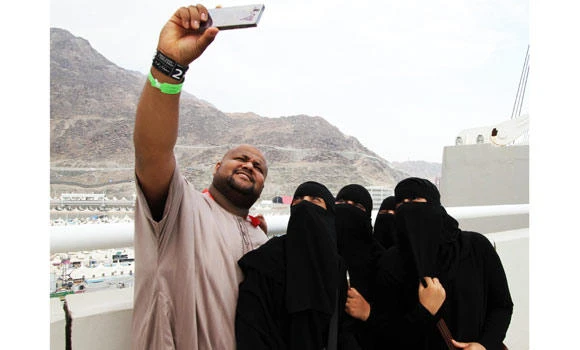
A prominent Saudi Islamic scholar has urged pilgrims not to indulge in taking infamous “seflies,” saying the new rampant phenomenon distracts worshippers from completing the rituals they came for.
“People often do it to show off, potentially disqualifying their entire act of worship and affecting the divine reward they would get for coming here,” said Ali bin Abdul Aziz Al-Shibal, a member of a Haj awareness committee and lecturer at the Majmaah University.
“Taking photos to let others know where you are or to show that you are engaging in good deeds affects the purity of intention and simply defies the purpose,” he said.
“That is not to mention the fact that other pilgrims will inevitably show up in the photos, violating privacy and rights and creating potential security issues.”
According to Al-Shibal, Islam prohibits Muslims from imitating such forms of non-Muslim culture and traditions.
“Muslims should be proud of their own culture,” he said, quoting a Prophetic “hadith” reported by Jabir bin Abdullah saying: “Those who imitate other nations belong to them.”
Several Islamic scholars have agreed that digital photography is prohibited except for essential purposes, such as taking photos of important events, exposing criminals, issuing ID cards, teaching students and publishing useful media programs, he said.
“The Prophet Muhammad (peace be upon him) said that photographers are among those who will be severely punished on Judgment Day. In another hadith, he says that photographers and painters will be asked to give life to their works on the day,” he added.
Publishing photos in print media is less problematic because the images are stagnant, “but painting individuals and animals, as well as caricatures, is prohibited,” he pointed out.
Abdullah bin Abbas, a companion of the Prophet (pbuh), told a man who said he draws for a living not to “draw living creatures.”
Asked whether there would be any campaigns against selfies in Haj and Umrah seasons, Al-Shibal said: “Our campaigns are aimed at educating pilgrims and other Muslims to keep them away from un-Islamic practices.”
“Islamic scholars spread awareness among pilgrims on basic Islamic teachings, including monotheism, the need to respect Prophetic teachings and adhere to the five pillars of Islam,” he said. “We also enlighten them on mistakes made before, during and after Haj. We reiterate the importance of good behavior and discuss other family-related issues.”
The committee, nevertheless, also cautions pilgrims against new phenomena such as this one.
“There are rules and regulations for all contemporary issues in our religion and this shows the universality of Islam and its applicability in any era.”
He said the Ministry of Islamic Affairs would continue conducting Islamic awareness campaigns throughout the year for the benefit of pilgrims, as well as the general public.
A fatwa program is available throughout the year, while toll free calls can be made around the clock for 45 days during the Haj season to inquire about various issues. The service, he said, is available in major languages.
“This year’s translation service was available in 14 languages. We also distributed pamphlets on Haj and its rules in 34 different languages,” Al-Shibal said.
The scholar opposed using Qur’anic verses as ringtones, saying it shows disrespect for the divine book.
“This is prohibited,” he said. “Worshippers can, however, listen to Qur’an or prayers on their devices.”
Selfies ‘distracting, boastful’