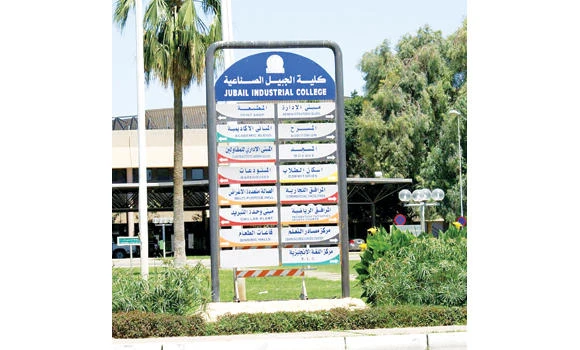
The Royal Commission for Jubail and Yanbu (RCJY) attaches great importance to higher education where thousands of male and female students are studying in RC colleges and institutes to obtain scientific degrees in various disciplines.
Educational institutions currently available in Jubail Industrial City include Jubail Industrial College (JIC), Jubail University College (JUC) and Jubail Technical Institute (JTI) which are operated by the Royal Commission.
This is in addition to Jubail College of Education for Girls, operated by University of Dammam.
Ali bin Hassan Assiri, general manager of colleges and institutes of the Royal Commission for Jubail (RCJ), told Arab News in an exclusive interview that the commission’s training programs are specially tailored to meet industries’ future requirements of manpower in Jubail Industrial City which still attracts leading world and local industries.
Assiri said that at the Royal Commission Colleges and Institutes we provide competency-based education (CBE) to ensure that graduates of all levels and types of programs are competent to achieve new levels of education and function in the real world of work.
“Partnership with the stakeholders helps us in creating CBE curricula and programs to assure, the right competencies are being assessed,” he said.
Excellent teaching:
“We have a diverse pool of intellectual capital drawn from various countries and fields, endowed with rich research and teaching experience,” said the general manager.
“Our academics with exceptional credentials are able to give individual attention to learners. Going beyond the textbooks and classrooms gives our teaching methodology the edge,” said Assiri.
Major focus on researches, seminars and conferences confirms the intellectual richness of our faculty.
Assiri said: “We regularly update the courses provided at our colleges and Institute to reflect relevant developments in technology, industry, and research, putting students at the forefront of professional knowledge for their study area.”
The official said that many of our JIC programs in Engineering Technology and Management are accredited by the top international accreditation commissions.
The associate degree programs in Electrical Power Engineering Technology, Instrumentation and Control Engineering Technology, Polymer Engineering Technology, Chemical Engineering Technology, Manufacturing Engineering Technology and the associate degree program in Mechanical Maintenance Engineering Technology are all accredited by the Engineering Technology Accreditation Commission of ABET.
The four business associate degree programs in Office Management, Marketing, Accounting, and in Computer and Information Technology are accredited by the Accreditation Council for Business School Programs (ACBSP).
The Industrial Chemistry Technology (INCT) associate degree program is accredited by the Canadian Technology Accreditation Board (CTAB).
Assiri said: “Recognition by these international accreditation boards means, our programs maintain global standards and will continue to do so in the future. These accredited programs give our students the capacity to study and work locally and internationally.”
World-class facilities at RCJ Colleges and Institutes:
The commissions’ colleges and institutes have a wide range of technologically advanced facilities to support students and trainees academic, social and sporting life at the college.
This includes discipline-specific facilities, access to computing labs for all our students, and a state-of-the-art multi-purpose hall.
The ‘Smart Campus’ provides fully integrated and automated services to staff, faculty members and students.
Assiri said the lecture theaters, classrooms and laboratories are equipped with the latest cutting edge technology equipment in line with the latest in industry.
The electronic information kiosks and digital signage screens across the campus provide instant access to important information and news.
Medium of instruction:
Assiri said that one of the principal objectives of our colleges and institutes is to prepare the students to face the current global challenges and enable them to utilize all sources of knowledge made available today by modern communications and information technology.
“Therefore, our academic staff members are inspired to impart world-class education, knowledge and foresight to our students adopting English language as the medium of instruction.”
Faculty:
Assiri said the RCJ Colleges and institutes managing directors and deputies are open-minded in their hiring preferences though preference is given to people with developed English language abilities.
He said: “Our faculties are distinguished by their willingness to embrace new technologies and developments, and great emphasis is placed on the swift introduction of these new and improved methods to the curriculum. In this regard, teaching methodologies, multi-media and information technology advances are key areas.”
Collaborative partnerships with Industry:
RCJ Colleges and Institutes believe in working in close collaboration with industry and other well-established national and international institutions in order to forge strategic partnerships which are mutually beneficial.
Two of the country’s premium organizations, i.e. Saudi Aramco and Saudi Basic Industries Corporation (SABIC) are engaged in frequent dialogue with the Colleges and Institutes to assess the development of curricula and facilities.
“All our colleges and Institutes programs have active industrial advisory committees to guide them,” said Assiri.
“Such guidance oversees a process of constant improvement and refinement. These partnerships and connections are of great importance to our programs as they directly influence student outcomes. Such ongoing collaboration and dialogue will keep us responsive to industry while remaining at the cutting edge of new technologies,” he said.
He said: “Our strong relationship with the industry helps our students and trainees in getting the ideal cooperative training, internship and final placements.”
It gives the RCJ graduates a competitive edge in the workforce.
He also said: “We have cooperative training programs within specific disciplines such as Business, Engineering, and Information Techno-logy. Agreements with leading corporate houses bring our students into contact with additional industry experience and cutting-edge technologies.”
Assiri added: “Industrial Relations departments of our colleges and Institutes organize industry visits and guest lectures with the heavy weights of the industry to keep our students abreast with the latest in the market and corporate world.”
Skills boost: Saudi youth compete for job market share