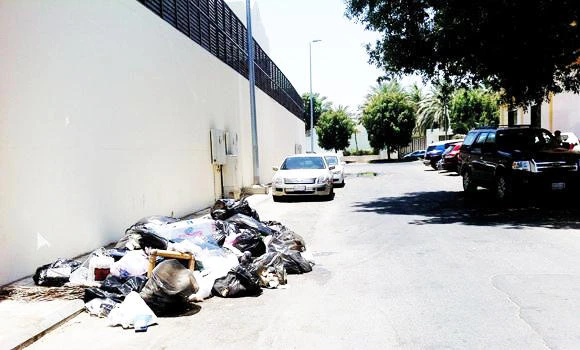
The new regulation on solid waste, which was recently approved by the Council of Ministers, will be effective 90 days from the time of approval. Fines for violations could be as high as SR 20,000.
A government source told Al-Eqtisadiah that the regulation targeted the producers of municipal solid waste, which were warned to keep the volume of the waste to the minimum, while recycling.
“Solid waste should be placed inside special containers without causing harm to others. Waste should not be accumulated, stored or disposed of in a way that harms the environment and public health,” the source said.
The regulation prohibits any person from using or allowing others to use buildings, land plots or facilities for disposing of municipal and solid waste disposal before conducting environmental evaluation studies and obtaining permission from the authorities. The source said the punishment will be applicable to those who place municipal and solid waste in flood paths, valleys, wells, beaches, sewage networks and rainwater drainage systems.
Those who obstruct the process of defined waste accumulation points or prevent others from using them and those who set up places to accumulate solid municipal waste for commercial purposes without licenses would also be punished.
“Others liable for punishment include those who place dangerous health care and industrial waste in containers of municipal solid waste, besides those who collect municipal solid waste, move it, store it, treat it or recycle it to benefit in ways contrary to its licensed purposes,” the source added.
The source said the regulation’s punishment and violations will be implemented by the Ministry of Municipals and Rural Affairs.
Those who commit six violations will be fined a maximum of SR20,000, in addition to other stricter punishments that are stated in other regulations.
Lesser fines of SR10,000 will be given to those placing solid waste outside designated containers, accumulating waste, or storing it in a way that harms the environment or public health, in addition to changing allocated waste disposal collection areas or destroying them or using plots of lands or facilities for waste disposal, whether in streets, public gardens or other people’s property.
The source said the regulation allows the Ministry of Municipal and Rural Affairs to distribute municipal solid waste management projects while bearing in mind regulations, the public interest, studies and economic standards.
The regulation also allows the ministry to sign contracts with a single contractor to carry out projects in remote areas or projects that don’t need more than one contractor.
Solid waste law to be stringent