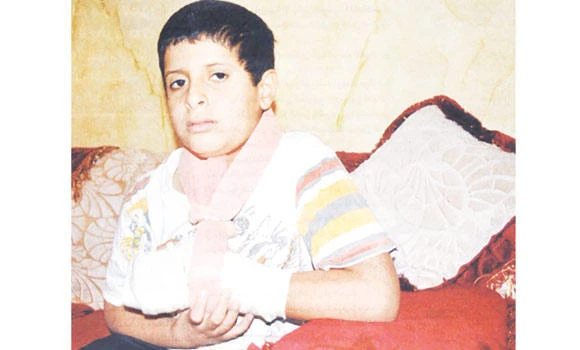
A teacher at a school in Khamis Mushayt has been accused of beating a 10-year-old elementary school student with his headband, breaking one of his fingers and bruising his back.
According to a report in Asharq newspaper, Ali Saeed Al-Shahrani, a pupil at the Al-Abbas bin Abdulmutaalib Elementary School in the Al-Hareer neighborhood, alleged that his teacher beat him.
The boy claimed that his teacher assaulted him because another student had said he had been making trouble in the class while he was away. “The teacher called forward several students to the whiteboard, and then whipped me twice using his headband on my hand and a third time on my back.”
“We pleaded with him to stop, telling him we wouldn’t misbehave anymore, but he then took off his headband again and whipped me nine more times. When he hit me the 10th time, my fingers became swollen. He then hit me five more times on my back,” he said.
Ali claimed another teacher refused him permission to leave the room to go to the headmaster’s office or call his father. He alleged that it was only after the school day that he was able to meet his father, who rushed him to King Fahd Military Hospital for treatment.
Saeed, Ali’s father, said he was surprised when he arrived at the school to find his son lying on his back near the school gate and crying. Saeed said that he then rushed him to the hospital where they told him Ali had broken a finger and had bruises on his back.
Saeed said he contacted the school principal the following morning but discovered he knew nothing about the incident. “I went to the school and found a group of teachers waiting for me. They begged me to drop the issue and not complain, to protect the reputation of the teacher and the school, but I refused,” Saeed said.
He claimed that Ali had been traumatized and suffers from nightmares.
Saeed said he had written a letter of complaint to the minister of education. He claimed that a committee from the department had started an investigation but refused to visit his house to speak with his son. He then took his son to the school, where the boy broke down in tears. This was an indication that he was suffering from trauma, Saeed claimed.
Mohammed bin Manea Al-Yahya, spokesman of the Asir Education Department, said the administration had sent a member from the monitoring department and another from the department of educators to the school. An investigation was done and findings were submitted for review.
This is the second incident of child abuse reported recently involving a teacher.
There was widespread condemnation of a Qur’an teacher on social media earlier this week, who was filmed beating a student at classes during lessons at a mosque in a Makkah neighborhood.
In the video, the teacher, a Burmese national, could be seen beating the child with a stick and then hurling him across the floor of the mosque several times. The teacher reportedly admitted that he beat the boy but claimed that his father had given him written permission to do so.
Sharif Nawaf Al-Ghalib, chairman of the Makkah Welfare Association, was quoted as saying that the government has banned teachers from using any form of corporal punishment.
About 97,000 male and female students attend about 4,900 official Qur’an memorization schools in Makkah, all of which are closely monitored, he said.
Al-Ghalib said the association had stopped the teacher from conducting any lesson and would submit a detailed report to the Makkah governorate for further action.
Abdul Aziz Hanafi, head of the Qhairkum Association for Qur’an Memorization, said that the Kingdom has more than 700 certified associations, but there are also other unlicensed schools operating outside the supervision of the Ministry of Islamic Affairs, which tend to make many mistakes.
He said that government bans the use of violence to discipline students. “Anyone who watches the video on social networking sites will automatically reject and renounce this violent behavior by the teacher. This incident will therefore not go away easily,” he said. Matouk Sharif, founder and president of the Saudi Society for Child Welfare, said beatings make it less likely for children to learn important life skills, gain self-confidence and become successful.
Teacher ‘whips student, breaks finger’