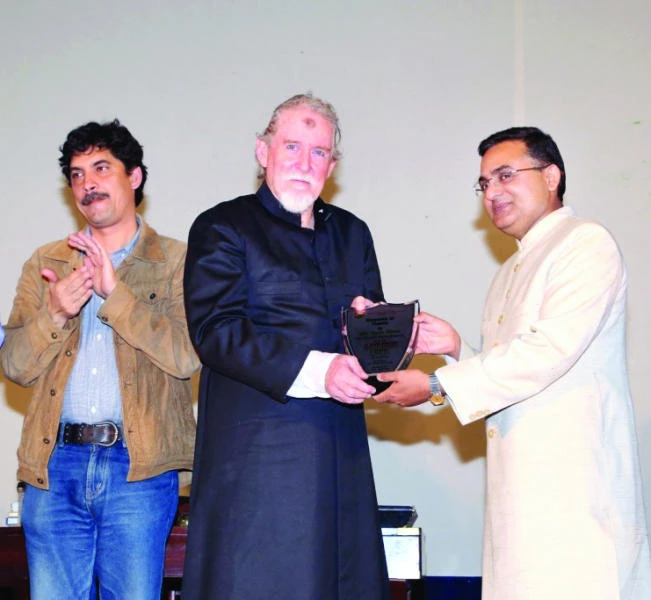
He’s performed the play “Maulana Azad” for almost 11 years but is still learning from it every time he goes on stage.
These are the sentiments of playwright, teacher and actor Thomas Beach Alter, known widely as Tom Alter, the son and grandson of American Presbyterian missionaries who first came to India in 1916. He grew up in north India in the towns of Rajpur and Mussoorie, and studied at Woodstock School and the Indian Film and Television Institute in Pune.
“It is an honor ... He is a leader my father spoke of very much. It is growing and so am I,” Alter told Arab News here in an interview on Monday about his play.
Alter said he has always been fascinated by Azad’s philosophy as a great writer, leader, statesman, scholar in Persian and Arabic, and a man who dedicated his life to finding the truth.
“Above all Maulana Azad believed that religion should not be the basis of a country with a multiplicity of religions. He was a devout Muslim, whose life and works are a tremendous lesson for the world. “Religion is an important part of life and is personal,” he said.
Alter said his grandparents were religious people and were “inspired by religion” and not “dictated” by it.
He said that having being born in India, which was “a great country,” he was very much an Indian.
Alter, who taught at a school in Jagadhri, Haryana in the early 1970s, and loves teaching, said most of his family members are or have been teachers. “It is a great passion in my family,” he said.
He said he has been to America, which he believes has strong and weak points, and that many Americans are totally unaware of what other people in the rest of the world are doing. “But that is true of some other countries and people as well. Because America is in the news all the time, people know much more about America than the other way round. It is a responsibility that America must take more seriously,” he said.
Alter said that India has changed beyond recognition in the last 50 years. There was a time when a young person could not dream of having a motorbike. Now if he does not have a car, he is considered a failure.
“It is the worst of the West. It is pathetic. We have gone backward.” He said the caste system is prevalent today, even though it was eliminated in the Indian constitution in 1950. “Gandhi and Nehru were beyond caste. We do not follow either the Constitution or Gandhi and Nehru,” he said.
He said that certain people, who did nothing during the time of the Mughals, the British or the freedom struggle, want to run the country. “They did nothing, just watched, and now want to be rulers. We have to be careful about such people.”
He said that if Indians did simple things such as not throw chips, cigarette butts and packets from their vehicles on the highways that would be a service to India. “Many people are happy in their own four walls, from which they have to come out,” he said.
Alter, who has acted in films, television and theater, said that films have evolved. There are now some great movies such as Man Singh Tomar and Bhaag Milkha Bhaag, away from the more formulaic films of boy meets girl.
He said that he has worked with Dilip Kumar, Raj Kapoor and Dev Anand, who were “just unbelievable.” He remembers Manoj Kumar “very fondly.” Chetan Anand, Man Mohan Desai, Satyajit Ray and Yash Chopra were directors “whose likes we will never see again,” he said.
Tom Alter says it’s an honor to play Maulana Azad