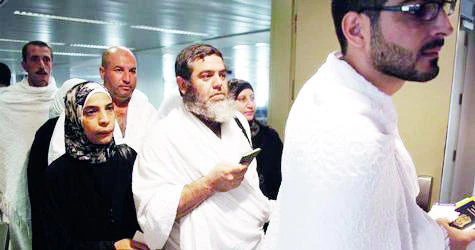
A number of Muslims from around the world come to Saudi Arabia on Umrah and Haj visas to fulfill their religious obligations but many of them stay back for various reasons without legal documentation.
Arab News spoke to some illegal pilgrims who overstayed their visit and are now in trouble with Saudi authorities due to violations of the immigration rules. Some of them ironically expressed their unawareness about any breach of law.
Amina Anwar came to Saudi Arabia with her husband almost 40 years ago. They were illiterate and didn’t understand the rules and regulations of the country. They acquired an iqama somehow but their sponsor was not supportive and eventually placed a final exit in the passport system without their knowledge. But in reality, they never boarded the flight to take them back home. Instead, they stayed on and had three children: A daughter and two sons. The girl was born at home and never had a birth certificate, national identity card or passport while one of the sons had a birth certificate but no national identity card or passport. The second son managed to leave the Kingdom and go back to their home country. Her husband meanwhile died leaving his family behind with an illegal status, no documentation and no choice.
A similar case is of Manthar Sarkar, who has been living in the Kingdom for the past 13 years. She came on an Umrah visa and decided not to go back home. She is now married with children and no documentation. Her youngest son fell sick and died in a local hospital and the family is now looking to bury the child but this is not possible without a no objection certificate (NOC) letter from the consulate and police station. However, as the family’s head has no legal papers himself, he will not be able to obtain the letter.
“Our family and friends advised us to leave the baby’s body at the hospital assuring us that the authorities will bury the body as we have no legal papers to fulfill the procedures. But the hospital told us to produce papers from the consulate and the police station. However, as none of us has an iqama, the consulate couldn’t do anything for us,” she said.
She further said that the hospital authorities later agreed to arrange papers for the burial of the child.
Another case Arab News came across is of a Sudanese family in a similar situation. They said that they had to surrender themselves and be taken to the Al-Shumaisi deportation center so they can be deported as there was no other option.
Arab News found that such cases where there is no proof of nationality or identification are very difficult to solve even for the consulates.
Arab News talked to Pakistan Consul General Aftab Khokhar whether there is any legal provision for people in such situations to obtain passports or documents from their consulates or embassies.
Aftab Khokhar said: “It’s a very difficult situation for consulates. However, people of any nationality should apply for a passport so that they have a legal document which proves their identity and consult with the consulate or embassy of their country.”
“It is also very important for the communities to advise people in such situations to acquire their travel documents and try to correct their statuses before it is too late,” he added.
Umrah overstayers in trouble over illegal status