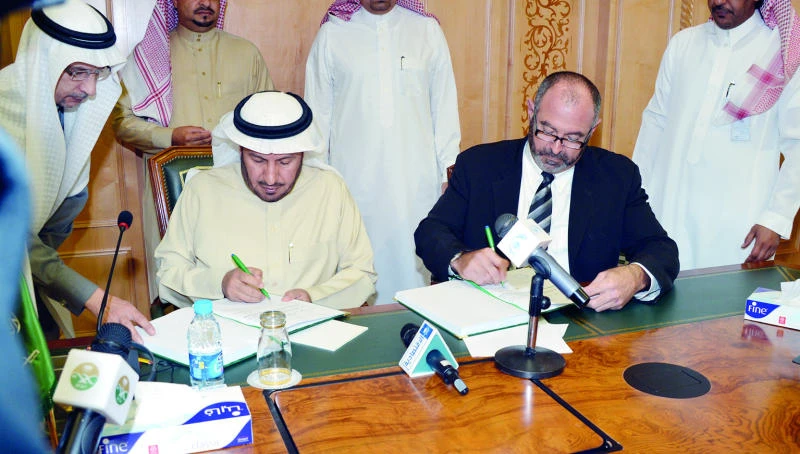
Saudi dialysis patients will be able to access renal services abroad under a new agreement signed Sunday between the Ministry of Health and a US company.
Health Minister Dr. Abdullah Al-Rabeeah signed the SR979 million agreement with DaVita, a division of DaVita HealthCare Partners Inc. and a leading provider of kidney care services, to maintain 74 dialysis centers throughout the Kingdom.
The project is expected to treat more than 5,000 dialysis and peritoneal patients irrespective of age.
The minister also said that the dialysis patients can also avail themselves of services abroad provided that the US company has support centers in those countries.
Al-Rabeeah recalled that his ministry invited quotations for this project from six companies in three countries such as the United States, Germany and Sweden.
The minister explained that the projects are being carried out within the framework of the vision of Custodian of the Two Holy Mosques King Abdullah.
He pointed out that that the treatment of dialysis patients is part of the ministry’s five-year plan and that the ministry already spent some SR1.9 billion during its launch.
Under the agreement, the health provider will rent and maintain state-of-the art centers using the latest technology in the field of medicine.
Aqeel Al-Ghamdi, undersecretary of hospital affairs at the ministry, said that this is a new project which would ensure dialysis services both within and outside the country. “We will maintain a 30 percent nationalization rate in the new centers,” he said, pointing out that there are 167 dialysis centers already functioning under the aegis of the ministry.
“It is an honor for DaVita to work with the Ministry of Health to deliver high-quality kidney care to its patients,” Dennis Kogod, chief operating officer of DaVita HealthCare Partners said to the foreign press. “We congratulate Health Minister Dr. Abdullah Al -Rabeeah on making this agreement possible and for working to improve the quality of life for people living with chronic kidney disease in Saudi Arabia.”
US firm to run 74 dialysis centers