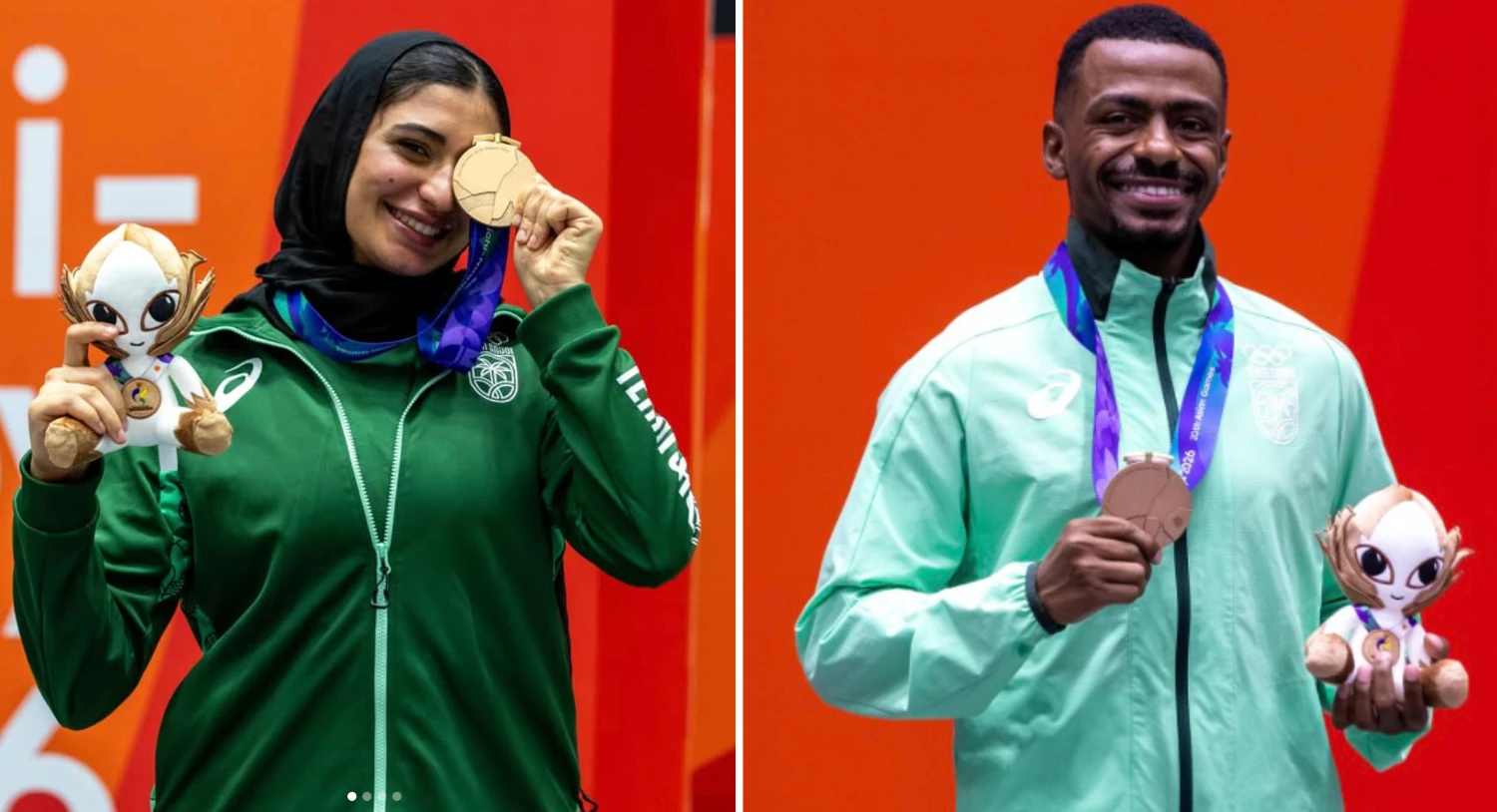
- Saudi Arabia’s first fencing medalist at World Championships has sights set on another success in Japan
DUBAI: It is one of sport’s oldest cliches but also one of its undeniable truths: to be the best, you have to beat the best. For Khalifah Al-Omairi, Saudi Arabia’s first fencing medalist at a World Championships, that meant getting past Olympic Champion Koki Kano on his way to a historic bronze in July.
With the Asian Games now underway in Aichi-Nagoya, Japan, the 27-year-old has quickly turned his attention to another major medal.
Al-Omairi was chosen alongside boxer Yara Al-Omari to carry the Saudi flag at Saturday’s opening ceremony and will compete in the men’s individual epee on Thursday.
The ongoing event also represents an important marker on Al-Omairi’s path toward the Los Angeles Olympics in 2028.
“Performing consistently at the Asian Championships, World Championships and Asian Games would show that I am moving in the right direction and becoming capable of competing for an Olympic medal,” Al-Omairi told Arab News in an exclusive interview.
Al-Omairi arrived in Nagoya less than two months after his breakthrough in Hong Kong. That historic bronze was secured after a quarterfinal victory over Kano, an opponent he had faced several times before.
Having spent the tournament watching Kano’s every move, Al-Omairi and national team coach Hossam El-Din were able to identify areas they believed could be exploited.
“We studied both the positive and negative aspects of his fencing and developed our tactical plan accordingly,” Al-Omairi explained.
“The key was to focus on the bout itself rather than on his name or achievements. I respected what he had accomplished, but once we stepped onto the piste, my attention was entirely on executing our strategy.”
Victory over Kano guaranteed Al-Omairi a medal, with the bronze he won setting a new benchmark that he will be aiming to match or surpass in Nagoya this week.
His journey in the sport had begun years earlier on Darin Island in Saudi Arabia’s Eastern Province, after a school friend encouraged him to try fencing because he believed being left-handed could work to his advantage.
Al-Omairi took his first steps at Al-Jazira Club, with his family backing the decision from the start despite their unfamiliarity with fencing.
“At the time, the people around me did not have much knowledge of fencing or a clear idea of what a career as an elite fencer might involve,” Al-Omairi explained. “We were all discovering that journey together as I progressed in the sport.”
Epee places particular demands on its competitors. The entire body is a target in bouts contested over three periods of three minutes, meaning a small error in distance or timing can quickly prove costly. For Al-Omairi, the early stages of a contest are often about learning as much as possible about the fencer opposite him.
“I study how the opponent moves, manages distance and responds to pressure,” he said. “I look at whether they prefer to attack or wait, how they react to feints and which situations make them uncomfortable. Those early observations help me understand their style and decide how to approach the rest of the bout.”
Al-Omairi believes the tactical side of fencing is often underestimated by those unfamiliar with the sport. Speed and reaction time matter, but so does adapting to an opponent and making the right decisions under pressure.
July’s World Championships medal improved Al-Omairi’s international standing, though he admits it has brought greater scrutiny of his own style and tactics.
“Every opponent steps onto the piste with a strong desire to defeat a world medalist,” he said. “That creates an additional challenge, but it also motivates me to keep developing and to avoid becoming predictable.”
The medal followed setbacks that Al-Omairi still regards as vital to his development. He was eliminated in the round of 16 at the 2023 Asian Games in China, while three losses at the Saudi Games also left a lasting impression.
“Those experiences taught me determination and patience,” Al-Omairi said. “They pushed me to train harder, examine my mistakes honestly and work on the details that had prevented me from achieving the result I wanted. Winning gives you confidence, but defeat forces you to confront your weaknesses.”
His success at the World Championships prompted messages from family and national team colleagues, as well as members of Al-Jazira Club, former coaches and officials he had worked with during his career. The bronze medal brought a welcome positive headline for a sport still developing its profile in the Kingdom.
“Seeing so many people share in the achievement showed me that the medal meant something beyond my individual result,” he said. “It was an important moment for Saudi fencing as a whole.”
Al-Omairi points to backing from the Ministry of Sport, the Saudi Olympic and Paralympic Committee, and the Saudi Fencing Federation as crucial to continuing the sport’s progress. He believes regular exposure to the world’s leading fencers, both in competition and training camps, can help Saudi athletes reach a higher level internationally.
And personally, for Al-Omairi, there is an obvious ultimate goal.
“Representing your country at the Olympic Games and winning a medal is the dream of every athlete,” he said. “It is certainly one of my greatest ambitions, and it is a goal I am determined to keep working toward.”
Saudi Arabia will host the Asian Games in Riyadh in 2034, and Al-Omairi hopes his success can encourage more young athletes to pursue fencing before the Kingdom welcomes the continent’s best athletes.
“Beyond medals, I want my journey to help both the current generation and the generations that follow,” he said. “I hope young athletes can look at what I have achieved and understand that nothing is impossible if they remain committed, work hard and continue believing in their goals.
“I would like my legacy to be not only the results I achieved, but also the belief that Saudi athletes can compete with the best in the world and continue building a lasting tradition of success.”