
 Saudi Arabia’s Space Legacy: Four decades of leadership, a vision for international peace
As Saudi National Day approaches, the Kingdom’s space legacy deserves to be understood across its full span; more than four decades of exploration, education and international cooperation. Its significance lies in the people it has trained and the knowledge it can contribute to humanity. Carrying that legacy forward means investing in research that improves life on Earth and in the institutions that allow countries to pursue discovery peacefully together.
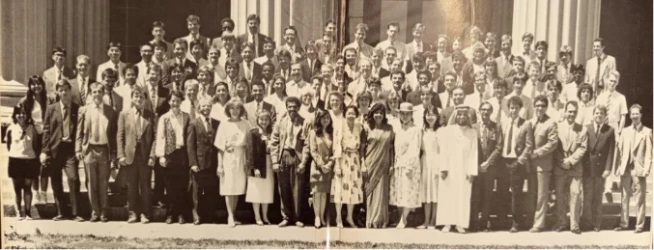
Little do people know that, in April 1988, before the International Space University opened its first summer program at MIT, the Saudi Arabian Embassy in Washington confirmed funding for two student places. Five years later, Strasbourg would be selected to host the university’s permanent campus. Saudi involvement was already part of the institution’s earliest educational history.
That early commitment offers a direction for the next chapter. Saudi Arabia can build on its space heritage by supporting international education and research with a clear public purpose. Scholarships, scientific partnerships and responsible stewardship of the orbital environment can turn national capability into benefits that reach beyond national borders.
The significance of Kingdom’s space legacy lies in the people it has trained and the knowledge it can contribute to humanity.
The chronology begins well before today’s space economy. On June 17, 1985, Prince Sultan bin Salman bin Abdulaziz Al-Saud became the first Arab and the first Muslim to travel into space, aboard Discovery on mission STS-51G. French astronaut Patrick Baudry was a fellow crew member, an early connection with France within a wider history of Saudi participation in international space exploration.
Education soon added another dimension. ISU held its founding conference at MIT from April 10-12, 1987. Its executive update of April 12, 1988 recorded the Saudi Embassy’s funding commitment. This places Saudi Arabia among the early sponsors of participation in ISU’s educational mission, before teaching began that summer.
Those places have names. Mohammed Alhomeida, studying Satellite Applications, and Nasr Abdulhamid Al-Sahhaf, studying Space Systems Engineering, participated in the first session at MIT, held from June 20 to Aug. 20, 1988, as part of a class of more than 100 participants representing 21 nationalities.
Writing in Boston in 1988, Al-Sahhaf expressed the ambition behind that participation: “All nations should be concerned with the development of space technologies for the benefit of mankind. I would like to see my country leading the pack in the development of solar power satellites.” His words brought national aspiration and international benefit into the same frame, a perspective that remains relevant to Saudi Arabia’s space ambitions today.
The following year, Saleh M. Al-Ghowinem, Fahad S. Al-Qurnas and Omar S. Sheshah participated in the second summer session, hosted by Universite Louis Pasteur in Strasbourg from July 1 to 31 Aug. 31, 1989. Their profiles appear in the archival record. Kenneth J. Davidian’s 1990 NASA and AIAA paper independently records two Saudi students in 1988 and three in 1989. These were five participants in the first two summer programs.
Only in 1993 was Strasbourg selected from seven competing proposals to host ISU’s Central Campus. The university relocated there in 1994, and its dedicated premises were inaugurated on Sept. 17, 2002. Saudi sponsorship and participation therefore preceded the selection and establishment of the permanent French campus.
France’s contribution remains an important part of that story. Strasbourg and the relevant French public authorities helped ISU to establish its permanent home, complementing the earlier support for students. The purpose was to prepare future leaders of space programs, across countries and disciplines, to work together. ISU’s credo expressed that shared ambition through “the unity of all mankind and the exploration and development of Space for the benefit of all humanity.”
The same commitment to knowledge found a new expression on May 21, 2023, when Saudi biomedical researcher Rayyanah Barnawi launched alongside fellow Saudi astronaut Ali Alqarni on Axiom Mission 2. She became the first Arab woman to travel into space, and the first woman from the GCC states and the Arabian Peninsula to do so. Aboard the International Space Station, she conducted biomedical research, including experiments examining the behavior of immune cells in microgravity. Her achievement showed how a national milestone can also contribute to scientific understanding.
Mishaal Ashemimry has helped to broaden that legacy through engineering and entrepreneurship. The Saudi American aerospace engineer founded MISHAAL Aerospace in 2010 to develop rockets for small satellites. Her graduate research at Florida Institute of Technology examined nuclear thermal propulsion with NASA funding. Her subsequent work leading the Center for Space Futures, a collaboration between the Saudi Space Agency and the World Economic Forum, connects technical expertise with international dialogue about the sector’s future. Her career illustrates the value of building Saudi capability across research, enterprise and cooperation.
The responsibility extends to the environment in which exploration takes place. The Saudi Space Agency launched the Space Debris Conference in Riyadh in 2024, followed by its second event on Jan. 26-27, 2026. A third is scheduled for the first half of 2028. This biennial forum brings international attention to debris policy, partnerships and removal technologies; its 2026 event involved ITU partnership and UNOOSA support.
This is where space cooperation can make a practical contribution to international peace. Researchers need dependable partnerships, shared standards and the ability to exchange knowledge. Protecting the orbital environment requires countries to address a common risk. Sustaining these relationships gives peaceful cooperation an everyday purpose, grounded in work whose benefits people can understand.
The continuity from the 1980s to the present deserves recognition. The early Saudi commitment to international space education finds renewed expression in the investment in knowledge, skills and international partnerships advanced through Saudi Vision 2030, launched on April 25, 2016 and led by Crown Prince Mohammed bin Salman. Under his leadership, the Kingdom has an opportunity to extend this inheritance through stronger scientific institutions and sustained cooperation. Its contribution to international peace can grow through the patient work of enabling research, widening access to education and protecting the conditions in which discovery remains possible.
That ambition has acquired an institutional structure. The Saudi Space Commission was established on Dec. 27, 2018 and became the Saudi Space Agency following the Cabinet decision of June 13, 2023. Its remit includes developing national capabilities, supporting exploration and advancing peaceful civilian uses of space. The Communications, Space and Technology Commission, known as CST, assumed its space regulatory responsibilities and current name in November 2022. The agency’s development role and CST’s regulatory role provide complementary foundations for the sector.
Commercial investment adds another dimension. On May 27, 2024, the Public Investment Fund announced Neo Space Group, a wholly owned company developing commercial space and satellite capabilities. Its portfolio includes NSG Geospatial Services, formerly TAQNIA ETS, whose acquisition and new identity were announced on Oct. 8, 2024. It also includes UP42, founded by Airbus in Berlin in 2019 and acquired by Neo Space Group in a transaction announced as completed on July 10, 2025. These businesses connect space investment to practical services in Earth observation, communications and geospatial analysis.
Space development supports Vision 2030 by diversifying economic activity, developing specialized skills and creating opportunities for enterprise. Its public value should remain equally clear. Research and satellite services can help people to understand environmental change, manage resources and make better decisions. The strength of a space sector should be judged in part by the usefulness of the knowledge it produces and the opportunities it opens to others.
A practical next step would be a sustained Saudi commitment to international space education, building on the example of 1988. Universities, public institutions and philanthropic partners could support scholarships, shared research and exchanges through ISU and other educational partners. Priorities could include space medicine, Earth observation and orbital sustainability, with funding tied to clear research objectives and opportunities for young scientists.
This effort could also welcome participation from other GCC countries and the wider Arabian Peninsula, MENA East and North Africa and West Asia under the leadership of Saudi Arabia as the main West Asia hub for ISU, alongside established partners worldwide, toward a sustainable and peaceful lunar and space exploration that serves humanity, species and planet Earth. Saudi leadership would give the initiative direction, while wider participation would strengthen the exchange of knowledge. The aim would be enduring non-partisan educational capacity and research that serves people across borders beyond space through the leadership of Saudi Arabia to establish and spearhead the West Asia hub for ISU.
As we look toward Saudi National Day, the record offers both pride and responsibility. The Kingdom was present when international space education (ISU) was taking shape a decade before even its permanent location in Strasbourg. Through Vision 2030, it can help to equip the next generation to carry that work further. Honouring the international space pioneers means ensuring that their contribution continues in the opportunities available to those who follow.
The measure of leadership will be the researchers equipped to make discoveries, the institutions able to sustain cooperation and the practical agreements that keep space safe for future generations. From the Saudi pioneers of the 1980s to the generation now preparing to follow them, the responsibility is clear; to turn ambition into lasting capability, and that capability into a contribution to humanity’s peaceful exploration and development of space, beyond the Earth and the Moon. The legacy will endure in what that knowledge makes possible for people here on Earth.
• Abeer Al-Saud specializes in multilateral engagement, cultural diplomacy and peacebuilding through a systems-thinking lens. She was the first Arab selected for the Explorers Club 50 (2025), and is a Club of Rome member, Karman Project fellow and expert member of the World Economic Forum.