The number of pilgrims arriving in Madinah has reached 16,487, while the number of pilgrims departing is about 15,020, according to statistics prepared by the Reports and Statistics Unit in the Secretariat of Haj Committee.
According to the reports, the total arrival of pilgrims in Madinah after Haj has reached 178,703.
The mosques and the historical monuments and sites have been witnessing a large influx of visitors, many of whom have been visiting the Prophet’s Mosque for prayer and enjoying the historical landmarks associated with the life and times of the Prophet (peace be upon him).
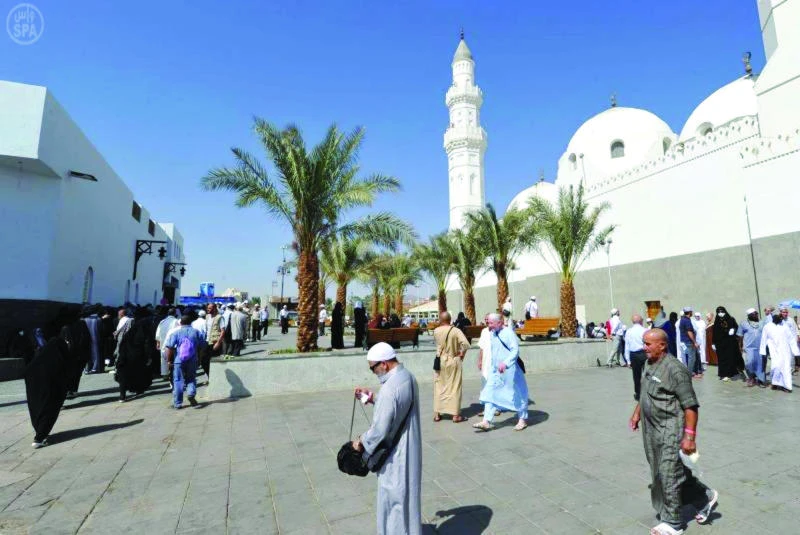
At the forefront of these landmarks is Quba Mosque, which is the first mosque founded on piety and the largest mosque after the Prophet’s Mosque. It is located in the southwest of Madinah.
Prophet Muhammad (pbuh) joined his companions in the building of the Quba Mosque. It was later renovated by the third Caliph Othman ibn Affan (may Allah bless him) who also expanded on its structure. It was rebuilt once more by the Caliph Omar bin Abdalaziz.
In 93 AD, he also added a minaret to the mosque which has since been continuously expanded. It has seen the largest expansion under the reign of the current Saudi rulers, which have initiated such expansions to accommodate 20,000 worshippers, as well as designated the northern part of the mosque for women with a capacity of up to 7,000.
Another famous mosque is Al-Jumaa Mosque, which received its name because the Prophet (pbuh) prayed his first Friday prayer there when he arrived from Quba on his way to Madinah. The mosque is also called Bani Salem Mosque because it was built in the Bani Salem bin Oaaf district. Also, it has been referred to as the Al-Wadi Mosque or Atteka Mosque.
The Qiblatain Mosque is another landmark in the city that is being visited by Hajis. It received its name because the Prophet (pbuh) changed the qiblah (the direction of prayer) from Jerusalem to the Kaabah while praying in it. It is also known as Bani Salmah Mosque due to its location in the neighborhood of Bani Salmah.
The city also houses the mosque of the Prophet's companion Abu Dhur Alghafari, also known as Masjid Al-Sajda (Mosque of Prostration), which is located north of the Prophet’s Mosque. It was given its name after the Prophet (pbuh) prostrated in the mosque for a long period of time. For this reason, it is also known as the Mosque of Gratitude.
All of these mosques have been renovated or expanded in recent years while maintaining their traditional form. The renovated mosques include Al-Anbriah, one of ancient mosques built by the Ottoman Sultan Abdul Hamid II in 1326, and Alskiah Mosque in Bab Al-Anbriah, which is a small mosque topped with three domes, but has no minaret.
In the era of Custodian of the Two Holy Mosques King Abdullah, all these mosques were renovated and refurnished without compromising on their Islamic architectural style.
Visitors to Madinah also are keen on visiting the Baqi cemetery, where more than 10,000 companions, followers and members of the Prophet's family, including his daughters, aunts and wives except Khadija and Maimona (God bless them) have been buried.
Other sites of attraction are the Ohod Martyrs district, the site of the famous battle of Ohod and the Al-Ghamamah Mosque, or Al-Mosala mosque, which used to be the place of Eid prayers until late in the nineteenth century when the prayer was transferred to the Prophet's Mosque.
Likewise, the Seven Mosques, which in reality are six mosques but are known by that name, is a major attraction for visitors. The mosques are located on the western side of Mount Salaa, where a trench was dug by Muslims to defend the city against the Quraish in the 5th Hijri year.
The mosques were reportedly sites of control and monitoring during the invasion, and each of these mosques was named after the leader stationed in it, except for Al-Fath Mosque, which was built at the Quba site where the Prophet (pbuh) was stationed. Al-Fath Mosque, the largest of the mosques, earned its name because it was the Prophet’s mosque during the battle, which Muslims won.
Hajis throng Madinah’s historic sites